China’s Unitree Proves Quadruped Economics Beat Utility—For Now
TL;DR: Unitree’s $4,000 robot dog exemplifies how aggressive cost reduction reshapes robotics markets, but thermal management and battery limitations expose why quadrupeds remain niche devices. The real play is humanoids at $13,500—where Unitree is gaining dangerous market share.
The Investment Signal: Price, Not Performance
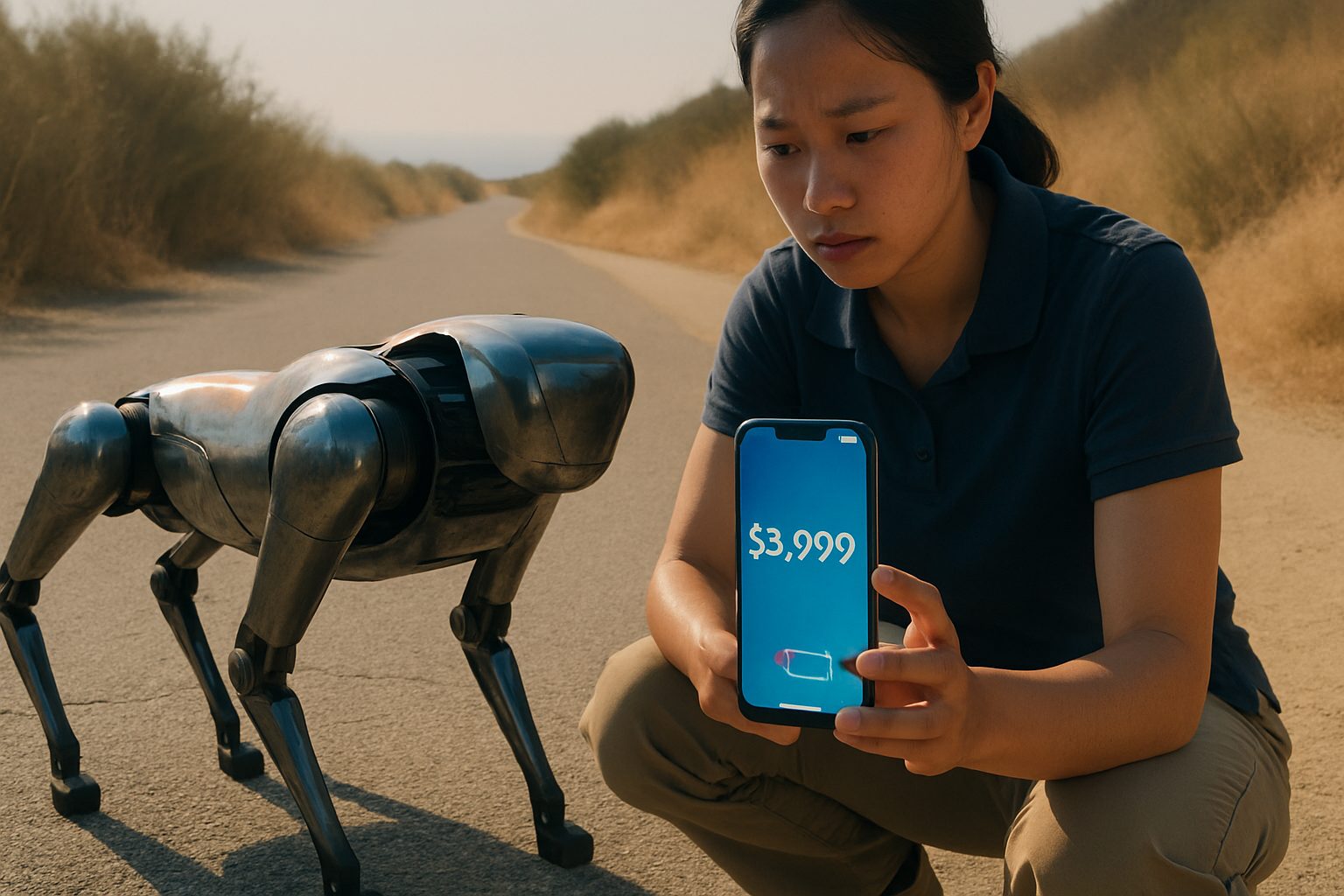
The robotics industry has a familiar arc: expensive academic toys become consumer commodities. Ars Technica’s hands-on test of Unitree’s quadruped illuminates why Chinese manufacturers are winning the next phase. A $4,000 price point for a functioning legged robot eliminates the “when will robots be viable” debate. The question is now: what problem becomes solvable at this cost?
That question matters more than engineering elegance. The Unitree unit collapsed from thermal stress on an 87°F day. Its battery barely survived a two-mile commute uphill. These aren’t showstoppers for a platform that costs 40% less than previous-generation quadrupeds.
Background: Unitree’s Path to Market Leadership
Unitree Robotics (hangzhou-based, founded 2016) has become China’s dominant quadruped manufacturer by prioritizing volume production over premium specs. The company manufactures several quadruped lines—Go2, B1, B2, and others—targeting research institutions, entertainment venues, and exploratory industrial applications.
The firm’s strategic pivot to humanoid robots in 2023, with models priced from $13,500, signals confidence in achieving manufacturing scale. This undercuts humanoid competitors (Boston Dynamics, others) by 50-70%, forcing Western robotics firms to rethink cost structures rather than differentiation.
Recent regulatory headwinds: U.S. import restrictions on Unitree hardware (citing unspecified national security concerns) arrived after the company had already established itself as the lowest-cost entry point for quadruped R&D. The timing suggests policy lag, not technological surprise.
Why Quadrupeds Remain Niche—And Why That’s Beside the Point
The reviewer’s honest assessment deserves credence: quadrupeds solve no unique problem that wheeled robots or drones handle better. Faster delivery requires wheels. Aerial inspection requires drones. Household tasks require manipulation (arms/hands). The Unitree Go2 excels at none of these.
But that utility gap doesn’t matter for market catalysts. Apple’s original Macintosh was less useful than a Commodore 64. What mattered was affordability at critical mass.
- Research pipeline acceleration: Universities can now run quadruped swarm studies at scale. Previously prohibitive experiments become feasible.
- Entertainment verticals: Theme parks, corporate events, social media content—none require reliability specs that mandate $40,000 quadrupeds.
- Competitive sandbox: Lower cost invites failure tolerance, speeding iteration cycles for next-gen legged platforms.
Humanoids: Where Unitree’s Cost Advantage Becomes Dangerous
The $13,500 humanoid is the real threat to Western robotics firms. Unitree leveraged quadruped manufacturing expertise to engineer humanoids at price points that break the venture-capital model of U.S. competitors.
Boston Dynamics has focused on performance over cost. Unitree is doing the inverse—and winning market share in emerging markets where $13,500 beats $150,000 for early-stage deployment.
Investors should track: (1) Unitree’s gross margins on humanoids, (2) customer diversity beyond research, and (3) whether Western firms can match cost curves or cede the emerging-market base entirely.
Thermal and Battery Realities Ahead
The Unitree Go2’s collapse—whether from overheating (84°C internal temp is dangerously high) or battery depletion—signals engineering corners cut for cost. The robot lacked graceful shutdown, lidar kept spinning, and thermal management failed under moderate conditions.
These aren’t fatal flaws for novelty or research use. They are problems for long-term field deployment. Unitree will address them in successive revisions, but the pattern is clear: Chinese manufacturers are shipping v0.5 at v1.0 prices, betting volume solves quality issues faster than Western premium approaches.
Regulatory Wild Card
The article notes U.S. legal restrictions on Unitree hardware are now in effect. This is policy theater masking a manufacturing reality: the cost curve has already shifted. Even if Unitree is blocked, other Chinese firms will replicate the model.
The technology isn’t classified. The advantage is execution and supply chain maturity.
The Bottom Line
Unitree’s quadruped validates a thesis: legged robotics are a solved problem in hardware—the remaining variable is price. At $4,000, quadrupeds enter the “worth trying” category for institutions that previously considered them prohibitive.
Humanoids at $13,500 are the inflection point. If Unitree executes on reliability without significant cost increases, they own the emerging-market deployment phase. Western competitors will compete on software ecosystems, customization, and support—not hardware alone.
For operators: Unitree’s platform now makes legged robot research viable at small scales. For investors: watch whether Western firms can defend premium positioning or must capitulate to cost leadership. The jury is in on Chinese manufacturing capacity. The question is whether first-mover U.S. robotics firms can compete on anything but regulation.
About the Author