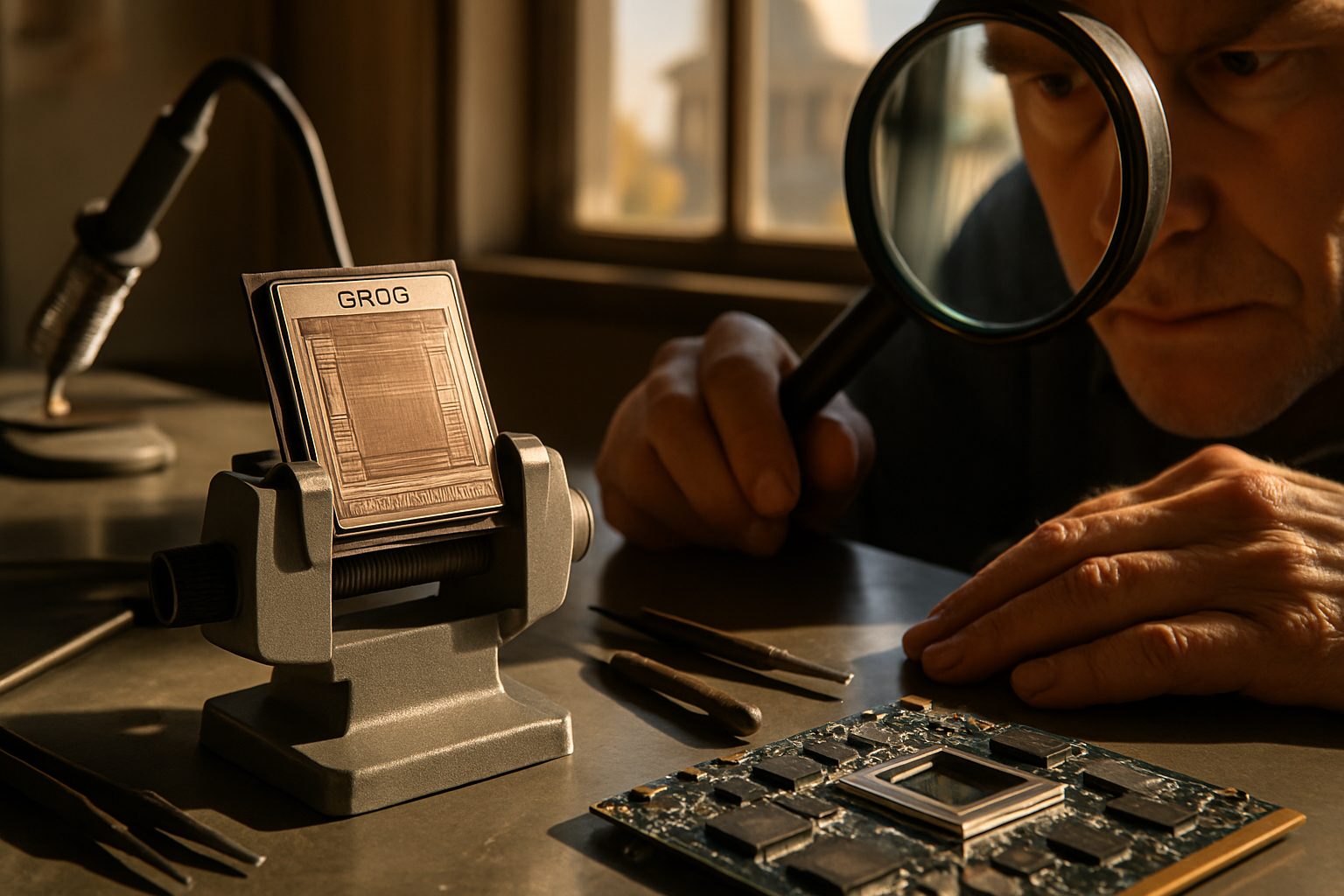
Nvidia’s $20B Groq Acquihire Dodges Regulatory Teeth, But Competition Already Won
TL;DR: The DOJ is probing Nvidia’s $20 billion Groq acquihire for antitrust violations, but a crowded field of disaggregated inference alternatives—Cerebras, SambaNova, d-Matrix—has already neutralized any monopolistic advantage. Even forced divestiture would matter less than regulators fear.
Why This Matters for Infrastructure Operators
If you’re evaluating inference accelerator strategies, Nvidia’s Groq acquisition proves silicon talent matters more than lock-in. The deal’s DOJ scrutiny signals regulators view talent acquihires as de facto mergers—but the real story is that disaggregated compute is no longer Nvidia’s exclusive play. Your inference workloads have viable paths that don’t depend on Groq-3 or Vera Rubin parity.
Background: The Acquisition That Wasn’t (Officially)
Groq’s legacy: Founded to solve LLM inference speed, Groq built SRAM-heavy dataflow accelerators achieving hundreds, now thousands of tokens per second—outpacing GPU inference on latency. The startup never achieved Nvidia’s throughput, but it solved a real problem: GPU-based systems struggled with inference workload velocity.
Nvidia’s move: In late 2025, Nvidia executed a $20 billion “acquihire”—licensing Groq’s silicon IP and recruiting its core engineering team while nominally leaving the inference-as-a-service business intact. By March 2026, Nvidia unveiled LPX racks stacked with 256 lightly-modified Groq-3 accelerators, positioned as the inference complement to Vera Rubin GPUs.
Regulatory flashpoint: The New York Times reported this week that the DOJ launched an antitrust probe into the deal. The agency’s concern: Nvidia stripped Groq’s talent while leaving the company technically independent, structuring the arrangement to avoid traditional merger review.
The Regulatory Problem: Harm Is Hard to Prove
Nvidia’s defense rests on competitive reality. The company frames Groq as validation of American startup innovation—entrepreneurs built something valuable, got acquired, and Nvidia integrated it. Whether that harms competition depends on alternatives.
Here’s the catch: alternatives are proliferating. Cerebras partners with AWS and AMD on disaggregated inference stacks. SambaNova works with Intel. d-Matrix combines in-memory compute with Nvidia GPUs to replicate Vera Rubin-LPX performance without Groq’s silicon. None of these require Groq’s IP or talent.
The DOJ’s legal standard requires proving the deal reduced consumer choice or raised barriers to entry. Given this landscape, that burden looks heavy.
What Nvidia Actually Acquired (And Why It Mattered)
Two assets drove the valuation: mature silicon and the talent pipeline. Groq’s LPUs delivered inference throughput Nvidia’s GPUs couldn’t match alone. The engineering team understood how to push that architecture further.
But here’s the operational truth: disaggregated inference isn’t novel anymore. Once the architecture pattern exists, it’s reproducible. Cerebras, SambaNova, and d-Matrix proved you don’t need Groq’s specific team to build competing systems. You need domain expertise in in-memory compute, dataflow optimization, and GPU integration—skills that exist across the industry.
Nvidia’s move accelerated its inference roadmap by ~18 months. It didn’t invent the roadmap.
The Damage Assessment: Already Baked In
Even if the DOJ forced Nvidia to unwind the deal—reconstituting Groq as independent and returning engineers—the competitive damage (if any) is irreversible. Why? Three reasons:
- Knowledge transfer is one-way: Groq’s team now knows Nvidia’s inference strategy. Unwinding doesn’t erase that.
- Competing architectures are live: Cerebras, SambaNova, and d-Matrix customers have production deployments. Groq returning solo wouldn’t displace them.
- Talent dispersion: Some engineers will stay at Nvidia regardless of legal outcomes. Others may follow venture capital into new startups. Reconstituting Groq means starting from a depleted roster.
What Operators Should Watch
The DOJ probe matters symbolically—it signals aggressive antitrust scrutiny of talent acquisitions in AI. But operationally, it’s theater. Your inference infrastructure decisions should factor in three viable paths: Nvidia’s Vera Rubin-LPX stack, Cerebras-AWS-AMD, or SambaNova-Intel. The acquihire didn’t create monopoly leverage; it just moved Groq’s engineering team earlier into Nvidia’s org chart.
If Groq re-emerges as independent, it enters a market where disaggregated inference is commoditizing. The real competition isn’t between Nvidia and Groq anymore—it’s between architectural paradigms. Nvidia bet on combining LPUs and GPUs. Others bet on recombining commodity silicon differently. The market will adjudicate, not regulators.
The Broader Signal
Senators arguing that deals engineered to avoid scrutiny should receive scrutiny anyway have a point. But antitrust enforcement requires proving consumer harm, and the evidence here is thin. Nvidia didn’t create a new market; it didn’t raise barriers to entry; it didn’t foreclose rivals’ access to essential inputs.
What it did: solved an engineering problem faster than competitors could. That’s competition, not monopoly. Whether the DOJ can reframe it otherwise remains an open question—but the answer will come after the die is cast.
About the Author