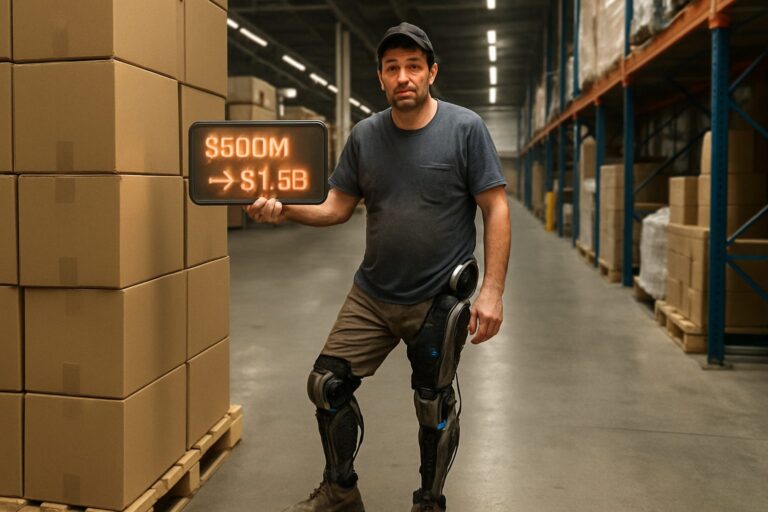
Mecka AI Nears $500M Valuation as Sequoia Backs Robot Training Data Rush
TL;DR: Mecka AI, a startup monetizing human motion capture for robotics training, is closing a Sequoia-led round at ~$500M valuation just three months after a $60M Series A. The deal signals explosive investor appetite for physical-world data infrastructure as robot deployments accelerate.
The $500M Valuation: What Changed in 90 Days
Mecka AI has achieved an 8x valuation jump in three months—from $60M Series A (June 2026) to approximately $500M in the incoming round. This velocity reflects not startup momentum but market structure recognition: physical-world data is the actual constraint blocking general-purpose robotics deployment.
The Sequoia investment validates a thesis competitors are racing to prove. TechCrunch reported that Mecka was projecting $100M annual run rate by end-2026—suggesting revenue visibility that justifies aggressive valuation multiples in a capital-flush environment.
Business Model: Egocentric Data at Scale
Mecka pays humans to perform everyday tasks—making coffee, repairing cars, assembly work—while recording with body sensors and smartphones. This “egocentric” perspective captures hand-object interactions and spatial reasoning that simulation alone cannot replicate.
The playbook mirrors Scale AI’s dominance in LLM training data. By positioning itself as neutral infrastructure rather than competing robotics platform, Mecka serves humanoid makers (Boston Dynamics, Tesla, Figure AI) and AI labs simultaneously. This horizontal strategy compounds network effects: more customers drive data volume, which attracts more customers.
Revenue Model and Unit Economics
Mecka’s $100M ARR projection implies either substantial customer concentration or a high-margin SaaS pricing model around motion datasets. The economics likely resemble enterprise data licensing ($5-50M annual contracts per major robotics OEM) rather than per-video pricing.
Market Context: The Robot Data Arms Race
Mecka operates in a newly congested space. XDOF, a parallel physical-data startup, reached $1.2B valuation in recent weeks. Scale AI and Micro1 are expanding beyond text into multimodal robotics datasets.
This competition validates market timing but raises consolidation risk. The real question: Can multiple data vendors coexist, or will robotics OEMs demand exclusive arrangements to prevent model leakage?
Founder Pedigree and Operational Risks
Mecka’s four co-founders—Josh Gao, Mogen Cheng (restaurant fintech), Jason Chong (Coinbase crypto), and Duy Nguyen (ops)—lack robotics domain expertise. This is intentional: they recognized data bottlenecks rather than building robots. However, scaling human-data collection at $100M ARR requires operational rigor most fintech founders haven’t demonstrated at this volume.
The risk isn’t product-market fit but execution: managing distributed labelers, data quality, contract compliance across multiple jurisdictions, and customer integration as robotics timelines accelerate.
Investment Implications for Robotics Stack
Sequoia’s lead signals that large-cap VC sees robotics infrastructure (not hardware) as the 2026-2027 exit vehicle. Mecka’s $500M implies an expected acquisition or IPO at $2-3B, compressed to 2-3 years post-Series B.
This creates a cascade effect: robotics OEMs must secure data partnerships before competitor lock-in, which justifies customer acquisition costs and pricing power for vendors like Mecka. Capital flows toward data, not metal.
Valuation Sustainability
The $500M valuation assumes:
- Achieving and sustaining $100M ARR through 2027
- Gross margins above 70% (standard for data licensing)
- Customer expansion driven by robot deployment acceleration, not market saturation
- No winner-take-most consolidation among data vendors
If robotics adoption stumbles or customers build in-house data collection, Mecka’s multiple compresses rapidly. The $1.2B XDOF valuation suggests the market is pricing optionality rather than proven unit economics.
The Bigger Picture: Infrastructure Wins
Mecka’s trajectory mirrors historical infrastructure plays—AWS, Stripe, Twilio—where horizontal platforms capturing commodity operations outvalue vertical solutions. If robotics becomes a $1T industry by 2035, data infrastructure represents 5-10% of value creation, suggesting $50-100B addressable market for vendors like Mecka.
Sequoia’s conviction isn’t really about Mecka’s execution. It’s a bet that physical-world data becomes as essential to robotics as cloud compute was to software. The valuation reflects that structural shift, not current revenue.
Disclosure: No positions. Endroid tracks Series B+ robotics and automation funding as market signals for industrial deployment timelines.
About the Author