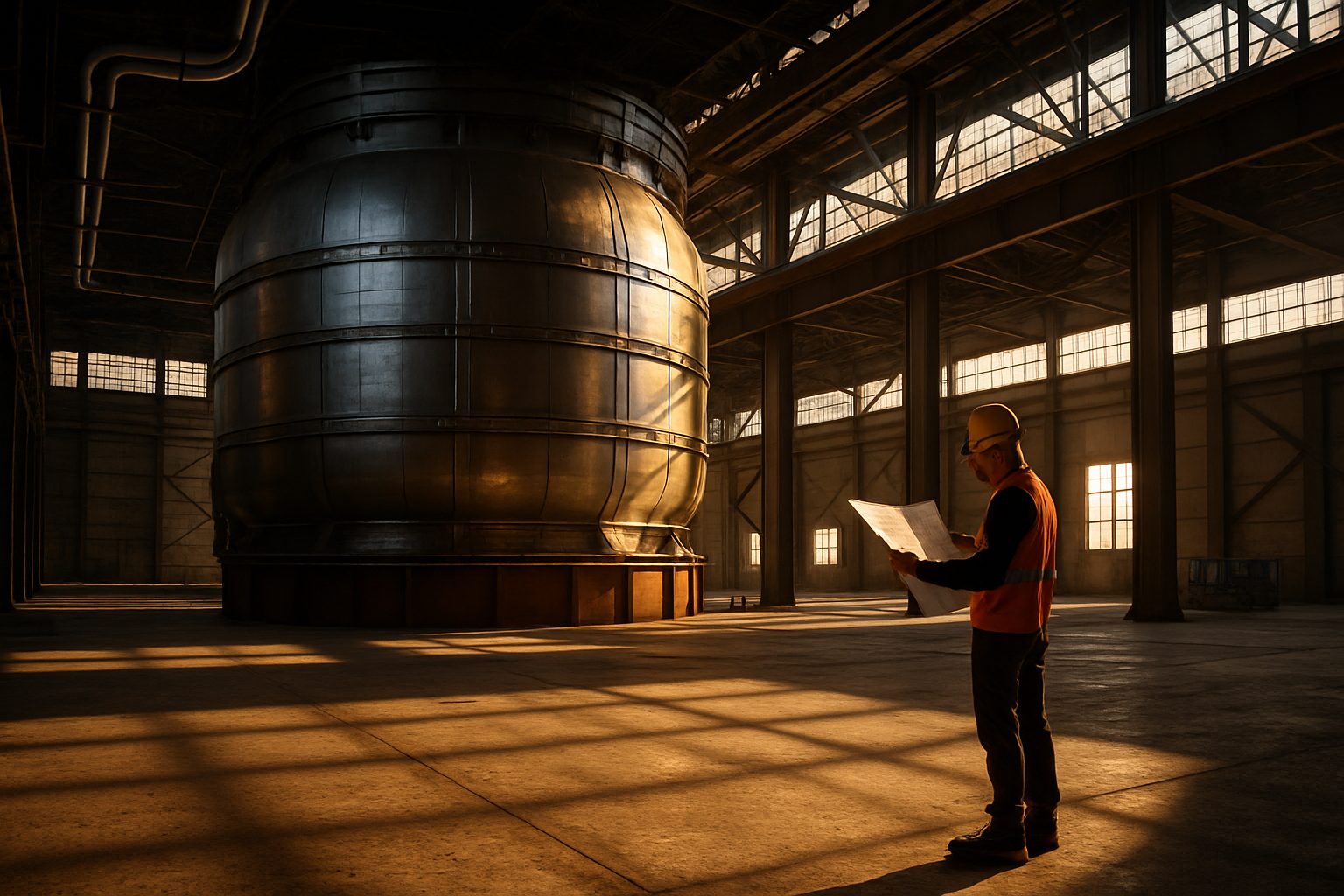
Pacific Fusion Breaks Ground on Net Facility Gain Demo—Reshaping Fusion Economics
TL;DR: Pacific Fusion is constructing an Albuquerque facility targeting net facility gain by 2030, aiming to generate 100 megajoules per pulse—10x the National Ignition Facility. The milestone-funded startup’s $1B+ Series A enables uninterrupted execution in a race where Commonwealth Fusion, Helion, and others target mid-2030s grid connection.
The Commercial Hurdle Pacific Fusion Is Tackling
The fusion industry has conflated two distinct achievements: generating net energy from reactions versus powering an entire facility. Net facility gain—where a machine produces more energy than the facility consumes—remains unexploited at commercial scale. Pacific Fusion’s announcement matters because execution timelines and capital velocity now determine winners, not physics feasibility.
The Albuquerque facility represents the first purpose-built demonstration plant targeting this specific milestone. This shifts the bottleneck from reaction engineering to systems integration and operational scaling.
Technology: Pulsed Inertial Confinement at Scale
Pacific Fusion employs intense electrical pulses to generate magnetic fields that compress fuel targets the size of pencil erasers. A one-third-scale pulser module test released 440 gigawatts in 80 nanoseconds—validating the architecture for full deployment.
The production system deploys 156 pulser modules, each containing 32 stages with dual capacitors and switching elements. Current demonstrations fire multiple shots daily; commercial plants require one shot per second—a 1,000x scaling challenge in operational tempo, not physics.
Output Targets and National Security Applications
Each pulse will generate approximately 100 megajoules—an order of magnitude above the National Ignition Facility. This capability also positions Pacific Fusion as a contractor for U.S. government high-yield fusion experiments, diversifying revenue before grid deployment.
The TechCrunch report notes that China is simultaneously building similar facilities, injecting geopolitical urgency into the timeline.
Capital Structure as Competitive Moat
Founded in 2023, Pacific Fusion compressed typical startup timelines by securing over $1 billion in a single Series A milestone round. This structure eliminates annual fundraising cycles, allowing multi-year planning and supplier commitments that competitors can’t match.
COO Carrie von Muench explicitly stated this capital design enabled the current execution velocity. In a field where timeline risk compounds capital requirements, this structural advantage is material.
The Competitive Field Condensing Around 2035
Commonwealth Fusion Systems, Helion Energy, Proxima Fusion, and Inertia Fusion are all targeting grid connection by mid-2030s. The race is no longer about feasibility—it’s about operations, supply chain, and regulatory navigation.
Pacific Fusion’s net facility gain goal of 2030 positions it 3–5 years ahead in demonstrating the economics that matter to utilities and grid operators: not peak reaction efficiency, but sustained facility-level power generation costs.
Investment Implications
- Operational milestones now trump physics breakthroughs. Net facility gain in 2030 is a capital-raising inflection, not a science inflection.
- Government contracts de-risk commercialization. High-yield fusion work provides revenue and validates systems before grid sale.
- Execution velocity matters more than technology differentiation. In a crowded field, the capital-backed company that hits 2035 first captures utility partnerships and grid slots.
- Supply chain dependency is understated. 156 pulser modules × 32 stages each = 5,000+ individual switching elements. Manufacturing scale and yield will determine winners.
Background: Pacific Fusion and the Commercial Fusion Landscape
Pacific Fusion emerged in 2023 as one of the youngest and best-capitalized entrants in the fusion space. Co-founders Carrie von Muench (COO) and Keith LeChien (CTO) designed the company around a pulsed inertial confinement approach rather than magnetic tokamak or stellarator designs. The $1B+ Series A, structured as a milestone-based round, reflects investor confidence in execution and removes the typical startup funding bottleneck that has historically forced annual capital raises.
The National Ignition Facility (NIF) achieved net energy gain in 2022—a landmark fusion breakthrough where the reaction itself generated more energy than the laser delivered. However, NIF remains a research facility with no path to commercialization; it consumes substantially more energy than it produces when facility-level costs are included. This distinction is critical: net energy from reactions ≠ net facility gain.
Commonwealth Fusion Systems, backed by Breakthrough Energy and others, targets 2025 demonstration with SPARC and mid-2030s commercial deployment. Helion Energy has secured government contracts and claims similar timelines. Proxima Fusion and Inertia Fusion round out a cohort of well-funded competitors, each with differentiated technical approaches but converging timelines. The consolidation of capital and talent into a handful of well-funded firms has accelerated the industry’s move from R&D to manufacturing and integration challenges.
About the Author