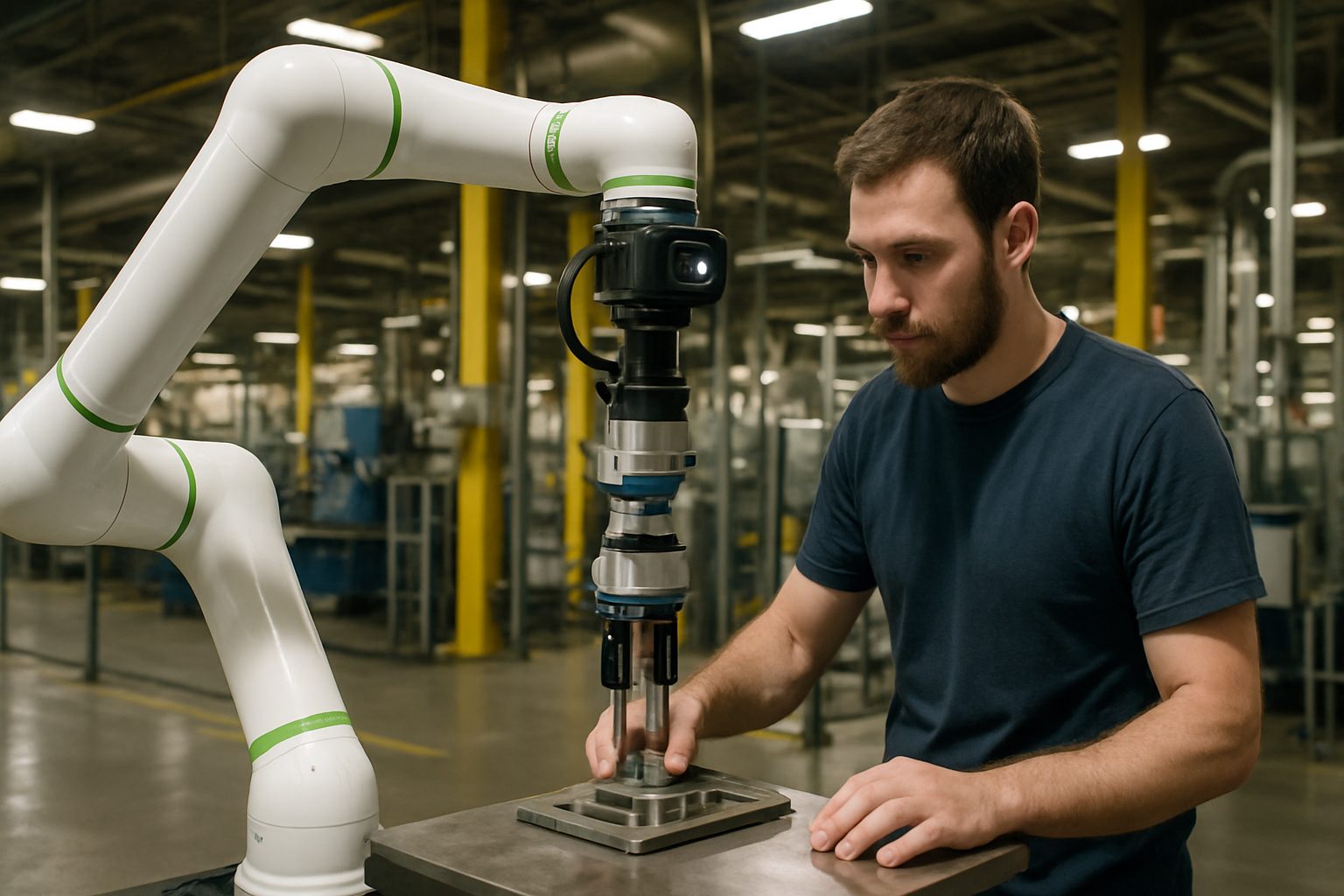
TL;DR: Fanuc’s CRX-25iA integrates collaborative manipulation with onboard vision AI, enabling SME manufacturers to automate quality control and part handling without external vision infrastructure—a significant shift toward edge-deployed manufacturing intelligence.
Fanuc CRX-25iA: Collaborative Robotics Meets Embedded Vision AI
Why This Matters for SME Operations
The CRX-25iA represents a strategic compression of the manufacturing automation stack. By embedding vision AI directly into the cobot’s end-of-arm tooling, Fanuc eliminates the need for separate vision servers, external compute, and complex integration—critical barriers for small and mid-sized enterprises operating on tight capex budgets and limited IT resources.
This moves the cost-per-deployment curve downward while reducing implementation timelines from weeks to days. For operators, that means faster ROI on collaborative automation.
Technical Architecture and Capability
Integrated Vision and Real-Time Decision Making
The CRX-25iA pairs a 25 kg payload cobot with integrated stereo vision and an onboard AI inference engine. The system can execute visual inspection, part identification, and adaptive gripper commands in real time—no latency to external servers.
Fanuc’s proprietary deep learning models handle common SME tasks: defect detection, bin picking, and pose estimation. The cobot operates at up to 1,700 mm reach with ISO/TS 15066 collaborative safety certification.
Simplified Deployment Model
Setup requires minimal external infrastructure. Operators train the system via demonstration and image labeling on a local touchscreen interface. No custom APIs, no vision software licenses, no separate GPU clusters required.
Market Position and Competitive Landscape
Universal Robots’ e-Series and ABB’s GoFa already dominate the mid-payload cobot market. Fanuc’s move addresses a distinct gap: integrated vision without external dependencies. This positions the CRX-25iA against cobots paired with third-party vision vendors (Cognex, Keyence), which remain modular and potentially more flexible but require systems engineering overhead.
The embedded approach trades modularity for simplicity—a rational bet for SMEs under 500 employees with standardized tasks.
Business Model and Pricing
Upfront Cost vs. TCO Dynamics
Fanuc has priced the CRX-25iA at approximately €185,000 for the base cobot unit. Vision AI modules and specialized grippers add €40,000–60,000. For comparison, a UR cobot plus Cognex vision system easily exceeds €200,000 installed.
The real advantage emerges in integration labor: Fanuc estimates 40–50% reduction in deployment hours versus modular competitors.
Software and Subscription Revenue
Fanuc offers optional cloud-linked analytics and monthly model updates (€2,500/year). This creates recurring SaaS revenue while keeping the edge inference on-device for latency-critical operations.
Operational Implications for Buyers
- Faster time-to-productivity: Day-one visual inspection without external vision integrators.
- Reduced skill barriers: No computer vision expertise required; training happens on-device.
- Supply chain resilience: No dependency on external vision hardware or cloud connectivity for core operations.
- Scalability path: Multi-arm deployments inherit the same vision stack, simplifying fleet management.
Investment Signal
This launch signals Fanuc’s pivot toward edge AI and operational technology convergence. The move threatens standalone vision vendors’ cobot adjacency play and validates the market thesis that SMEs prioritize integration simplicity over modularity.
Investors should watch adoption rates among manufacturers in automotive supply, consumer electronics, and food processing—sectors where quality gates and bin picking represent the bulk of automation ROI.
About the Author