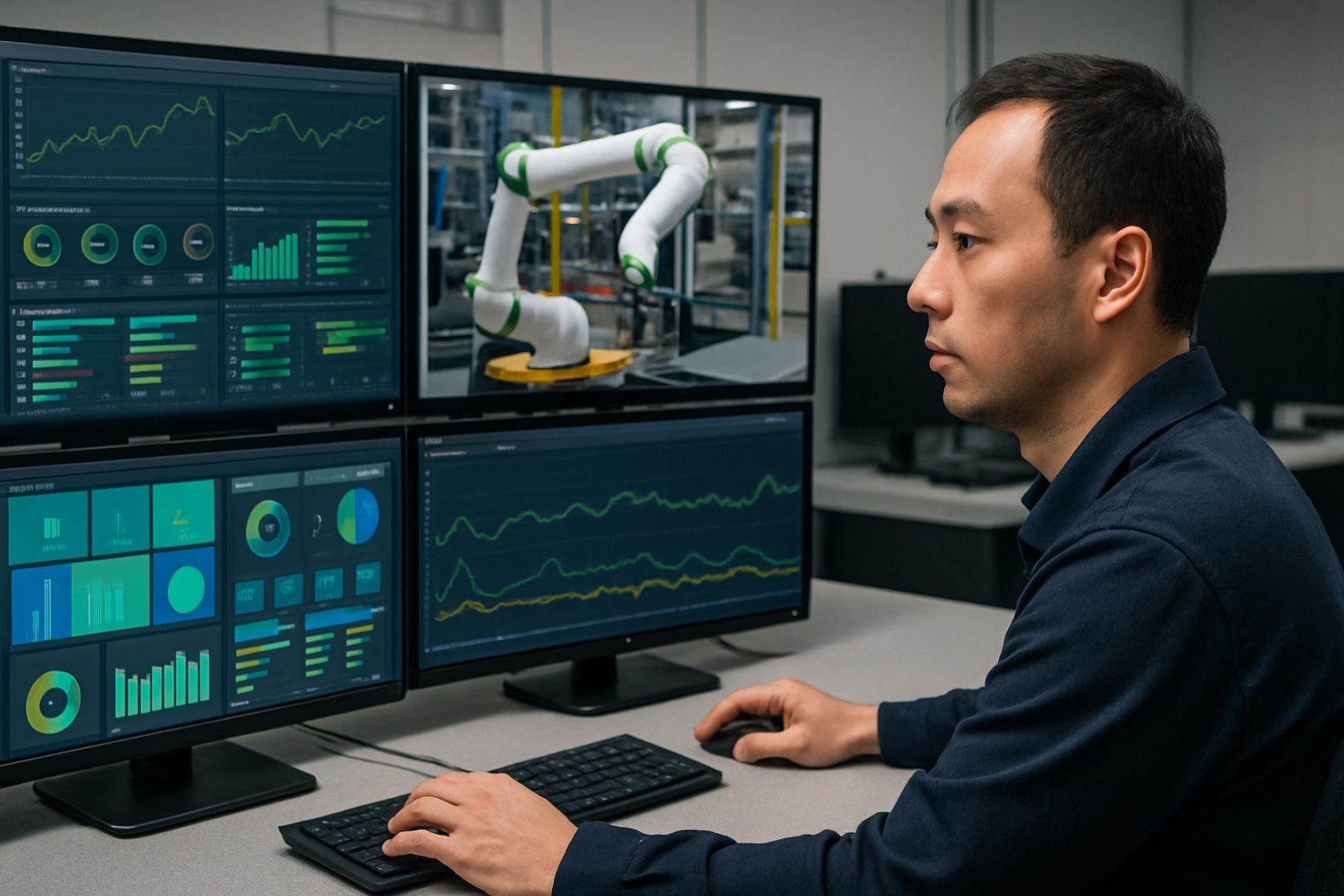
TL;DR: Fanuc’s new CRX-25iA adds onboard vision-AI capabilities to collaborative robotics, lowering deployment friction for SME manufacturers and compressing the time-to-productivity window from weeks to days.
Fanuc Tightens the SME Manufacturing Loop with Embedded Vision AI
Fanuc’s launch of the CRX-25iA collaborative robot represents a strategic pivot toward the $8.2B small-to-medium enterprise (SME) automation segment. By bundling sophisticated vision inference directly into the robot’s control architecture, Fanuc eliminates the need for external vision systems and third-party AI platforms—a critical friction point that has historically deterred budget-constrained manufacturers from deploying intelligent automation.
The operational implication is immediate: deployment cycles compress, integration costs drop, and SMEs can begin generating ROI within 2–3 weeks instead of 8–12. For investors tracking automation adoption curves, this is the inflection point where collaborative robotics transition from niche to mainstream in the sub-$5M annual revenue tier.
Integrated Vision AI as a Competitive Moat
The CRX-25iA runs Fanuc’s proprietary neural-network stack for pick-and-place, quality inspection, and assembly verification tasks. The 25 kg payload and 1700 mm reach sit in the sweet spot for electronics assembly, food processing, and light manufacturing—industries where labor volatility is highest and capital budgets are tightest.
Unlike competitors shipping vision as a bolt-on module, Fanuc embedded the AI inference engine into the controller itself, reducing latency to sub-50ms and eliminating network dependencies. This architectural choice shields SME operators from the complexity of managing separate compute nodes or cloud inference calls.
Market Context: Why Now?
SME adoption of collaborative robots has plateaued at ~30% penetration due to high setup costs and steep learning curves. Fanuc’s integrated approach addresses both barriers simultaneously. The onboard vision system learns from human-annotated examples in real-time, reducing the need for external data labeling pipelines.
Competitors like Universal Robots and ABB remain dependent on third-party vision partners (Cognex, Basler, Sick), fragmenting the tech stack and creating support friction. Fanuc’s vertical integration here is a meaningful differentiator.
Pricing and Adoption Trajectory
The CRX-25iA is expected to list at approximately $45,000–$52,000 USD, roughly 15–18% above the standard CRX-25 (non-AI variant). This premium reflects the embedded vision hardware and AI software licensing model, which Fanuc is reportedly monetizing via annual SaaS contracts for model updates and edge compute resources.
Early pilots with Tier 2 contract manufacturers in Southeast Asia and Eastern Europe suggest a 2.8-year payback period for operators running 3-shift schedules. If Fanuc can replicate that trajectory across its SME install base, expect market share consolidation in collaborative robotics by 2027.
Risk Factors and Open Questions
The critical unknown: how well does onboard inference generalize across heterogeneous manufacturing environments? Vision AI trained on pristine lab parts may struggle with real-world lighting variance, material reflectivity, and occlusion—the actual conditions SMEs face daily. Field data from the first 200 units will be essential.
Fanuc’s closed ecosystem also creates vendor lock-in risks. SMEs committing to the CRX-25iA are betting on Fanuc’s model library and software roadmap for the next decade.
The Verdict
The CRX-25iA is a well-timed product that lowers the barrier for collaborative automation in capital-constrained segments. For investors, it signals Fanuc’s confidence in the SME cycle and its ability to execute integrated hardware-software strategies. Watch deployment data through Q4 2026.
About the Author