Anthropic’s Hardware Standard Breaks AI Out of the Digital Box
TL;DR: Anthropic’s Model Hardware Standard (MHS) enables AI agents to control physical devices through standardized drivers, compressing experimental setup from weeks to hours and opening robotic automation beyond software-only tasks.
Why This Matters for Operations and Capital
The transition of AI agents from digital-only tasks to physical-world control represents a significant shift in automation economics. MHS eliminates custom integration overhead—the hidden cost multiplier in robotics deployments. For enterprises managing complex lab infrastructure, manufacturing workflows, or research facilities, this standardization directly impacts project timelines and ROI.
Investors should track this as a horizontal layer play. Unlike vertical robotics solutions, MHS commoditizes the integration problem, making AI-powered hardware accessible to smaller operators who previously couldn’t absorb custom development costs.
The Model Hardware Standard: Architecture and Function
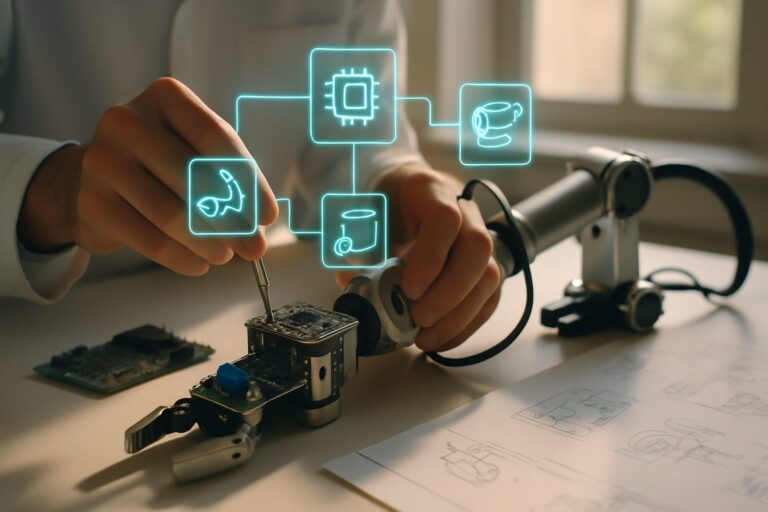
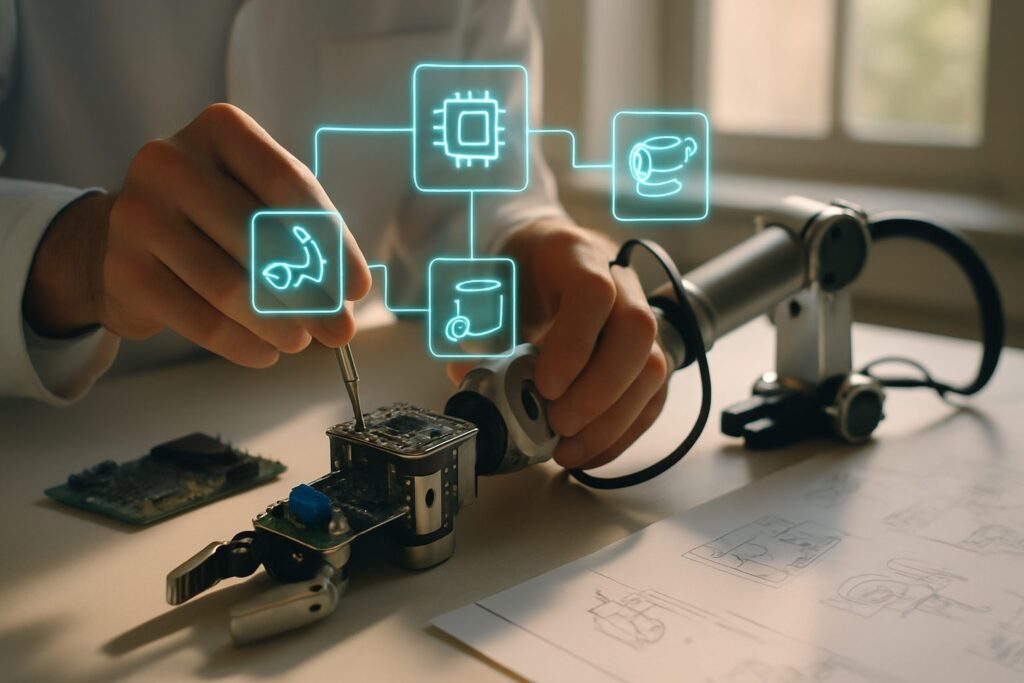
MHS operates as a translation layer between AI models and heterogeneous devices. Rather than writing bespoke software for each hardware integration, operators use standardized drivers that expose device capabilities through a common interface and data format. According to Ars Technica’s reporting, this approach allows disparate lab components to coordinate “without needing a bespoke ‘translator’ program in between.”
The system includes three critical components:
- Standardized drivers for device communication
- Real-time control via CLI and API interfaces
- Integration with Anthropic’s Model Context Protocol for natural-language reasoning
Real-World Constraint Encoding
MHS embeds hardware metadata into reference files, tagging physical characteristics (weight, range, force limits), adjustable parameters, measurement capabilities, and enforced safety boundaries. This semantic layer allows AI models trained primarily on digital data to reason about physical constraints without trial-and-error burns through hardware.
Demonstrated Capabilities and Use Cases
Anthropic’s demo videos highlight two distinct operational models. In supervised mode, Claude adjusts laser calibration iteratively, using camera feedback to converge on target parameters—tasks requiring real-time reasoning and error recovery. In autonomous scripting, the model sequences multi-step procedures across instruments by generating and revising API calls as conditions change.
The robotic arm demonstration shows capability generalization: Claude picked up an aluminum can without task-specific training, reasoning through the required gripper adjustments based on hardware metadata alone.
Scientific Workflow Acceleration
MHS’s origin story stems from observation at HHMI Janelia Research Campus, where neuroscientist Arco Bast manually integrated rotating lasers, microscopes, and cameras for memory-formation experiments. Anthropic Technical Staffer Alek Kemeny recognized the pattern: “This idea could be used to have AI run any science experiment in the world.”
The operational impact: experimental setup compressed from weeks to hours. A model can autonomously focus microscopes, analyze results, identify regions requiring deeper observation, and navigate to those sections—all without scientist intervention.
Background: Anthropic’s Position in Agentic AI
Anthropic, founded in 2021 by former OpenAI researchers including Dario and Daniela Amodei, has positioned itself as the steward of safe, interpretable AI systems. The company’s Claude model family has evolved from pure language generation toward agentic reasoning, particularly after the introduction of the Model Context Protocol (MCP)—an open standard for AI-to-tool integration.
MHS extends this philosophy from software APIs to physical hardware. Where MCP enables Claude to access databases, file systems, and web services, MHS creates a standardized abstraction for robotics, lab equipment, and industrial machinery. This represents Anthropic’s strategic bet: if AI agents are to operate beyond knowledge work, they need reliable, physics-aware interfaces to the material world.
The research context matters. Janelia, a division of the Howard Hughes Medical Institute, operates as a long-term science factory focused on neurobiology and related fields. Its environment—complex experimental apparatus, bespoke measurement systems, tight feedback loops between hypothesis and data—mirrors the constraints Anthropic is targeting. Real lab scientists, not hypothetical users, validated the pain point.
The “research preview” framing signals Anthropic’s cautious approach. Unlike competitors rushing robotics-as-a-service models to market, this rollout prioritizes safety validation and real-world hardening before broader deployment. This aligns with Anthropic’s broader constitutional AI philosophy: demonstrate capability, iterate on safety, then scale.
Market Implications and Timeline Risk
MHS addresses a genuine infrastructure gap. Current robotics integrations require systems integrators—expensive, slow, and fragile to customization. A standardized hardware abstraction could enable smaller labs, startups, and enterprises to deploy AI-driven automation without $500K+ custom integration budgets.
However, adoption depends on ecosystem buy-in. Hardware vendors must contribute drivers. Model developers must train reasoning capabilities around physical constraints. Operators must trust safety encodings. Anthropic’s strategy—starting with scientific tools in a trust-heavy domain (research institutions)—is sensible but slower than venture-backed robotics firms pursuing consumer or logistics markets.
Watch for partnerships with major lab equipment manufacturers (Zeiss, Leica, Thorlabs) and enterprise automation vendors (ABB, KUKA) as signals of real traction.
Safety and Constraint Architecture
The embedded safety boundaries in MHS metadata represent a design choice worth examining. Rather than hardcoding safety rules in software, Anthropic encodes them as hardware properties the model must respect. This distributes safety responsibility: hardware vendors declare limits; AI models reason within them; operators tune constraints per deployment.
This approach mirrors physical safety principles—a robot’s torque limit is mechanical, not just a software flag. But it requires trust in vendor metadata accuracy and model robustness to adversarial or erroneous constraint definitions.
What’s Next
The near-term play is scientific automation: universities and biotech firms replacing weeks of manual experimental coordination with AI-assisted workflows. The medium-term extends to manufacturing quality control, lab diagnostics, and materials science. The long-term—if generalization holds—is any task requiring real-time reasoning over heterogeneous hardware.
Anthropic is betting that the standardization layer, not the model, is the moat. That’s a infrastructure play, not a capability play. If correct, this matters more than any single model release for enterprise robotics adoption.