TL;DR
Sundar Pichai is the CEO of Google and Alphabet, the world’s most dominant digital advertising and AI infrastructure company. He rose from a middle-class family in Chennai to become one of tech’s most consequential operators—a product-focused engineer who navigated the company’s transformation from search to AI with uncommon strategic clarity.
Career Highlights
Pichai joined Google in 2004 as employee number 175, when the company was still in its early hypergrowth phase. He arrived as a junior engineer and stayed for two decades, building the product instincts and organizational leverage that would define his rise. Unlike many tech leaders, he never left to start a company or test the venture world. He stayed inside Google, deepening his grip on product, platform, and ultimately the entire company.
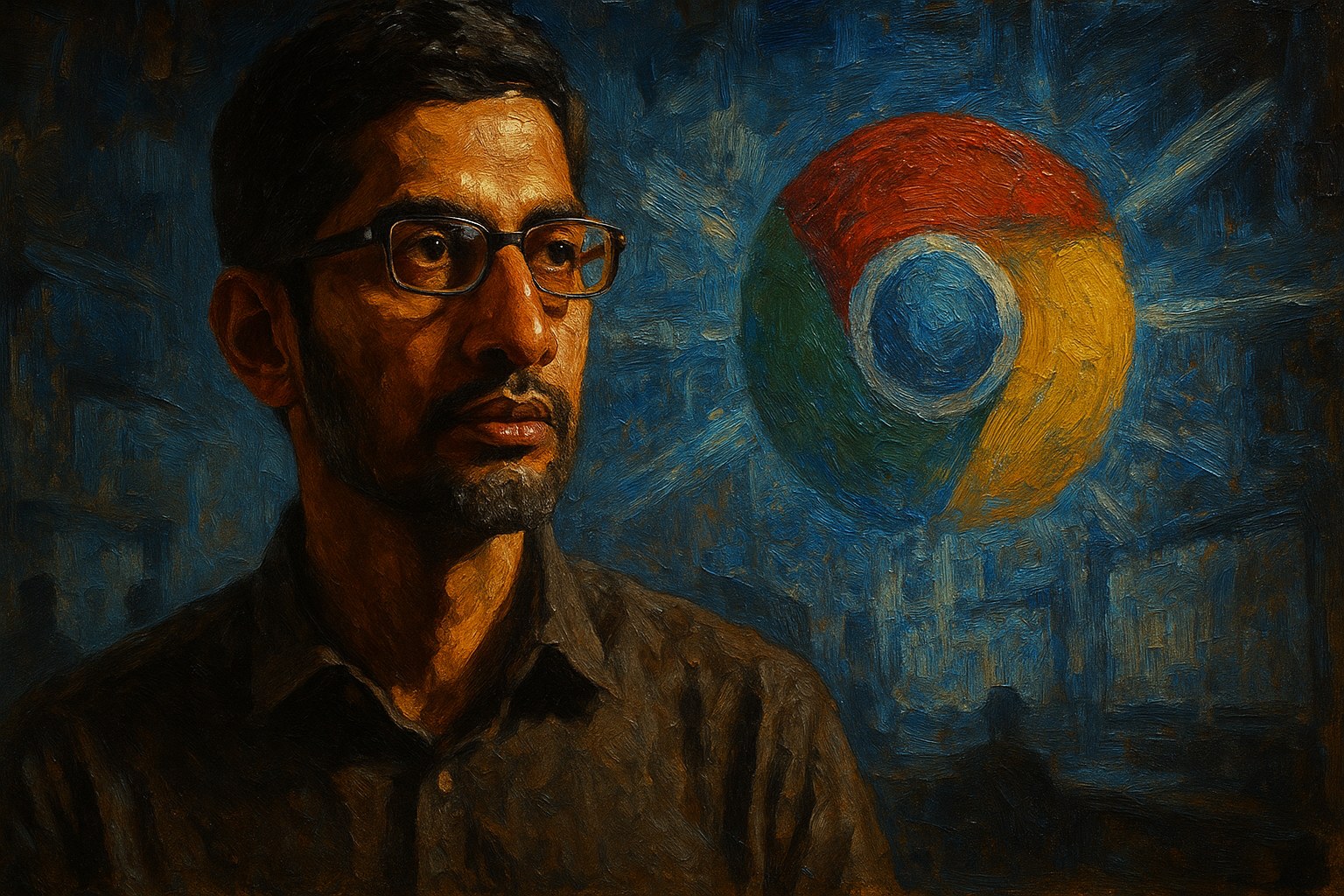
His breakthrough came with Chrome. In the mid-2000s, Pichai saw that browsers were slow, clunky, and built on aging architecture. He championed a complete rewrite—a V8 engine that was faster, lighter, more modular. Chrome launched in 2008 and became the internet’s nervous system. By 2012, it had captured half the browser market. The project proved something crucial about Pichai: he had the patience to rebuild foundations, not just tweak surfaces.
By the 2010s, Pichai had expanded his portfolio to Android, the world’s most-used operating system. He managed the product roadmap, shepherded OEM relationships, and navigated the existential complexity of leading a platform used by billions. In 2015, CEO Sundar Pichai became the public face of Google’s operating system strategy. Then came the AI moment. As machine learning and neural networks became central to Google’s future, Pichai positioned himself at the center of that shift. “AI is as profound a change as fire or electricity,” he said in 2023, and Google’s strategy reflected that conviction.
In December 2019, Google restructured. Pichai was elevated to CEO of Google—the operating company—while remaining under Alphabet’s holding structure. In 2023, after founder-driven Alphabet stumbled with product delays and competitive threats from OpenAI, Pichai was promoted to CEO of Alphabet itself. He became the rare engineer-operator to lead the entire $1.7 trillion conglomerate.
I. The Inflection Point
The Chrome decision in 2006 was the inflection point. Google Search was phenomenally profitable, but Pichai and his team believed the browser itself was a bottleneck to the internet’s evolution. Internet Explorer dominated but was sluggish. Safari and Firefox existed but were fragmented. Pichai made the case internally: Google needed to own the browser layer to ensure its search and services could operate at full velocity.
It was a contrarian call. Critics said Google should stay in search. But Pichai pushed for autonomy, recruited engineering talent, and built Chrome as a modular, open-source project. The bet was that if you owned the platform layer—the browser—you could accelerate the entire web. Launch happened in September 2008. Within five years, Chrome had become the world’s dominant browser. “We believed that a fast browser could unlock the web,” Pichai later reflected. The insight wasn’t just technical; it was strategic. He had identified that layers—not just products—matter.
II. The Build
Pichai built a portfolio of interconnected platforms and services that lock users into Google’s ecosystem while competing ruthlessly against emerging threats. His strategy was not to invent new categories but to dominate existing ones through velocity and integration.
- Chrome: The world’s dominant browser, enabling Google to control how users interact with the web and their own services.
- Android: The operating system running ~70% of the world’s smartphones, generating billions in ad impressions and app distribution revenue.
- Search & Ads: The core profit engine, now augmented with AI-powered search refinements and integration with generative models.
- Cloud & Workspace: Enterprise platforms competing directly against Microsoft and Amazon, powered by Google’s infrastructure and AI capabilities.
- AI Infrastructure: TPUs, Vertex AI, and large language models (Gemini and PaLM) positioning Google as an AI compute provider and foundation model company.
- YouTube: The world’s largest video platform, generating $30B+ annually and serving as a distribution channel for ads and emerging AI features.
Pichai’s genius is integration. Each platform feeds the others. Chrome data informs search. Search informs ads. Android distribution drives YouTube engagement. YouTube engagement trains AI models. AI models improve search. The system is circular, reinforcing, and nearly impossible to disrupt from outside. His strategy is not innovation for its own sake but control of distribution and data flow.
III. The Person
Pichai is unusually calm for a tech CEO. He grew up in Chennai in a middle-class family—his father was a General Electric electrical engineer, his mother a stenographer. That background instilled pragmatism. He studied mechanical engineering at Indian Institute of Technology Kharagpur, then moved to the U.S. for a Stanford master’s degree. He doesn’t have a founder’s mythology or a venture capitalist’s appetite for chaos. He has an operator’s focus: get the product right, ship fast, measure relentlessly.
His leadership style is consensus-driven but final-decision-aware. He listens deeply in meetings, asks granular technical questions, and rarely overrides engineering judgment without data. Colleagues describe him as unfailingly polite, even in contentious moments. He speaks carefully, choosing words precisely. He is not a showman. His public appearances are functional, not theatrical. “Sundar moves like a chess player,” one longtime Google executive said. “He’s thinking three moves ahead, but you don’t see him celebrating each move.”
He is known for deep work—long stretches of focus on a single problem—and for reading voraciously about technology, history, and geopolitics. He does not maintain a visible social media presence. He is married with two children and lives in the Bay Area. He avoids the celebrity CEO trope entirely.
IV. The Network & Numbers
- * Joined Google: 2004
- * CEO of Google: December 2019
- * CEO of Alphabet: December 2023
- * Alphabet Market Cap: ~$1.7 trillion (as of 2024)
- * Employees: ~190,000
- * Annual Revenue: ~$307 billion (2023)
Key Relationships
- Larry Page & Sergey Brin: Founders; Pichai reports to their governance structure and has internalized their long-term thinking on AI.
- Ruth Porat: Chief Financial Officer; strategic partner in capital allocation and shareholder communication.
- Demis Hassabis: CEO of DeepMind; Pichai oversees DeepMind’s integration into core Google product strategy.
- OpenAI: Competitive threat; ChatGPT’s success accelerated Pichai’s push to embed generative AI into Google Search and Workspace.
V. The Thesis
Pichai’s big bet is that AI will be the organizing principle of computing in the next decade. He has positioned Alphabet as a compute and foundation model company first, an advertising company second. Search will be AI-native. Ads will be AI-generated and AI-targeted. Workspace will use AI copilots. Cloud will sell AI infrastructure. The thesis is that whoever owns the data, the compute, and the models wins.
This represents a deliberate pivot from mobile-first to AI-first strategy. Google was late to recognize mobile’s importance. Pichai is determined not to be late again. He has reorganized teams, redirected capital, and begun integrating generative AI into every product. The risk is execution—OpenAI and other competitors are moving faster on certain fronts—but Pichai’s conviction is visible in his organizational choices and his public statements.
“We’re at an inflection point in AI,” Pichai said in 2024. “The question isn’t whether AI will be transformative. It’s how fast, and who builds the tools that everyone relies on.” That statement encapsulates his philosophy: not innovation for innovation’s sake, but dominance of the layer that matters most. For Pichai, that layer has always been the infrastructure upon which everything else runs.
Factbox
Name: Sundar Pichai Sundararajan | Age: 52 | Location: Mountain View, CA, USA | Company & Role: Alphabet and Google, CEO | Joined Google: 2004 | Most Recent Role Change: CEO of Alphabet, December 2023 | Employees Under Management: ~190,000 | Contrarian Belief: Distribution and platform control matter more than breakthrough innovation; the layer you own determines your destiny.
About the Author