Perseverance’s Autonomous Navigation Proves Self-Driving Works Beyond Earth
TL;DR: NASA’s Perseverance rover has completed 45.16 km on Mars with 90% autonomous driving capability, shattering Opportunity’s distance record in one-third the time. The breakthrough demonstrates that onboard AI vision systems and real-time processing eliminate Earth-command latency, delivering both operational efficiency and scientific advantage.
The Operational Edge of Martian Autonomy
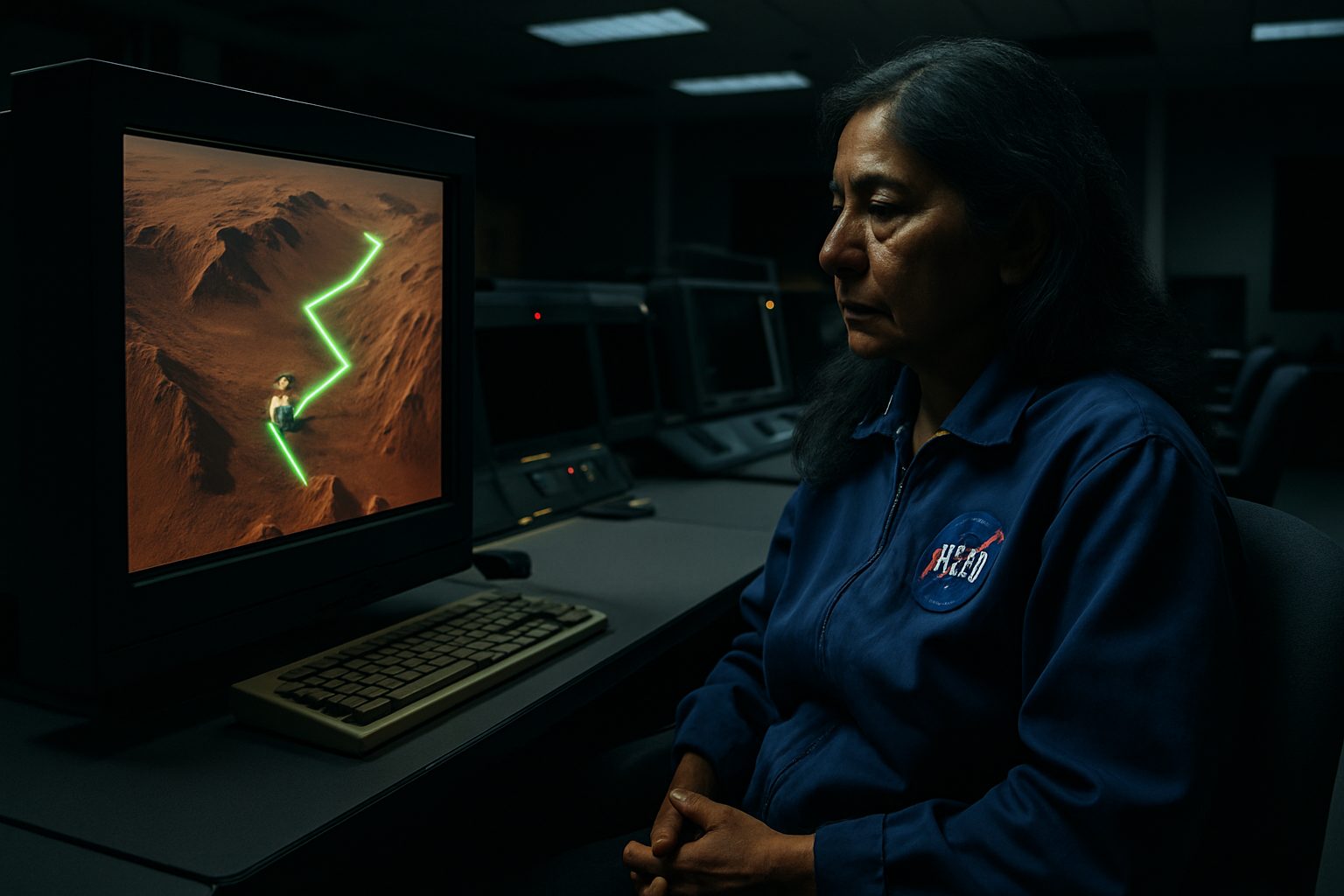
Speed on Mars isn’t about velocity—it’s about eliminating Earth-command bottlenecks. Perseverance’s Vision Compute Element processes terrain imagery in real-time, enabling the rover to navigate while moving rather than pausing for terrestrial operators. This architectural shift compounds exponentially: breaking the 45.16 km distance record in just five years versus Opportunity’s 15-year span represents a productivity multiplier that investors should understand as foundational to deep-space exploration ROI.
The technology gap is stark. Curiosity, launched nine years before Perseverance, achieves only 10% autonomous driving due to 1990s-era chipsets. Perseverance’s generational hardware leap unlocks 90% autonomous operation—a tenfold improvement in self-sufficiency. This isn’t marginal optimization; it’s structural transformation.
Background: Mars Rover Evolution and Autonomous Systems
NASA’s Jet Propulsion Laboratory has operated Mars rovers continuously since 1997, with Opportunity (2004-2018) establishing the previous distance benchmark at 28.06 miles over 15 Martian years. The rover program evolved from pre-programmed pathfinding to increasingly autonomous decision-making as computational resources permitted. Project Manager Steven Lee emphasized that onboard processing capability—not algorithmic sophistication—represents the limiting factor in rover efficiency.
Perseverance launched in July 2020 and touched down in Jezero Crater in February 2021 as part of NASA’s astrobiology-focused Mars Sample Return campaign. The rover carries 19 cameras and integrated science instruments designed to identify biosignatures in ancient Martian geology. Unlike Curiosity’s methodical climb up Mount Sharp, Perseverance’s mission requires distributed site investigation across geologically diverse terrain.
The autonomous navigation system mirrors terrestrial self-driving architecture: stereo vision, real-time obstacle detection, and algorithmic path optimization execute locally rather than via delayed ground commands. Mars communication latency (4-22 minutes one-way) makes Earth-controlled driving untenable for dynamic terrain. Onboard autonomy solves this constraint through hardware-software integration.
Scientific Impact: Exploration Velocity as Data Multiplier
Deputy Project Scientist Vivian Sun articulated the research advantage: autonomous mobility enables broader investigation scope than previous missions. Perseverance can traverse between geologically significant sites faster than planned timelines, compressing discovery cycles. The rover has investigated rocks older than 4 billion years, predating Earth’s complete geological record.
Jezero Crater’s science targets span ancient lake-bed systems and “heavy bombardment”-era formations. The rover’s distributed sampling strategy requires vehicular agility that ground-commanded rovers cannot match. Earlier site arrivals generate unexpected data optimization opportunities—the inverse of delay-based mission planning.
Technical Architecture Driving Performance Gains
Perseverance’s vision system processes Martian terrain at speeds compatible with active locomotion. The onboard computer simultaneously:
- Captures stereo imagery from multiple cameras
- Detects hazards (boulders, sand drifts, slopes)
- Calculates optimal routes via learned algorithms
- Executes wheel commands in real-time
Maximum wheel speed (150 meters per hour) remains deliberately conservative, prioritizing safety over velocity. Yet elimination of stop-and-wait Earth-command cycles compounds the practical throughput advantage. Curiosity’s 38.6 km across 16 years translates to ~2.4 km/year; Perseverance’s trajectory suggests 9+ km/year—a 4x efficiency gain.
Investment Implications: Autonomous Systems as Space Economics Enabler
Mars rover efficiency directly impacts mission cost-per-science-return. Faster geological survey cycles reduce operational overhead and accelerate sample-return timelines. For commercial space operators eyeing lunar and asteroid missions, Perseverance validates that onboard autonomy—not remote teleoperation—defines economic viability.
The technology compounds: each generation’s processing advances enable higher autonomy percentages. Next-generation rovers will approach 95%+ autonomous operation, fundamentally reshaping exploration economics. Organizations deploying autonomous systems in other industries (terrestrial robotics, autonomous vehicles) should recognize Mars rovers as living proof-of-concept for real-time, low-communication environments.
Perseverance’s success suggests that autonomy-first architecture—prioritizing local processing over remote command—defines the next era of space exploration. This architectural principle extends directly to orbital refueling, asteroid mining, and lunar infrastructure deployment.
About the Author