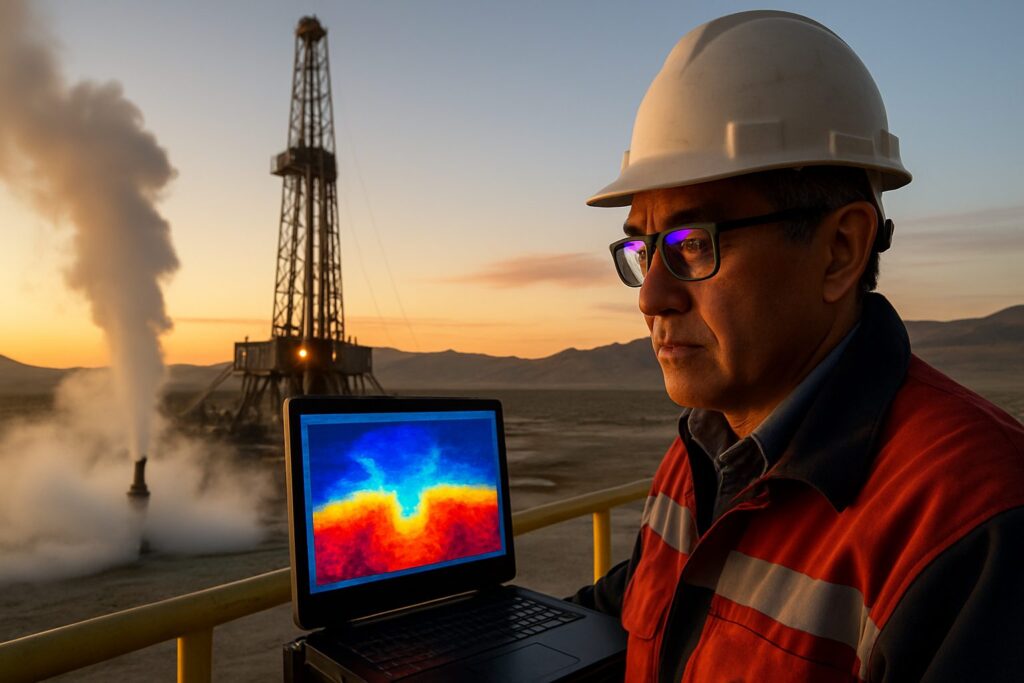
Powering the Cloud After 60 Years Underground: Ormat’s Geothermal Pivot to AI
TL;DR: Ormat Technologies is leveraging six decades of geothermal expertise to capture AI data center demand through enhanced geothermal systems (EGS), partnering with Google, SLB, and Sage Geosystems to deploy baseload clean power at scale across the Western U.S.
The Investment Thesis: From Niche to Mission-Critical
Ormat’s strategic repositioning represents a rare convergence: proven baseload generation technology meeting explosive AI infrastructure demand. Unlike solar and wind, geothermal delivers 24/7 power—exactly what hyperscalers need for data center reliability.
CEO Doron Blachar’s confidence stems from asymmetric positioning. Ormat already controls land positions, hyperscaler contracts for “hundreds of megawatts,” permitting expertise, and grid interconnection capabilities. Traditional geothermal competitors lack this operational scaffold. The company’s battery storage business provides a hedge if EGS underperforms.
Enhanced Geothermal Systems: Drilling Into Scale
Breaking the Geographic Constraint
Traditional geothermal required proximity to volcanic zones and high-temperature reservoirs. EGS removes this friction by combining oil-drilling and fracking techniques to tap deeper, hotter formations anywhere in the continental U.S.
The physics are validated. Economics remain unproven at commercial scale—the critical gap Ormat must close.
Dual Pilot Strategy Hedges Technology Risk
Ormat is running parallel EGS projects: one with geothermal startup Sage Geosystems, another with SLB, the world’s largest oilfield services firm. This dual-track approach de-risks execution and accelerates learning.
Partnership with Google and data center developer Switch signals real demand signals, not speculative positioning.
Competitive Landscape: Why Ormat Wins vs. Fervo
Wall Street draws comparisons to Fervo Energy, which IPO’d in May 2026 with a $10 billion valuation on the “biggest clean energy IPO ever” but has since halved to $5 billion. The valuation collapse reflects EGS execution risk and timeline uncertainty.
Ormat’s advantage: operational maturity and customer relationships. Fervo is a pure-play EGS startup. Ormat already generates revenue from 60 years of traditional geothermal operations and expanding battery storage—earnings visibility that justifies current execution.
Market Dynamics: The AI Demand Floor
Hyperscalers face a power wall. GPU-dense AI models consume 10-20x more electricity than traditional compute. Nuclear, the only other viable baseload option, requires 10+ years to permit and build. Geothermal’s 2-4 year development cycle becomes mission-critical.
Blachar’s framing—”endless demand for our product”—reflects hard math. Microsoft, Google, and Meta need terawatts of incremental power. Geothermal captures the overlap between sustainability mandates and operational necessity.
Background: The Companies and Events
Ormat Technologies was founded on geothermal generation expertise, building the world’s largest fleet of geothermal power plants across the Pacific Ring of Fire and beyond. Under Doron Blachar’s leadership since 2020, the company has expanded into battery energy storage while positioning EGS as the next growth inflection.
Enhanced Geothermal Systems (EGS) represent the convergence of traditional geothermal drilling with hydraulic fracturing techniques borrowed from oil and gas. EGS decouples geothermal generation from geographic constraints, enabling deployment in regions without natural high-temperature reservoirs.
Fervo Energy emerged as the leading EGS pure-play, achieving a $10 billion IPO valuation in May 2026—marketed as the biggest clean energy IPO ever. The subsequent 50% valuation decline reflects market skepticism about near-term commercialization timelines and cost curves.
AI Data Center Power Crisis: Large language models and GPU clusters consume exponential electricity. Google, Microsoft, and Meta face permitting bottlenecks for new power generation. This supply-demand imbalance creates a multi-year window where energy providers can command premium terms and accelerated deployment budgets.
Key Partnerships: Ormat’s collaboration with Google, SLB, and Sage Geosystems signals de-risking through complementary expertise. Google provides demand guarantees and customer channels. SLB brings subsurface engineering at scale. Sage contributes lean EGS-focused methodology.
Execution Risks and Timeline Sensitivity
EGS pilots must deliver proof-of-concept within 18-24 months to justify capital allocation. Any significant cost overruns or technical delays reset investor expectations and potentially trigger a Fervo-style valuation reset.
Permitting remains opaque. Western U.S. jurisdictions haven’t established clear EGS regulatory frameworks. Unexpected environmental reviews or tribal consultation requirements could extend timelines beyond AI infrastructure deployment windows.
The Bottom Line
Ormat is uniquely positioned to capture geothermal’s inflection moment, but success requires flawless execution on two fronts: proving EGS economics and scaling permitting velocity. The company has the operational advantages and customer demand to succeed, but EGS technology remains unproven at commercial scale. Investors should view Ormat as a leveraged bet on both AI power demand and EGS commercialization—with downside protection from legacy geothermal and storage businesses.