TL;DR
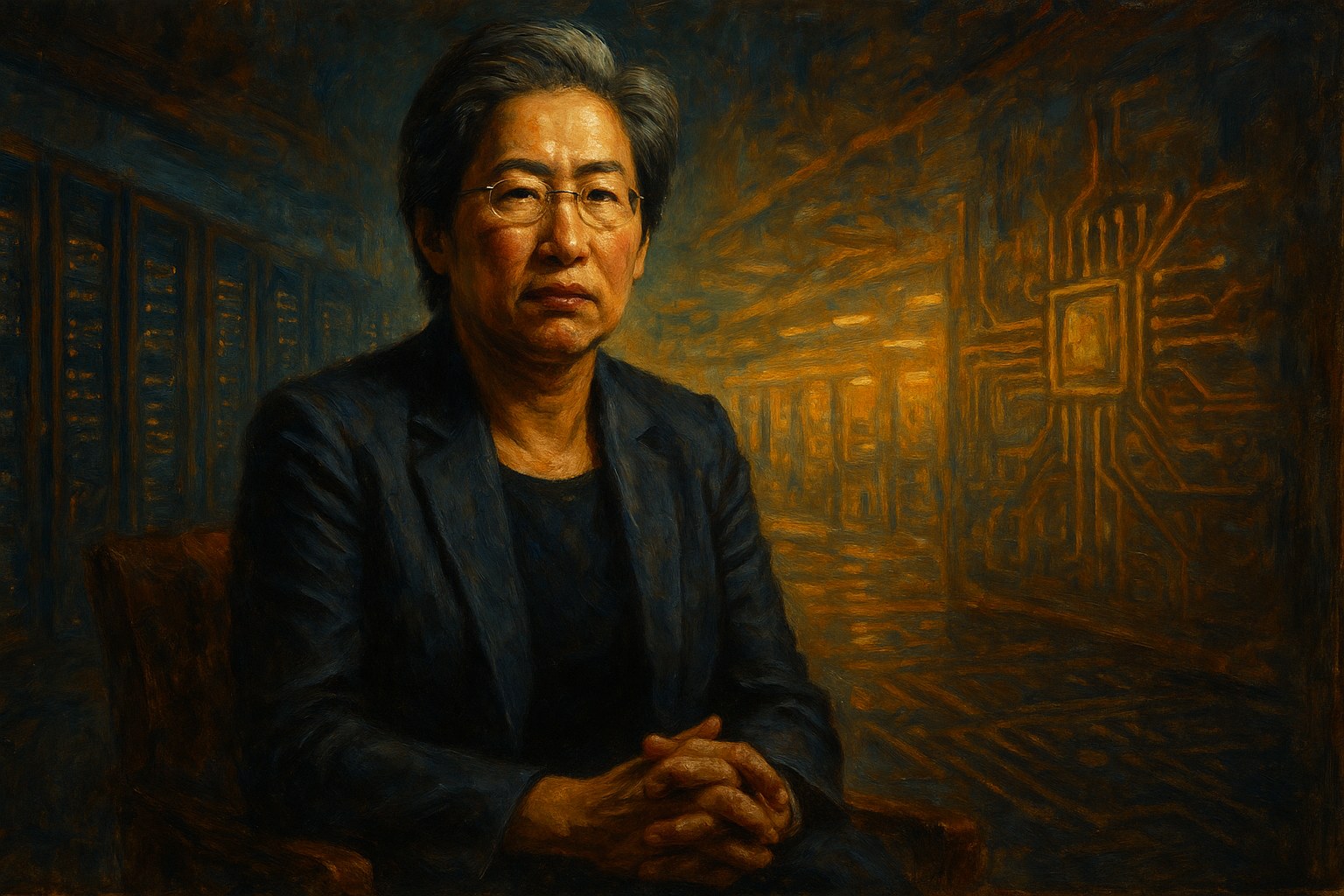
Lisa Su transformed AMD from a fading chipmaker into a multi-billion-dollar powerhouse. Her bet on high-performance computing and data center processors positioned the company to rival Intel. Today, under her leadership, AMD competes across servers, gaming, and AI—markets that barely existed in her first years as CEO.
Career Highlights
Lisa Su joined AMD in 2012 as Senior Vice President of Product Development, arriving from IBM where she had spent 15 years building expertise in semiconductor design and manufacturing. She moved quickly through the ranks. By 2014, at 42, she became President and CEO—a rare promotion for a woman in the notoriously male-dominated semiconductor industry. AMD was in crisis then: bleeding money, losing market share to Intel, and burdened with legacy businesses that drained resources.
Su’s first decision was radical. She sold off the manufacturing plants—AMD’s original core business—to focus exclusively on chip design. This freed capital and eliminated overhead. She then doubled down on markets where AMD could win: high-performance processors for data centers and gaming. The strategy seemed reckless. Wall Street doubted her. But she had conviction. “I believe we can be a leader in high-performance computing,” she said in early interviews, when few believed it possible.
By 2020, that bet paid off spectacularly. AMD’s server processors began displacing Intel’s entrenched dominance. The company completed its acquisition of Xilinx, a major FPGA player, expanding its footprint in edge computing and AI inference. Revenue accelerated past $15 billion annually. Su’s stock options—originally considered generous but dubious—became worth billions. She had not only saved AMD. She had resurrected it as a genuine rival to the semiconductor establishment.
Today, Su steers AMD into artificial intelligence and data center acceleration, the two fastest-growing markets in computing. She reports directly to the board, controls strategic direction, and maintains unusual autonomy for a public-company CEO. Employees describe her as analytically rigorous, unforgiving of imprecision, and quietly ambitious.
I. The Inflection Point
The moment came in 2014, during Su’s first year as CEO. AMD had been sliding for a decade. Intel owned the server market. Graphics belonged to Nvidia. AMD’s own Radeon division, once respected, had lost momentum. The company was executing on too many fronts with insufficient capital. Su saw the problem clearly: AMD would never beat Intel in breadth. But it could win in specific, high-value segments where performance mattered more than brand incumbency.
She made the choice to separate design from manufacturing. She spun out the foundries, creating Global Foundries, and licensed AMD’s production to external fabs. Critics called it a retreat. Su saw it as liberation. “We could focus on where we have the deepest expertise—architecture and design,” she explained later. Without the burden of running billion-dollar fabs, AMD could invest in R&D, hire world-class architects, and iterate faster than rivals. The strategy flipped AMD’s cost structure upside down and allowed her to compete on brain power, not real estate.
Within three years, that shift bore fruit. AMD’s EPYC server processors launched in 2017 and began winning design wins at hyperscalers like Google and Amazon. Intel’s position, unshaken for 15 years, had cracks. By 2019, AMD controlled roughly 10% of the server market. By 2023, it held nearly 25%. That inflection—from desperation to momentum—defined Su’s tenure.
II. The Build
Su constructed AMD into a three-pillar powerhouse: data centers, gaming, and edge/AI. Each pillar feeds the others, creating a virtuous cycle of engineering talent, manufacturing allocation, and customer lock-in.
- EPYC Processors: The data center CPU line that displaced Intel. Now the company’s largest revenue driver by segment.
- Radeon GPUs: Graphics accelerators competing with Nvidia in AI training and inference, though trailing in market share.
- Ryzen & Threadripper: Consumer and enthusiast CPUs that recaptured mindshare from Intel in gaming and creative workloads.
- Xilinx Acquisition (2022): $49 billion deal that added programmable logic and adaptive compute to AMD’s portfolio, expanding into automotive, industrial, and edge markets.
- Manufacturing Partnership: Deep relationships with Taiwan Semiconductor Manufacturing Company (TSMC) as primary fab, ensuring access to leading-edge nodes ahead of competitors.
- AI Accelerators: MI-series GPUs designed for large language models, challenging Nvidia’s H100 dominance.
Su’s strategy is architectural. She doesn’t chase every trend. Instead, she identifies compute-intensive workloads where performance leadership justifies premium pricing. Data centers were obvious. Gaming followed. AI acceleration became inevitable. By concentrating resources on these domains and building modular, scalable designs, AMD has achieved margins and growth rates that rival Nvidia, while maintaining lower multiples than the graphics-chip juggernaut.
III. The Person
Su is measured and direct. She speaks with precision, avoiding hyperbole even when discussing AMD’s achievements. Colleagues describe a leader who reads every product spec, understands the physics of chip design, and asks incisive questions in meetings. She is not charismatic in the mold of Steve Jobs or Elon Musk. Her authority derives from competence, not personality.
She is also disciplined. Su is known for punctuality, preparation, and follow-up. She maintains a rigorous schedule and expects the same from executives. She has built a senior team of accomplished chip architects—Frank Garofolo, Forrest Norrod, David McAfee—and grants them autonomy while holding them accountable for results. “We move fast and make decisions,” she has said. “Not every decision is perfect, but speed of execution matters more than perfection.”
Outside work, Su is guarded about personal details. She is married with two children and lives in the Bay Area. She is active in industry organizations and mentors younger engineers, particularly women entering semiconductor careers. Her influence extends beyond AMD—she sits on boards, speaks at conferences, and has become a role model for female leaders in hardware technology, a sector where women remain significantly underrepresented in executive ranks.
IV. The Network & Numbers
- Founded (AMD): 1969
- Su Appointed CEO: 2014
- IPO: 1972 (well before Su’s tenure)
- Current Market Cap: ~$180–200 billion (as of late 2024)
- Employees: ~24,000
- Latest Annual Revenue: ~$23 billion (FY 2023)
Key Relationships
- Xilinx Leadership (Pre-Acquisition): Successfully integrated acquired company and retained key architects.
- TSMC: Strategic partner and primary foundry; critical to AMD’s ability to manufacture at bleeding edge.
- Hyperscalers (Google, Amazon, Meta): Major customers whose workload demands shape AMD’s roadmap.
- Intel: Primary competitive rival; AMD now holds meaningful market share in previously Intel-dominated segments.
- Nvidia: Competitor in AI accelerators; AMD trails in GPU share but gains ground annually.
V. The Thesis
Su’s conviction is straightforward: specialized, high-performance processors will command the market over the next decade. She rejects the notion that computing will homogenize around a few generalist chips. Instead, she believes data centers, edge devices, and AI systems will demand custom silicon optimized for specific workloads. AMD’s modular architecture—Zen CPU cores, CDNA GPU architecture, and now Xilinx’s programmable logic—positions the company to serve that fragmentation.
She is also bullish on AI acceleration, though measured in her language. While others speak of AI as an existential opportunity, Su treats it as a massive engineering problem requiring sustained investment in architecture, manufacturing, and talent. AMD is building for the long cycle, not the hype cycle. “We don’t make bets on short-term enthusiasm,” she has noted. “We build for problems that will matter in five years. AI will matter. So will energy efficiency, and real-time processing, and everything else people haven’t yet imagined.”
That pragmatism—combined with technical depth and operational discipline—is Su’s enduring advantage. She has proven she can execute at scale, pivot when needed, and lead a 24,000-person organization with the precision of a small design team. AMD’s trajectory under her leadership suggests she will remain central to semiconductor competition for years to come.
Factbox
Name Lisa Su | Age 53 | Location San Jose, California, USA | Company & Role AMD, Chief Executive Officer & President | IPO AMD went public in 1972; Su became CEO in 2014 | Current Market Cap ~$180–200 billion | Employees ~24,000 | Contrarian Belief Specialized, high-performance chips for specific workloads will outcompete generalist processors over the next decade.
About the Author