TL;DR
Demis Hassabis built DeepMind into the world’s leading artificial intelligence lab—then watched Google acquire it for a reported $650 million. His mission: use machine learning to solve the hardest scientific problems. He’s the rare technologist who thinks like a neuroscientist, plays like a chess prodigy, and executes like a CEO.
Career Highlights
Hassabis arrived in AI through an unconventional route. A chess prodigy and competitive gamer in his youth, he studied neuroscience at University College London, then spent years in video game design at Elixir Studios and Lionhead, building AI systems for virtual worlds. But video games felt too small. In 2011, at 25, he founded DeepMind Technologies with Mustafa Suleyman and Shane Legg. His thesis was sharp: if you want to understand intelligence, study the brain. Then build machines that learn the same way.
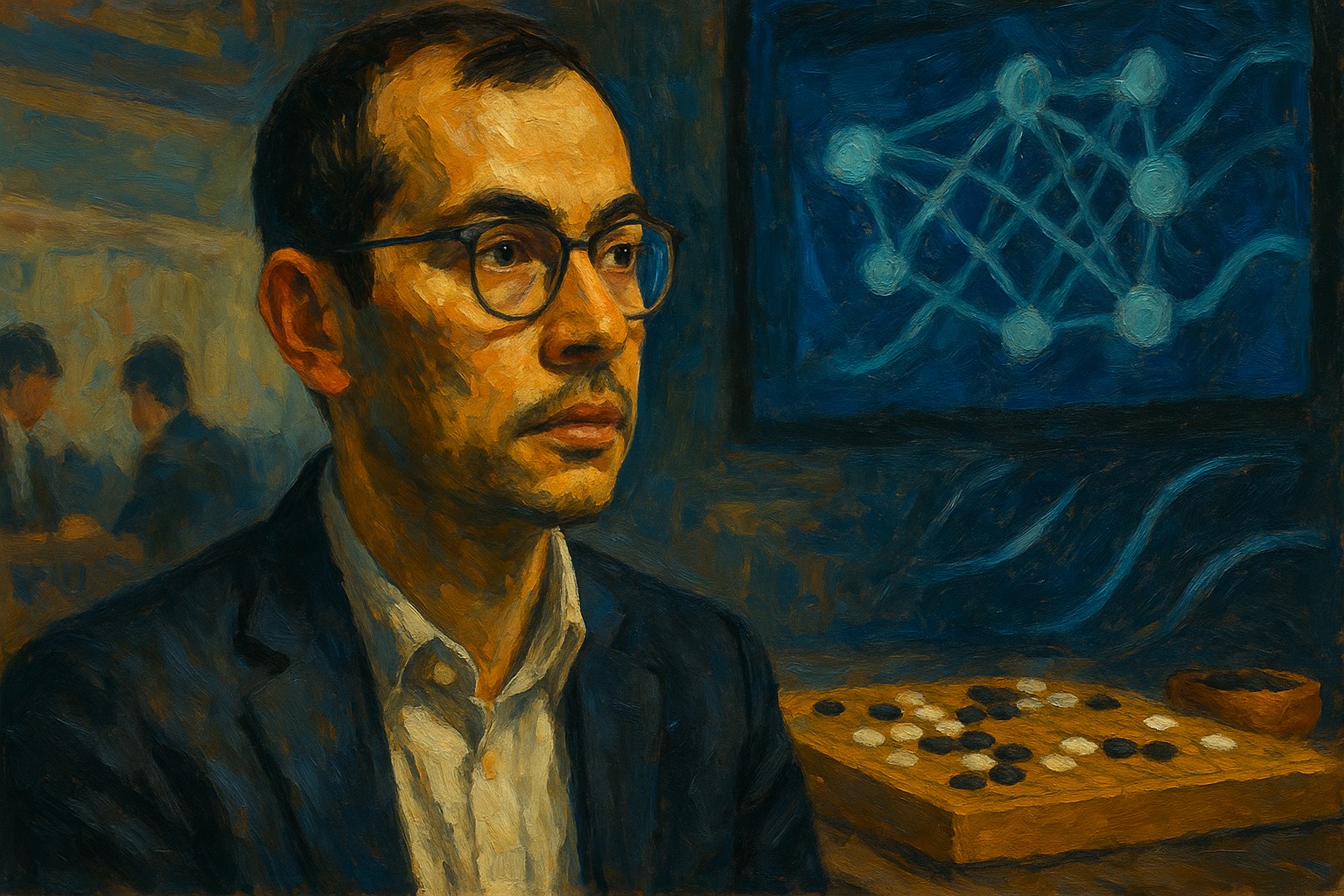
The lab’s breakthrough moment came in 2016 when AlphaGo defeated Lee Sedol, one of the world’s greatest Go players, in a match watched by 200 million people. Go is a game of impossible complexity—more possible positions than atoms in the universe. Conventional algorithms choked. AlphaGo combined deep neural networks with Monte Carlo tree search and learned from human games. It won four of five matches. The world paused. AI, which had been a steady hum of academic progress, became front-page news.
Google acquired DeepMind in 2014—before AlphaGo’s triumph, a bet that proved prescient. Hassabis stayed on as CEO. He has since expanded the lab’s ambition beyond games to protein folding (AlphaFold), weather prediction (GraphCast), and materials science. In 2023, Google folded DeepMind’s parent company into a new entity called Google DeepMind, with Hassabis as chief scientist, then elevated him back to CEO in 2024. He is relentless about one thing: DeepMind exists to advance science, not to chase consumer products.
I. The Inflection Point
The moment arrived in late 2015, when AlphaGo’s development team prepared to announce their results. Hassabis knew the match against Lee Sedol would either validate the entire enterprise or expose a fundamental limit. Go had been the uncracked puzzle of AI for decades. Machines could beat humans at chess, but Go demanded intuition, pattern recognition, and something close to creativity. If DeepMind couldn’t solve Go, skeptics would call the whole approach a dead end.
They won in March 2016. The victory rewired how the world thought about artificial intelligence. It wasn’t just a technical win—it was a philosophical one. It proved that machines could learn strategies no human had coded in. They could develop intuition. The win gave Hassabis enormous credibility and, crucially, justified Google’s investment. More importantly, it gave him permission to think even bigger. “When we beat Lee Sedol, a lot of people thought, ‘OK, so you’ve solved Go, what’s next?'” he recalled. “What’s next is using these methods to solve problems that matter for humanity.”
II. The Build
DeepMind is not a company in the traditional sense. It is a research engine inside Google, funded without regard to quarterly earnings, tasked with expanding the frontier of AI and its applications to science. Hassabis has built it around a few obsessions: mastering complex domains, transferring those insights to real-world problems, and publishing discoveries openly.
- AlphaGo and AlphaZero: Game-playing systems that invented their own strategies, trained entirely from self-play, with no human knowledge. Proved that machines could discover novel approaches.
- AlphaFold: Predicted the 3D structure of proteins from amino acid sequences—a 50-year problem in biology solved in two years. Accelerated drug discovery and fundamental biological research.
- Gemini and Foundation Models: Large language models and multimodal systems that drive DeepMind’s current research in reasoning, planning, and embodied AI.
- GraphCast and Scientific Tools: AI systems for weather prediction, climate modeling, and materials discovery. Moving AI from abstract challenges to applied science.
- Neuroscience Partnerships: Deep collaboration with neuroscience labs to extract principles from the brain that inform AI architecture.
- Robotics and Agent Research: Work on embodied intelligence—agents that act in physical environments, learning through interaction.
The strategy is clear: start with abstract, high-complexity challenges where success is measurable. Win convincingly. Then extract the underlying principles and apply them to problems that matter—disease, energy, climate. Publish. Repeat.
III. The Person
Hassabis is cerebral and measured, with the quiet confidence of someone who has achieved improbable things young. He is a polymath: chess master, neuroscientist, game designer, and now AI researcher. He speaks carefully, avoiding hype, which is rare in AI. He is also driven by a singular conviction that intelligence—artificial and otherwise—is the lens through which to understand the world.
He codes less than he once did, but he reads voraciously—neuroscience, physics, biology, philosophy. He has a photographic memory, a gift he has put to use in chess since childhood. Colleagues describe him as collaborative but intensely focused. He surrounds himself with top researchers from academia and industry, pays them well, and gives them freedom to pursue long-term questions. He is not interested in moving fast and breaking things. He is interested in moving deliberately and building something that lasts.
In interviews, Hassabis emphasizes patience and fundamentals. “The key thing is to focus on the science,” he has said. “If you focus on the science, the applications will follow.” It is the inverse of most Silicon Valley wisdom, and it works because he has proven it twice—with AlphaGo and with AlphaFold.
IV. The Network & Numbers
Milestones Box
- Founded: 2011
- Acquisition: Google acquired DeepMind in 2014 for ~$650 million
- Current Role: CEO of Google DeepMind (appointed 2024)
- Employees: ~1,000+
- Parent Company: Alphabet Inc. (Google)
Key Relationships
- Mustafa Suleyman: Co-founder of DeepMind; now heads AI policy at Google.
- Shane Legg: Co-founder of DeepMind; Chief AI Scientist at Google DeepMind.
- Sundar Pichai: CEO of Google and Alphabet; oversees DeepMind strategically.
- David Silver: Principal Research Scientist; led AlphaGo and AlphaZero programs.
- Alphabet / Google: Parent company and primary funder; DeepMind operates with significant autonomy.
V. The Thesis
Hassabis believes that artificial general intelligence—systems that can learn and reason across domains the way humans do—is the defining technological frontier. But he does not see AGI as a binary endpoint. He sees it as a spectrum of increasing capability, and each step up requires breakthroughs in learning, reasoning, and what he calls “causal understanding.” Machines need to understand not just what correlates with what, but why.
His bet is that by studying neuroscience alongside machine learning, by testing ideas in constrained domains (games, protein folding, weather), and by publishing findings openly, DeepMind can accelerate the field without hype or shortcuts. He believes AI’s highest calling is to amplify human scientific capability. Not to replace humans. To help humanity solve its hardest problems faster.
“The ultimate goal is to create general-purpose learning algorithms,” Hassabis has said, “and then apply them to the real world in ways that benefit humanity.” It is a statement of faith masquerading as strategy. But his track record suggests he is onto something.
Factbox
Name: Demis Hassabis | Age: 38 | Location: London, UK | Company & Role: Google DeepMind, CEO & Co-founder | Education: BSc Neuroscience (University College London) | Funding: Acquired by Google in 2014; operates as division of Alphabet Inc. | Contrarian Belief: The most important problems in AI will be solved by teams that prioritize long-term science over short-term product cycles.
About the Author