Compact AI Models Enable Autonomous Drone Targeting Without Cloud Dependency
TL;DR: NATO-backed Scaleout Systems deploys lightweight AI models on edge devices to give drones autonomous target identification and attack capabilities, eliminating reliance on centralized servers and reducing vulnerability to jamming and strikes on data centers.
The Operational Advantage: Battlefield AI Independence
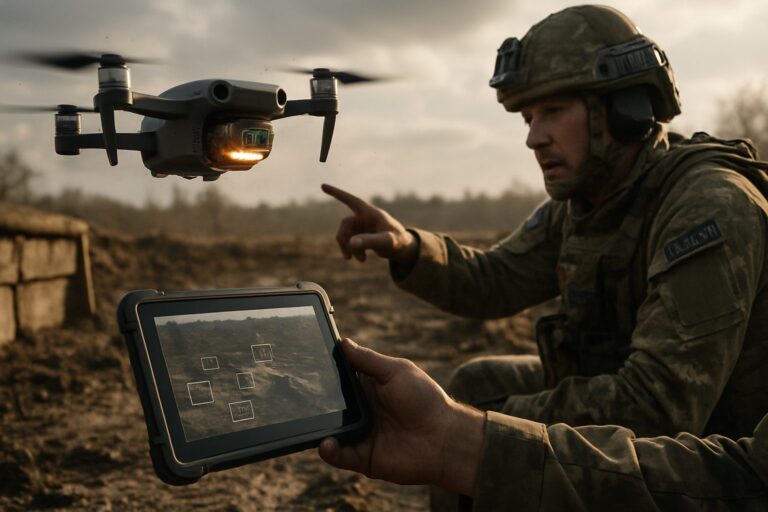
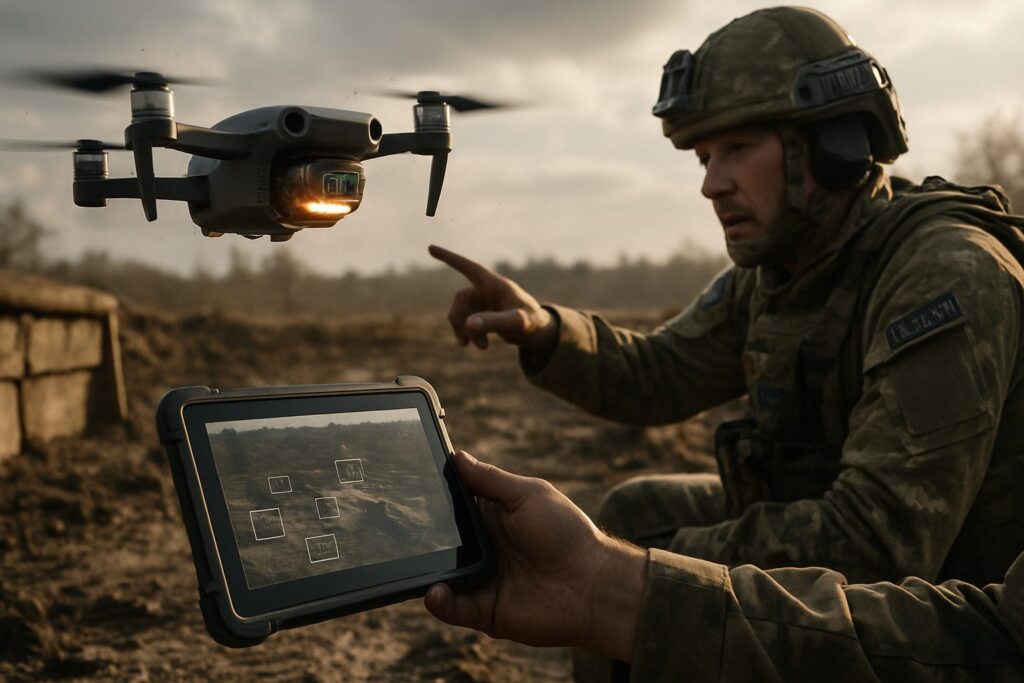
The shift toward edge-based AI in military drones addresses a critical vulnerability: centralized AI infrastructure. Scaleout Systems is working within NATO’s Defence Innovator Accelerator program to deploy computer vision models directly on drone hardware, tablet systems, and forward command posts rather than relying on cloud connections to distant servers.
This architecture matters in contested environments where electronic warfare disrupts communications and adversaries target data centers. Drones operate autonomously during signal blackouts while selectively uploading battlefield data to nearby command nodes for model retraining.
Why Edge Models Beat Frontier AI for Military Deployment
Scaleout eschews OpenAI and Anthropic’s large language models in favor of compact, specialized models optimized for specific hardware constraints. A drone’s onboard processor can’t run a 70-billion parameter model; it needs something 100-1000x smaller that still performs target detection reliably.
CEO Andreas Hellander emphasized the adaptation challenge: models trained in desert environments fail in urban zones. The federated learning approach allows daily model refreshes based on aggregated sensor data from multiple drones, creating a persistent learning loop that improves accuracy mid-operation.
Background: The Companies and Strategic Context
Scaleout Systems originated from Uppsala University researchers in 2018, initially focusing on deploying machine learning directly to commercial vehicle hardware. The 2022 Russian invasion of Ukraine redirected the company toward defense applications where edge AI became strategically critical. The startup joined NATO’s DIANA Challenge Program in 2025, securing institutional backing and testing grounds within alliance infrastructure.
The Federated Aerial Intelligence for Recon (FAIR) project represents Scaleout’s flagship NATO engagement. It addresses the practical requirement that forward-deployed forces need AI capabilities independent of rear-area infrastructure, a lesson Ukraine’s military learned painfully during early Russian strikes on communication networks.
BAE Systems Bofors partnership extends this approach to the Affordable Loitering Modular Ammunition (ALMA) program, developing low-cost autonomous kamikaze drones with onboard intelligence. This integration signals mainstream defense industry adoption of edge AI architectures, no longer treating drone autonomy as a future concept but immediate operational requirement.
Strategic context: Data center destruction has occurred during US-Iran conflicts, validating NATO’s push toward distributed AI. Ukrainian forces already field cheap commercial drones with onboard AI for target identification—a capability that shifted from experimental to battlefield-proven within 18 months.
Federated Learning: The Technical Model
The architecture operates in three tiers. Edge devices (drones, tablets) run inference on compact models for real-time target detection. Local command nodes aggregate data from multiple sources and retrain models on battlefield-specific patterns. Updated models deploy back to edge devices during operational pauses or favorable communication windows.
This eliminates the latency and vulnerability of server-dependent systems while enabling rapid adaptation. A model’s performance improves measurably within hours as fresh data from multiple sensors feeds retraining pipelines.
Defense Investment Signal: Autonomous Systems Entering Procurement Reality
This isn’t research—it’s NATO-accelerated deployment. The DIANA program specifically targets technology readiness levels 6-8 (pilot production to operational prototype). Companies like Scaleout that crack the edge AI problem face urgent procurement demand from European militaries upgrading drone fleets.
Investors should track whether BAE Systems, Northrop Grumman, or European OEMs license Scaleout’s model compression and federated learning frameworks into production platforms. Integration into existing drone ecosystems (Switchblade, Loitering Munition variants) would indicate institutional confidence in the technology’s reliability.
Risks and Limitations
Autonomous targeting at scale introduces accountability and escalation risks that regulation hasn’t addressed. Models trained on Ukraine data may exhibit geographic or tactical bias when deployed elsewhere. Adversaries will adapt—jamming edge devices differently, spoofing sensor feeds with adversarial examples—creating an arms race in model robustness.
Supply chain exposure also matters: compact models still require specialized training infrastructure and depend on chipsets vulnerable to sanctions or export controls.
What Operators Should Watch
- Model update frequency in live exercises—daily retraining validates the federated approach’s operational viability
- Interoperability standards emerging from NATO testing—modular AI could become as critical as communications protocols
- Defense contracts awarded to Scaleout or its competitors in 2026-2027, signaling production-line adoption
- Real-world Ukraine deployments of federated learning systems, which would confirm tactical effectiveness beyond simulation
Bottom line: Edge AI is no longer an engineering challenge—it’s a military doctrine shift. Forces that master compact model deployment, federated retraining, and autonomous target handling gain asymmetric advantage against opponents relying on centralized infrastructure. The companies solving this problem will shape defense technology procurement for the next decade.