Data Centers Become “Killer Application” for Solid-State Power Transformers
TL;DR: AI data centers’ shift to direct current (DC) power architectures is accelerating commercialization of solid-state transformers, with startups raising $280M+ to replace 140-year-old transformer technology. This could resolve critical power grid bottlenecks affecting both data center expansion and broader infrastructure modernization.
The Operational Imperative: Why Data Centers Drive the Transformer Revolution
The AI infrastructure boom has created an urgent need for power conversion technology that conventional transformers simply cannot deliver. Data centers operating DC power systems require direct AC-to-DC conversion—a task that traditionally demands multiple separate devices stacked in series, each introducing inefficiencies and control complexity.
Solid-state transformers solve this by consolidating voltage conversion and AC/DC transformation into a single semiconductor-based device. For operators managing server racks packed with energy-intensive AI chips, this means simplified electrical architecture, reduced material costs, and tighter power management. Srdjan Lukic, professor of electrical and computer engineering at North Carolina State University, described this as “one magic box that eliminates a lot of the infrastructure and also provides one control location.”
Market Momentum: $280M in Funding Signals Commercial Viability
Three US companies—Amperesand, Heron Power, and DG Matrix—have collectively raised over $280 million in the past year alone. This capital surge reflects both venture confidence and urgent utility demand. The competitive landscape is consolidating around semiconductor-based solutions using materials like silicon carbide, which enable mass manufacturing at scale.
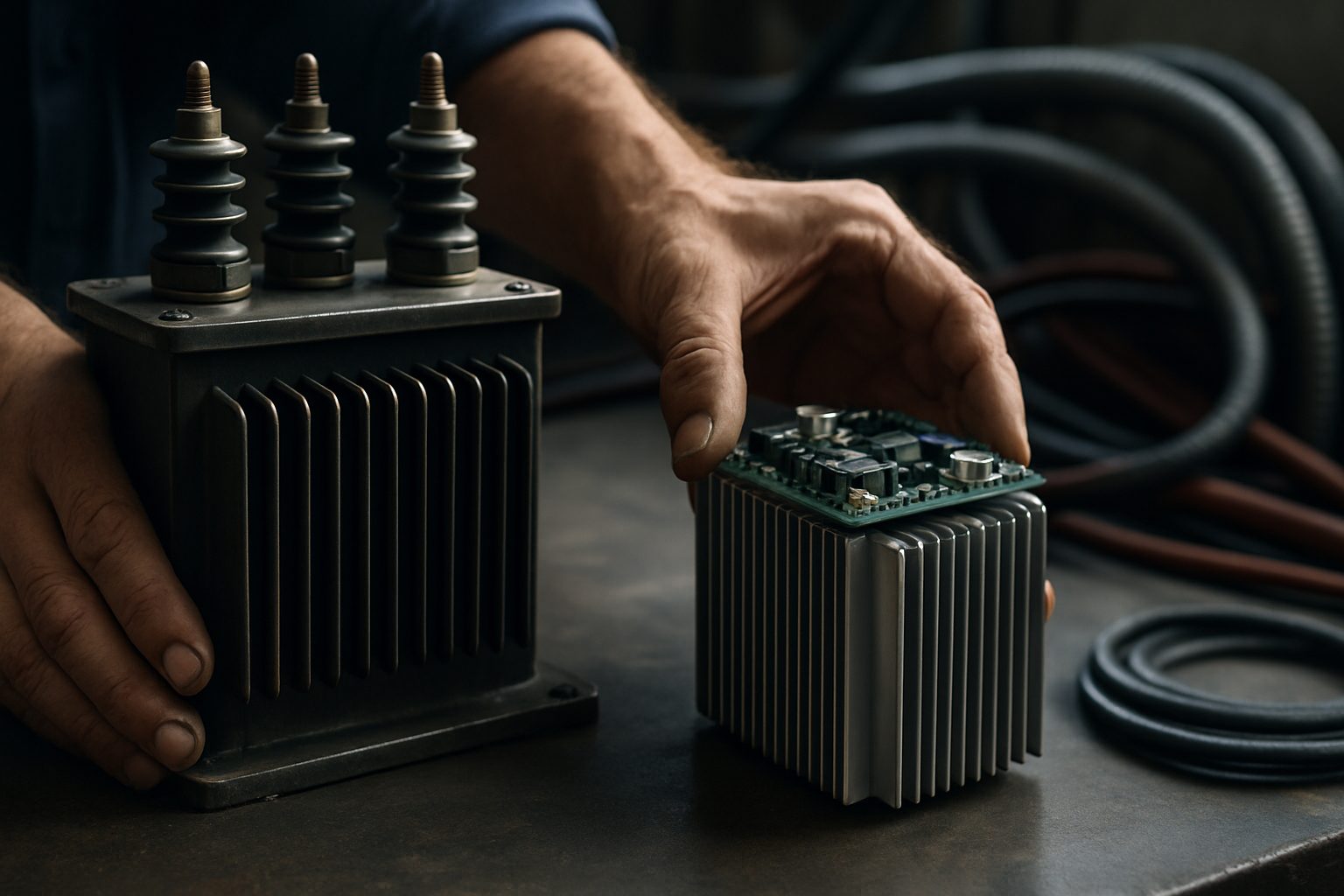
Unlike conventional transformers (custom-built by hand, with 3-7 year lead times), solid-state transformers use modular, mass-producible designs. Smaller physical footprint, reduced copper requirements, and plug-and-play component upgrades make them operationally superior for data center environments.
Background: The Conventional Transformer Bottleneck
Power grids worldwide still rely on transformer technology fundamentally unchanged since the 1880s. Two copper wire coils wound around a steel core create electromagnetic fields for voltage step-up (transmission) or step-down (distribution). These devices are irreplaceable—literally.
Manufacturing constraints are severe. The largest power transformers cannot be mass-produced; each is custom-built for specific utility substations. Lead times routinely exceed five years. This creates a cascading infrastructure problem: aging transformers cannot be replaced quickly, and new grid capacity cannot be deployed to meet surging electricity demand driven by AI data centers.
The US power sector is already strained. Data centers have become the largest driver of surging electricity demand straining US power grids, according to Ars Technica’s reporting. Without transformer technology innovation, both grid operators and data center developers face multi-year infrastructure delays.
The Technology Advantage: From Industrial Design to Modern Power Electronics
Solid-state transformers use high-frequency semiconductor switching to perform voltage conversions in real time. This approach delivers several operational advantages over electromagnetic induction:
- Mass manufacturability: Silicon carbide and other semiconductors use established fabrication processes, eliminating hand-assembly constraints
- Compact form factor: Physically smaller and lighter than conventional transformers, freeing data center floor space for additional compute capacity
- Modular architecture: Components can be upgraded or replaced independently without rewiring
- Multi-function integration: Single device handles AC/DC conversion, voltage transformation, and power conditioning simultaneously
For data center operators, the control integration is particularly valuable. Traditional facilities require multiple power electronic devices attempting to regulate the same electrical parameters, creating interoperability risks. Solid-state transformers consolidate that control at a single conversion stage before power reaches server racks.
Supply Chain Implications: Relief Beyond Data Centers
The broader infrastructure payoff could be significant. Successful commercialization of solid-state transformers could substantially reduce copper and raw material demand, while semiconductor manufacturing capacity scales more rapidly than specialized transformer facilities.
This creates a positive externality: utilities upgrading aging power grids for non-AI loads (residential, industrial, EV charging infrastructure) would gain access to faster delivery timelines and lower costs. The data center “killer application” becomes the catalyst for grid-wide infrastructure modernization.
Investment Signal: Hardware Scaling as Core AI Infrastructure Play
For investors, solid-state transformer startups represent a fundamental infrastructure category: enabling technology for the hardware that enables AI scaling. These companies sit upstream of data center operators, power utilities, and equipment manufacturers—capturing value across the entire power delivery chain.
The $280M funding surge reflects recognition that power delivery is now a binding constraint on AI infrastructure growth. Companies solving this constraint at the component level have significant leverage over downstream customers facing multi-year lead times and capacity constraints.
About the Author