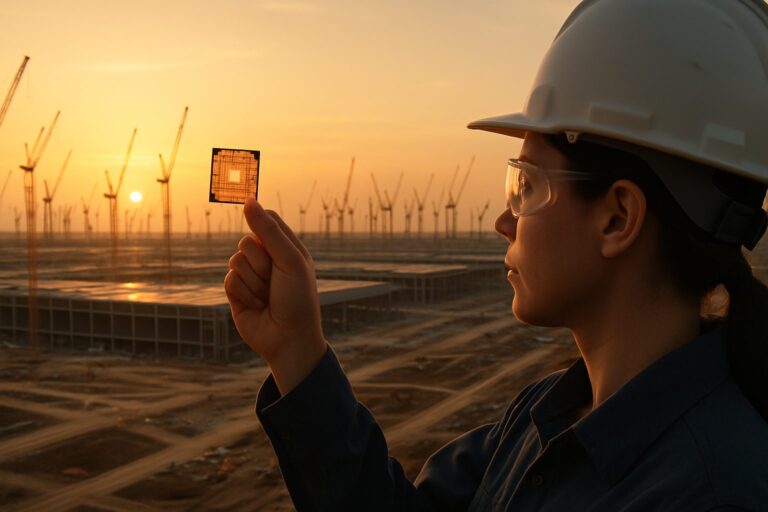
Anthropic Builds In-House Silicon Team to Reduce Nvidia Dependency
TL;DR
Anthropic is hiring a custom silicon team to design proprietary chips for Claude inference. The move mirrors OpenAI, Google, and Meta—signaling that frontier AI labs are vertically integrating hardware to gain competitive edge and escape Nvidia’s supply constraints.
The Strategic Shift: Why AI Leaders Are Going Vertical
Anthropic confirmed plans to build an in-house silicon design capability, announced through job postings for senior semiconductor engineers and technical program managers. A company spokesperson told Ars Technica the effort will operate alongside partnerships with other chipmakers—a “multi-chip approach” that hedges against single-supplier risk.
This isn’t defensive posturing alone. Co-designing hardware and software unlocks performance gains competitors can’t match. Anthropic plans tight collaboration between its model teams and silicon engineers, embedding hardware expertise directly into product development.
The Nvidia Bottleneck Driving the Industry
Nvidia’s stranglehold on AI compute infrastructure created a vulnerability too large to ignore. As demand for training and inference capacity continues exceeding supply, frontier labs face both cost exposure and availability risk.
The imperative is clear: custom silicon lets providers optimize for their specific model architectures while reducing per-unit inference costs. OpenAI already launched Jalapeño for datacenter LLM inference with Broadcom. Google, Meta, and reportedly Mistral are following similar paths.
Background: The Vertical Integration Wave
Anthropic, founded in 2021 by former OpenAI researchers, has grown into one of three credible frontier AI laboratories alongside OpenAI and Google DeepMind. The company raised $5+ billion in funding and competes primarily on Claude’s reasoning and safety properties. Hardware ownership has never been core to Anthropic’s positioning—until now.
OpenAI‘s chip announcement this year (Jalapeño) marked its pivot from pure software-as-service to infrastructure verticalization. The chip targets inference workloads where cost-per-token directly impacts unit economics for deployed applications.
Google designed TPUs starting in 2016 and runs all Gemini inference on proprietary silicon. This vertical integration funded research into sparsity, quantization, and attention mechanisms optimized for Google’s tensor shapes. Meta similarly designed chips for training and inference after heavy Nvidia capex constraints limited its research velocity.
The Samsung rumor, previously reported by The Information, suggests Anthropic may license manufacturing rather than build fabs—the capital-efficient path taken by fabless design houses like Broadcom, Qualcomm, and Apple.
Implications for Operators and Investors
For cloud operators: Custom silicon concentration among frontier labs will fragment the inference market. Customers choosing Claude may eventually face Claude-optimized hardware pricing that undercuts commodity GPU rates—but only on Anthropic’s infrastructure. This favors larger enterprises with captive workloads.
For Nvidia: The trend is material but not existential. Inference chips have longer go-to-market timelines than training silicon, and Nvidia’s software ecosystem (CUDA, cuDNN) remains sticky. However, margin pressure on inference products is real.
For investors in AI infrastructure startups: The play shifts from pure chip design to chiplet ecosystems and specialized inference accelerators. General-purpose GPU suppliers face commoditization risk in the long tail.
Timeline and Execution Risk
Anthropic is early in hiring—no silicon team exists yet. Full custom silicon for Claude inference is likely 18–24 months away. The company must recruit experienced chip architects (typically from Tesla, Apple, Google, or Amazon) and establish design partnerships before first silicon.
The multi-chip strategy hedges against execution risk: even if proprietary silicon slips, Anthropic continues using Nvidia and other partners. This pragmatism separates Anthropic from more bravado-laden hardware announcements.
The Competitive Calculus
Custom silicon won’t make Claude architecturally superior—model quality remains software-determined. The win is operational: 15–30% inference cost reduction could enable new pricing tiers that undercut OpenAI’s token pricing without sacrificing margin.
For enterprise buyers, this matters. If Anthropic can deliver API-compatible Claude at meaningfully lower cost-per-token within 2–3 years, switching costs drop. That threatens OpenAI’s pricing power on GPT-4-class models.
In the near term, expect announcements of Anthropic’s silicon hires and design partnerships within 12 months. First silicon taped-out would signal credibility; public benchmarks comparing Anthropic’s chip to Nvidia H100s on Claude inference would move market expectations.