NVIDIA NIM packages GPU-accelerated models as inference microservices and optimizes latency for particular model and GPU combinations. The documentation reviewed does not establish a universal sub-10ms industrial inspection guarantee. A valid inspection claim must identify the model, hardware and workload, and distinguish inference time from the complete request and production pipeline.
Does NVIDIA NIM guarantee sub-10ms defect inspection?
NVIDIA describes NIM performance in terms of particular models and NVIDIA GPU systems, rather than assigning one latency figure to every vision model or factory deployment.
[VERIFY: Which NIM container version, inspection model, GPU, image resolution, precision, batch size and concurrency produce sub-10ms latency, and does the result measure GPU compute, server response or camera-to-decision time at a stated percentile?]
What does NIM provide for deployment?
NIM provides containers for self-hosted GPU-accelerated inference across clouds, data centers, and RTX AI PCs and workstations, with industry-standard APIs for application integration.
The NIM architecture description explains that the microservices package domain-specific code and optimized inference engines for each model and hardware setup.
NVIDIA supplies observability metrics, Helm charts and guides for scaling NIM on Kubernetes.
How does NVIDIA build an industrial inspection pipeline?
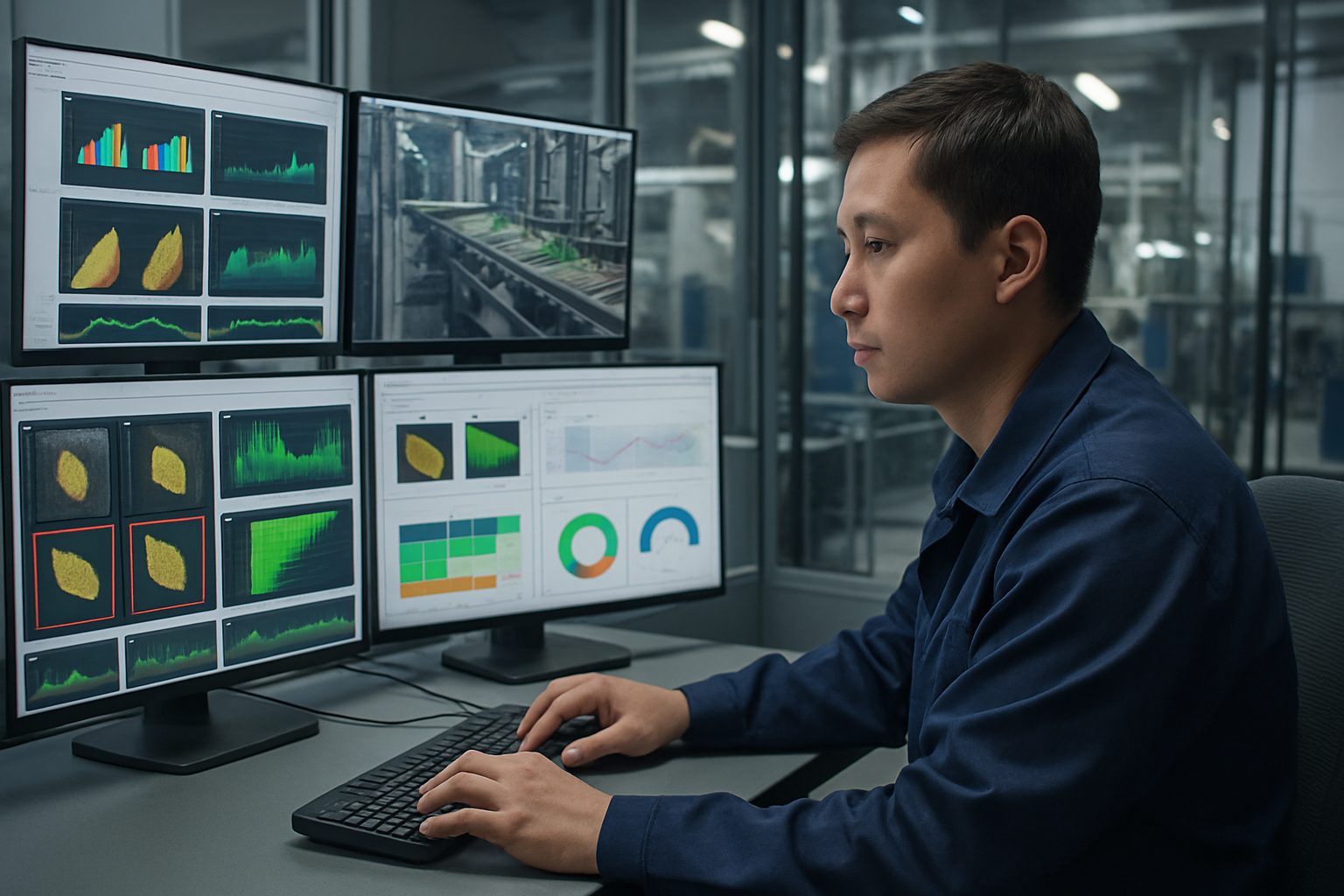
NVIDIA’s September 2025 visual-inspection reference uses TAO 6 for model customization and optimization, and DeepStream 8 for deployment in a streaming analytics pipeline.
The reference workflow includes self-supervised fine-tuning using domain data, knowledge distillation for efficiency, and deployment through DeepStream Inference Builder.
For inspection tasks, the reference identifies NV-DINOv2 and C-RADIOv2 foundation backbones and task heads for classification, detection and segmentation.
Which latency measurement matters for inspection?
NVIDIA’s Triton Perf Analyzer documentation distinguishes client-observed latency from server latency and separates server queueing, compute and endpoint overhead.
| Measurement | What NVIDIA's documentation measures |
|---|---|
| Server latency | Time from the request being received to the response being sent |
| Queue time | Waiting for an available model instance in the inference scheduler |
| Compute time | Actual inference, including copying data to and from the GPU |
| HTTP client latency components | Client send/receive time and waiting for the server response |
| Throughput | Completed requests divided by the measurement duration in seconds |
Perf Analyzer’s CSV output includes concurrency, throughput, latency components, and p50, p90, p95 and p99 latency columns.
Does containerization remove queueing and network delays?
Container packaging is not evidence of zero overhead: NVIDIA’s inference measurements explicitly include requests waiting for model availability and client time spent sending requests and receiving responses.
What must operators verify before deployment?
Conduct latency benchmarks with your specific model and hardware.
About the Author