Zoox Escapes Nevada Fleet Cap as Robotaxi Wars Intensify
TL;DR: Amazon’s Zoox loses its 100-vehicle regulatory ceiling in Nevada on September 25, freeing expansion just as Waymo, Tesla, and Uber commercialize competing services. The move matters operationally: Zoox gains deployment flexibility under a federal exemption for up to 2,500 vehicles annually, but competitive density could pressure unit economics across the Las Vegas market.
Regulatory Constraint Expires Mid-September
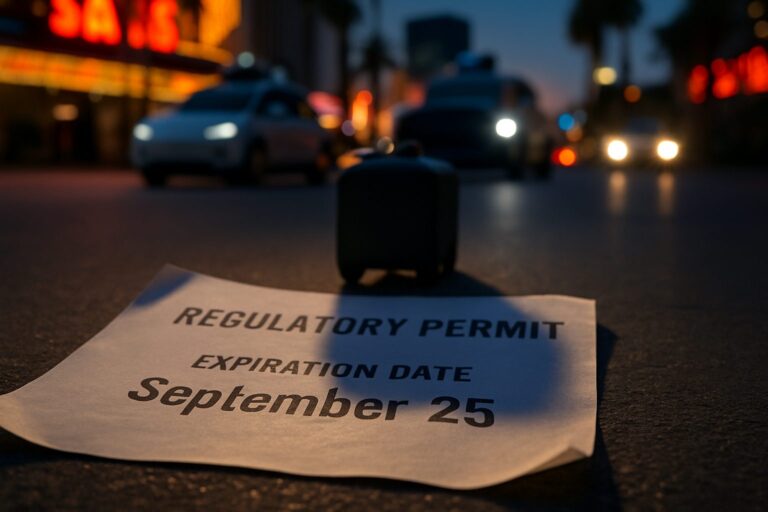
The Nevada Transportation Authority permit capping Zoox at 100 robotaxis expires September 25, according to NTA officials and company confirmation. This removes the only hard fleet limit on Zoox’s autonomous operations in the state, though expansion velocity remains unclear.
Zoox’s robotaxis differ fundamentally from Waymo’s: the cube-shaped vehicles lack steering wheels, pedals, and traditional controls entirely. This design required a federal exemption from NHTSA in August, allowing deployment of up to 2,500 units annually for two years. Nevada approval followed, but California regulators still block paid rides in San Francisco pending additional permits.
Zoox’s Current Footprint and Market Position
The company operates roughly 100 custom robotaxis across four cities: Austin, Miami, Las Vegas, and San Francisco. Las Vegas remains the sole commercial revenue market. Independent tracking suggests 30+ vehicles actively operating there, though Zoox declined specific deployment figures.
Zoox began charging for rides last month following the federal exemption. A company spokesperson committed to “steady increases” over coming months but offered no concrete expansion targets. The vagueness signals either aggressive competitive positioning or internal uncertainty about unit economics in a rapidly crowding market.
Competition Accelerates in Las Vegas Market
Zoox faces three well-funded competitors with approved Nevada permits. Waymo launched commercial service in Las Vegas earlier this month with its Ojai minivan robotaxis across a 23-square-mile Strip-adjacent zone. Tesla and Uber secured permits in August, with combined approval for up to 7,000 vehicles over 12 months.
This density fundamentally changes Zoox’s operating environment. The company controlled Nevada’s only commercial robotaxi service for months. Now it competes on three dimensions: vehicle reliability, driver training (or lack thereof in Zoox’s case), and surge-resistant pricing in a city with elastic tourism demand but limited ride-hailing elasticity at scale.
Fleet Growth Dynamics and Investor Implications
Removal of the 100-unit cap gives Zoox operational optionality but not operational necessity. The federal exemption ceiling (2,500 annually) remains the binding constraint. Real deployment will track customer demand, vehicle reliability metrics, and margin targets—not regulatory permission.
For Amazon investors: Zoox’s robotaxi unit sits at the intersection of three unresolved questions. First, whether custom-built platforms without redundant controls can achieve insurance and liability pricing parity with conventional robotaxis. Second, whether Las Vegas’s tourism-driven ride density sustains 7,000+ robotaxis profitably. Third, whether robotaxi ride-hailing economics ever reach food-delivery-level margins (they haven’t, anywhere, yet).
The September 25 permit expiration is procedurally significant but operationally neutral absent Zoox’s own expansion decisions. Watch the fleet size in October and November—that’s the real metric.
Technical and Regulatory Differentiation
Zoox’s steering-wheel-free design creates competitive asymmetry. Federal exemptions are non-transferable: Waymo’s minivans, Tesla’s Cybercabs, and Uber’s driverless rentals must each navigate their own regulatory pathways. Zoox’s two-year exemption window is narrow and irreplaceable if revoked.
This concentrates regulatory risk. A single accident involving a Zoox vehicle—particularly one arguing the absence of manual controls prevented mitigation—could trigger NHTSA review or exemption suspension. Waymo’s architecturally conservative design trades optimization for regulatory optionality; Zoox trades optionality for optimization.