Hello Robot’s Stretch 4 Redefines Robot ROI: Task-Focused Over Spectacle
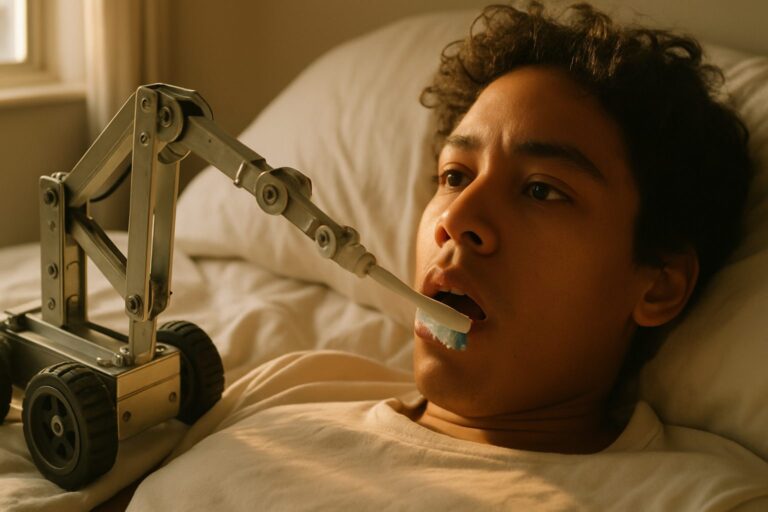
TL;DR: Hello Robot CEO Aaron Edsinger demonstrates Stretch 4 at TechCrunch Disrupt 2026, showcasing a deliberately unglamorous robot designed for genuine accessibility gains—feeding, grooming, environmental control—rather than viral moments. The sold-out first production run signals market validation for utilitarian robotics over humanoid theater.
The Operational Shift: Functionality Trumps Form Factor
While the robotics industry chases bipedal humanoids for headlines, Hello Robot is bringing Stretch 4 to the Real World AI Stage to demonstrate a radically different thesis: a wheeled platform with a single telescoping arm outperforms two-legged robots at tasks that matter to users with severe mobility impairments.
The metric shift is deliberate. Success isn’t measured in backflip videos. It’s measured in whether someone with quadriplegia can independently drink, adjust eyeglasses, or brush teeth—the unglamorous daily victories that define functional independence.
Design Philosophy: Constraint as Competitive Advantage
Stretch 4’s architecture reflects ruthless prioritization. No legs means lower center of gravity and stable operation in domestic spaces. One arm reduces complexity and cost while reaching most household surfaces. Compact wheeled chassis navigates corridors designed for human width. Sensor-dense contact sensitivity enables safe human-robot proximity.
These aren’t compromises. They’re optimizations for the actual problem space—cohabitation, not industrial warehouses or entertainment venues.
Market Validation: Sold Out Before Launch Clarity
The first production run sold out by June 2026, months after the May launch. This isn’t typical launch hype; it’s signal that operators—likely care facilities, occupational therapy clinics, and direct users—have already validated the value proposition.
For investors, the lesson is unambiguous: robots solving accessibility gaps generate pull-through demand regardless of aesthetic appeal. The addressable market for mobility-assistance robotics vastly exceeds the entertainment robotics segment.
Background: The Players and Platform
Hello Robot was founded by Aaron Edsinger and co-founder Srinivasa Narasimhan to bridge the gap between industrial robotics and household automation. The company’s thesis is that manipulator robots can become affordable, safe, and useful in unstructured domestic environments—a category largely abandoned by incumbent manufacturers focused on manufacturing and logistics.
Aaron Edsinger brings credibility from two previous exits to Google (Meka Robotics and Redwood Robotics, 2013). At Google, he directed robotics strategy across multiple hardware platforms, covering human-robot interaction design, real-time control architectures, and manipulation systems. His pattern is building for constraint-driven environments rather than idealized lab conditions.
TechCrunch Disrupt 2026 spans six industry stages with emphasis on “Real World AI”—a thematic shift away from pure language models toward embodied systems. The event attracts 10,000+ operators, VCs, and enterprise buyers. The Real World AI Stage specifically platforms robotics and hardware startups that claim practical deployment, not prototypes.
The Stretch product line launched as Stretch 1 with limited distribution; iterations have focused on sensor fidelity, software robustness, and cost reduction. Stretch 4 represents the first model with sufficient production capacity to address institutional demand at scale. The fact that initial allocation sold through before widespread awareness suggests suppressed demand in care and accessibility sectors.
Investment Implications: The Unglamorous Market Is Larger
Mobility assistance represents a $200B+ addressable market globally (aging populations, spinal cord injuries, MS, ALS, stroke recovery). This market has zero current robotic penetration below $500K per unit. Stretch 4’s price point (unconfirmed publicly but likely $50-150K based on component architecture) could address 5-10% of institutional care settings within five years.
Contrast this to humanoid robotics startups burning $100M+ to build $150K robots for undifferentiated tasks. Hello Robot’s path is narrower but defensible: solve a specific problem better than the alternative (human caregivers, static equipment) at a price that justifies purchase.
The Demo Reel Gamble: Live Execution at Disrupt
Bringing Stretch 4 to a live stage is a deliberate choice with execution risk. Unlike pre-recorded content, a live demo reveals real sensor latency, gripper precision, and recovery from unexpected states. For Edsinger, this signals confidence in reliability—or acceptable failure modes.
The session title—”Come, Meet Stretch. The Robot Built for Real Life, Not a Demo Reel”—is explicitly anti-hype. This framing suggests Hello Robot is competing on trustworthiness, not excitement. For a hardware company in a market that values long-term deployment reliability, that’s the right narrative.
What’s Next
Production constraints will be the limiting factor through 2027. If Hello Robot can scale manufacturing to 500+ units annually, institutional adoption will accelerate. Regulatory pathways for medical device classification may emerge, enabling insurance reimbursement in some markets.
The real test: can utilitarian robotics command venture capital’s attention when humanoids remain the narrative default? Edsinger’s Disrupt appearance is that statement—useful robotics deserve the stage.
About the Author