Real World AI Stage at TechCrunch Disrupt 2026: Physical AI’s Infrastructure Gap Takes Center Stage
TL;DR: TechCrunch Disrupt 2026 debuts a dedicated Real World AI Stage recognizing that autonomous hardware deployment—from robots to defense systems—requires fundamentally different solutions than digital AI. The conference spotlights the data, safety validation, and edge computing challenges blocking physical AI’s “ChatGPT moment.”
Physical AI Lacks Its Foundational Data Layer
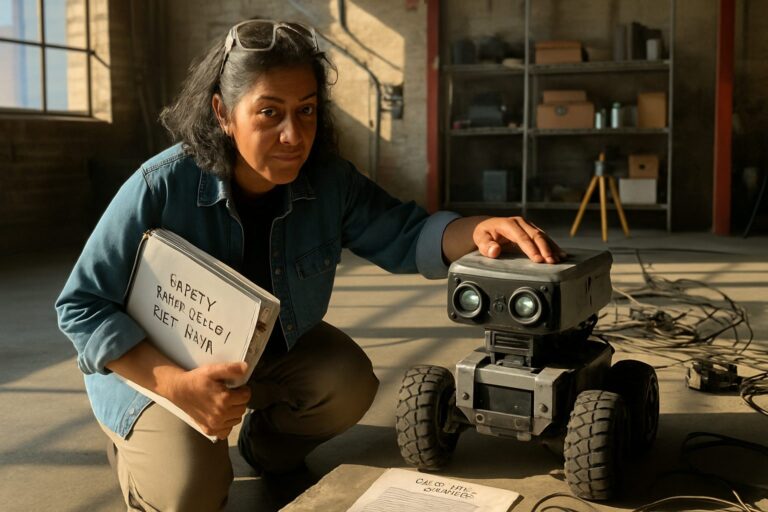
The gap between digital and physical AI infrastructure is now the explicit focus of enterprise investment conversations. Large language models scaled on internet-wide data; self-driving cars on millions of hours of road telemetry; general-purpose robots have neither. This data scarcity explains why breakthroughs in transformer architectures haven’t translated to consumer robotics despite seven years of hype.
TechCrunch’s expanded Disrupt programming now reflects this reality with a dedicated Real World AI Stage running October 13-15 at San Francisco’s Moscone West. Nvidia’s Head of Physical AI Les Karpas will keynote a session directly addressing what the robotics industry needs to replicate LLM-style capability explosions: standardized simulation environments, synthetic data pipelines, and foundational models trained on diverse manipulation tasks.
Safety Validation Becomes the Deployment Gatekeeper
Autonomous systems operating in physical space carry liability profiles that digital AI never faces. A vehicle crash or defense system failure creates immediate consequences—legal, financial, and human.
Shield AI’s CTO Nate Michael will lead sessions on safety culture, validation frameworks, and regulatory navigation. The operative question for investors: which validation methodologies will become industry standard before autonomous hardware enters public spaces? Companies that establish defensible testing protocols early will control market access.
Edge Deployment: Where Cloud Dependency Fails
The most economically valuable AI systems operate disconnected from cloud infrastructure. Defense platforms, space systems, and industrial robots cannot tolerate latency or rely on connectivity guarantees.
FieldAI’s Dr. Ali Agha and other edge-focused founders will discuss architectural trade-offs: model quantization, local inference, and graceful degradation under connectivity loss. This represents a fundamental shift from enterprise software’s cloud-centric paradigm.
De-Extinction as AI’s Most Visible Real-World Proof Case
Colossal Biosciences CEO Ben Lamm has built a billion-dollar company around synthetic biology and AI-driven genetic reconstruction. The woolly mammoth revival project functions as public-facing evidence that AI-driven engineering can manipulate physical reality at scale.
This positioning matters strategically: de-extinction demonstrates AI’s capability to optimize complex biological systems, potentially unlocking investor appetite for other biotech-AI hybrid ventures. However, Lamm’s appearance also signals the emerging tension between engineering solutions and preservation priorities—a narrative that will define public perception of physical AI deployment.
Industry Background: Key Players and Market Context
TechCrunch Disrupt has operated as the technology industry’s primary platform for announcing breakthroughs and raising capital since 2011. The decision to split AI programming into digital and physical tracks reflects investor consensus that autonomous hardware now warrants parity with software-based AI systems.
Nvidia positions itself as infrastructure layer for both categories. Les Karpas’s appointment as Head of Physical AI signals the company’s strategic pivot from GPU commodity supplier to robotics foundation model developer—directly competing with companies like Sanctuary AI and Figure AI.
Shield AI operates in autonomous defense systems, addressing a regulatory category (military/national security autonomous systems) where failure tolerance thresholds are explicitly quantified and proven through testing protocols. Their involvement legitimizes the safety validation discussions.
FieldAI and Medra represent the emerging edge-deployment specialist category: companies that have abandoned cloud-first architecture and built systems expecting intermittent or absent connectivity. This mirrors how mobile development evolved away from desktop-dependent frameworks.
Colossal Biosciences demonstrates AI’s application to biological systems engineering, a category attracting substantial venture capital despite (or because of) its controversial status. The company’s valuation validates investor appetite for AI-driven biology, even amid ethical debates.
Strategic Implications for Robotics Investors
The conference schedule signals market consensus on three technical bottlenecks:
- Data infrastructure for robot learning remains unsolved—startups addressing simulation, synthetic data generation, and federated robot fleets represent immediate investment targets
- Safety validation frameworks will determine which autonomous hardware companies reach production deployment; companies with early regulatory relationships (FAA, DARPA, DOD) hold advantages
- Edge computing competence separates viable deployments from cloud-dependent prototypes; this favors teams with embedded systems expertise over traditional software companies
The Real World AI Stage’s existence itself is the signal: physical AI deployment is no longer theoretical—it’s an infrastructure and validation problem. Companies solving these problems will control market access for the next 18-24 months.
Full speaker lineup and session details available on TechCrunch. Registration opens for October 13-15 Disrupt event.