Meta’s Data Center Robot Deployment: Labor Displacement Accelerates as AI Infrastructure Scales
TL;DR
Meta is quietly testing multiple robot platforms to automate data center labor—cable management, server resets, power cycling—with one estimate suggesting 80% task displacement. The initiative signals accelerating robotics adoption in infrastructure operations as AI training demands explode and skilled worker scarcity persists.
The Operational Shift
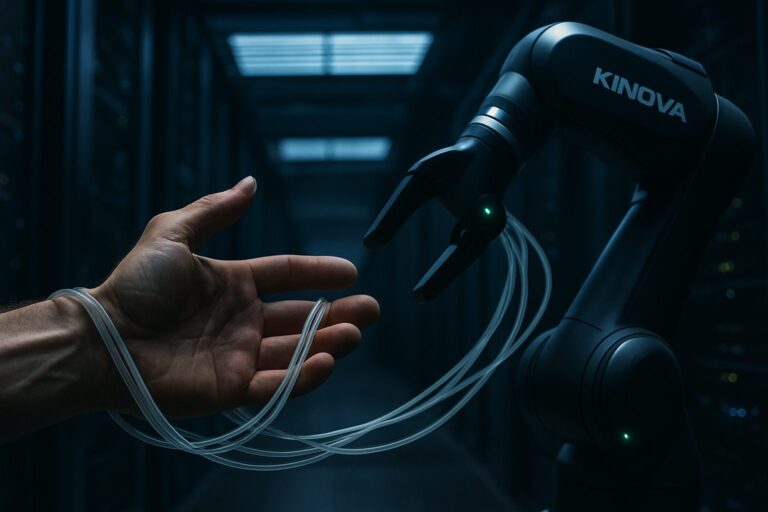
Meta’s unreported robotic experiments represent a critical inflection point for data center economics. According to Ars Technica’s investigation, the company is evaluating hardware from Watney Robotics, Kinova, and ABB for tasks previously requiring human technicians.
The financial calculus is straightforward: as Meta’s AI infrastructure spending accelerates, labor costs become a material liability. Robots offer consistent output at declining per-unit costs, particularly in rural data center clusters where qualified technician availability is constrained.
Current Deployment Status
Meta’s robotics portfolio spans three distinct capabilities:
- Kinova Gen3 robotic arms for power cycling and electricity management
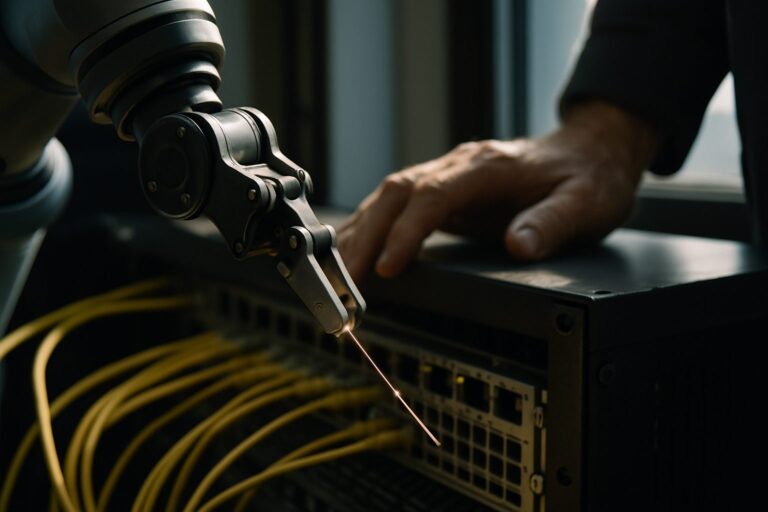
- Cable-swapping robots handling networking infrastructure—estimated to replace up to 80% of some technician workloads
- Finger-like automation that remotely presses power buttons on Mac Minis and comparable devices for server restarts
One anonymized Meta data center worker told Ars Technica: “We thought those of us performing the physical tasks were safe for a while, but not anymore.” This candid assessment captures the speed of transition.
Technical and Market Context
Hardware constraints that previously limited data center robotics have evaporated. Cost barriers have collapsed, and AI model improvements have solved precision-and-dexterity problems that caused earlier systems to crush equipment.
The addressable market is substantial. Data centers require constant preventative maintenance, incident response, and environmental monitoring—all labor-intensive, repetitive tasks ideal for robotic automation. Industry analysts note similar pressures across hyperscalers seeking to optimize capex-to-performance ratios.
Meta’s Public Messaging vs. Reality
Meta spokesperson Francis Brennan stated that the company is “investing heavily in training and hiring workers” and needs “more workers, not fewer.” This aligns with the stated infrastructure boom narrative.
However, Eric Xu, Meta’s senior robotics manager, outlined different long-term ambitions at a recent conference: robots for incident response acceleration, environmental monitoring, and preventative maintenance. The implicit endpoint is human labor elimination from routine operations.
Broader Industry Implications
Multiple vendors are developing commercial-grade data center robotics. Analog Devices’ Paul Golding noted that customers increasingly request humanoid robot deployments because they tolerate higher temperatures, darkness, and inhospitable environments—conditions incompatible with human workers.
This opens a pathway for underwater data centers, space-based infrastructure, and other extreme-environment deployments. The elimination of human operational requirements fundamentally changes data center site selection and design parameters.
Investment Signals
Meta’s deployment velocity suggests robotics vendors have crossed the performance/cost threshold for commercial viability. Investors should monitor:
- Automation adoption rates across other hyperscalers (AWS, Google, Microsoft, OpenAI)
- Venture funding in physical intelligence and data center robotics sectors
- Downstream labor market impacts and potential regulatory responses
- Equipment reliability metrics and failure modes in production environments
This is not a theoretical future state. Meta’s testing phase will likely conclude within 18-24 months, followed by deployment scaling. Competing infrastructure operators face pressure to adopt equivalent systems or accept rising per-unit operational costs as labor markets tighten.