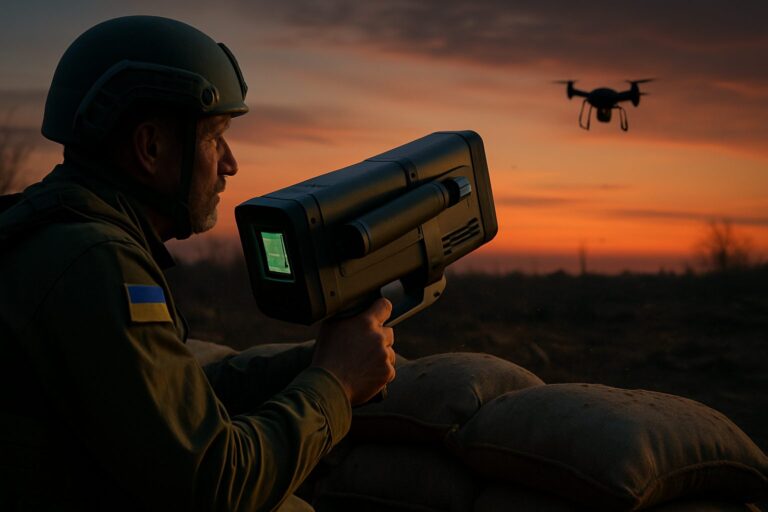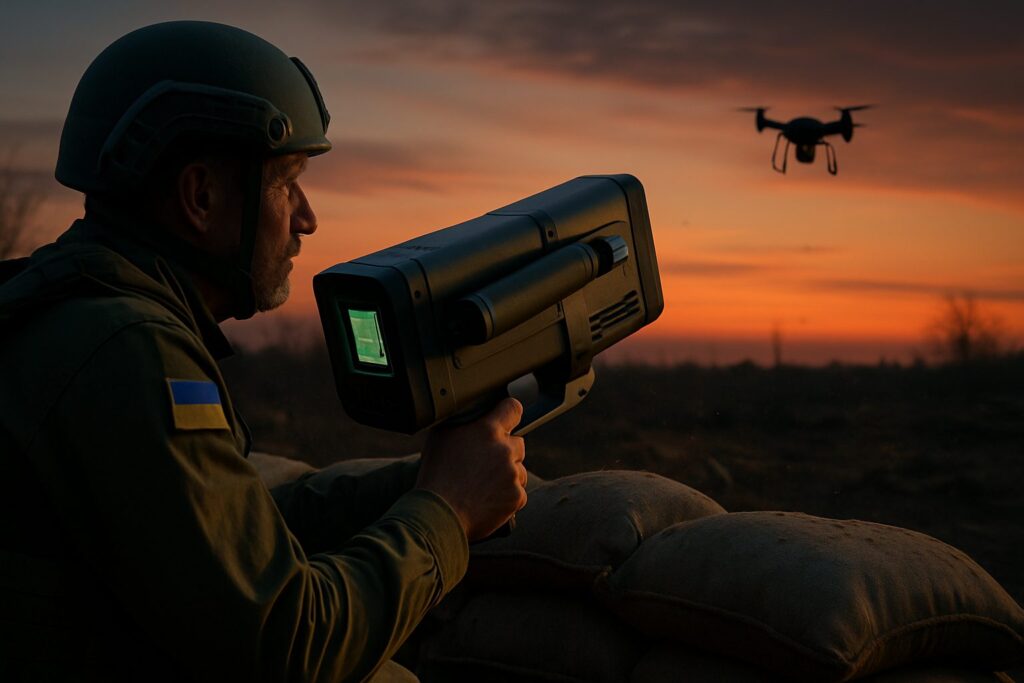
Mara Raises $7M for Portable Counter-Drone System as FPV Swarms Reshape Defense Economics
TL;DR: San Francisco defense startup Mara closed a $7M Series A led by Khosla Ventures to deploy Spike, a distributed counter-drone system using 250g kinetic interceptors. The platform scales from rucksack-portable to base perimeter defense, targeting the asymmetric threat of cheap FPV attack drones proliferating in Ukraine.
The Funding Play: Distributed Defense Wins Capital
Mara’s funding signals investor confidence in distributed defensive architecture over centralized point solutions. CEO Daniel Kofman’s thesis directly addresses the operational problem: FPV drones democratized precision strike, but counter-measures remained expensive and concentrated. This funding validates that modular, scalable interception systems attract serious defense capital.
Khosla Ventures’ lead position indicates venture conviction in defense tech beyond traditional aerospace incumbents. The $7M runway funds production-ready deployment—Mara has already conducted field trials with US Army exercises and Ukrainian frontline operations.
Technical Architecture: Seeker and Spotter Decoupled
Spike comprises two discrete systems. Spotter units fuse electro-optical, acoustic, and optional low-signature radar for all-weather detection and tracking. Seeker interceptors—250g, tube-launched, traveling at 200 kmph—carry onboard guidance intelligence to autonomously track targets once cued.
A single launcher mounts 48 Seekers with sub-60-second reload capability. This modularity enables deployment from individual rucksacks (squad-level) to vehicle mounts to multi-kilometer base perimeters. The system integrates with existing US Army command systems, reducing integration friction.
Operational Scalability Without Central Coordination
Mara frames Spike as a “distributed mesh” where each node independently targets and fires in multiple directions. This architecture eliminates single points of failure and scales horizontally rather than vertically—a critical advantage against swarm tactics where adversaries coordinate dozens of FPV drones simultaneously.
The Ukraine Validation Factor
Ukrainian forces have operated Spotter near the frontline, tracking multiple FPV drones in real combat conditions. This isn’t simulation or controlled exercise—it’s proof-of-concept under actual adversarial pressure. Ukraine’s drone casualty problem created urgency that traditional procurement cycles cannot match.
Mara’s early-stage engagements span UK, Czech Republic, and Ukraine defense ministries. This geopolitical diversity hedges against single-nation procurement decisions and signals allied interest in counter-FPV capabilities.
Background: The FPV Drone Problem Reshapes Battlefield Economics
FPV Drones as Asymmetric Threat: First-person view quadcopters equipped with explosive payloads cost $300–$1,000 per unit and can be mass-produced by non-state actors. In Ukraine, they’ve inflicted disproportionate casualties against armor and personnel, creating a cost-asymmetry problem: a $500 drone kills or disables a $3M tank or $500K+ soldier-equipped kit. Traditional air defense (Patriot systems, Avenger platforms) are overkill and economically untenable for distributed defense.
Mara’s Market Position: Founded by defense technologists, Mara identified the gap between expensive centralized systems and cheap distributed threats. The company has positioned itself as the “cost-effective counter” to FPV swarms—pricing and performance details remain undisclosed, but the funding round suggests commercial viability.
Defense Procurement Acceleration: Traditional defense contracting cycles run 18–36 months. Ukraine’s immediate operational need compressed timelines. Mara’s field trials with US Army and live-fire integration with Ukrainian forces bypass bureaucratic delays, creating first-mover advantage in a newly urgent market segment.
Competitive Landscape: Other counter-drone systems exist (Dedrone, Fortem, AeroVironment), but most focus on detection or jamming rather than kinetic interception. Spike’s kinetic approach—physically destroying drones rather than disabling them—appeals to military operators seeking guaranteed neutralization without reliance on electronic countermeasures vulnerable to adaptive adversaries.
What Remains Unclear
Mara declined to disclose exact Seeker interception range or per-unit cost. These metrics are critical for operators evaluating coverage density and ammunition supply chains. The Register signaled intent to follow up—forthcoming specifics will determine whether “cost-effective” means $1K or $5K per interceptor.
Integration complexity with non-US systems remains untested. UK, Czech, and Ukrainian forces operate different command architectures; Mara’s Army system compatibility doesn’t guarantee allied interoperability.
Investment Implications
This round validates a broader thesis: military robotics and autonomous systems attract venture capital when combat validation exists. Ukraine serves as a live testbed for defense startups, compressing product-market fit timelines. Operators willing to field unproven systems under pressure accelerate feedback loops that traditional procurement cannot match.
Khosla Ventures’ involvement signals sector-wide recognition that drone swarms represent a permanent battlefield feature, not a temporary tactical novelty. Counter-drone economics—per-unit cost, engagement rate, ammunition density—will define 2026–2028 defense spending priorities.
- Stock ticker relevance: Aerospace incumbents (RTX, LMT, NOC) should monitor Mara’s traction; distributed kinetic interception undercuts margins on large integrated air defense systems.
- Venture pattern: Expect follow-on funding for competing counter-drone startups in next 12 months; market validation attracts capital concentration.
- Procurement timeline: NATO countries will likely fast-track counter-FPV procurement in 2026 budget cycles, creating $2B+ addressable market.