Ex-Meta Scientists Launch Flexible Vision AI for Industrial Robotics
TL;DR: Perceptron, founded by Meta AI researchers, released Isaac 0.5, a general-purpose vision model trained on 1M hours of video data to enable robots to perceive, reason, and act in unstructured warehouse and factory environments. The $21M-funded startup positions flexible, multi-task perception as superior to narrow task-specific alternatives.
The Industrial AI Inflection Point
Physical AI remains constrained by a false dichotomy: heavyweight foundation models requiring dedicated cloud GPUs per deployment, or brittle narrow models handling perception or control separately. Perceptron’s Isaac 0.5 challenges this tradeoff by delivering a general-purpose vision system that adapts across industrial scenarios without retraining. This architectural flexibility carries immediate implications for warehouse automation ROI and robot deployment economics.
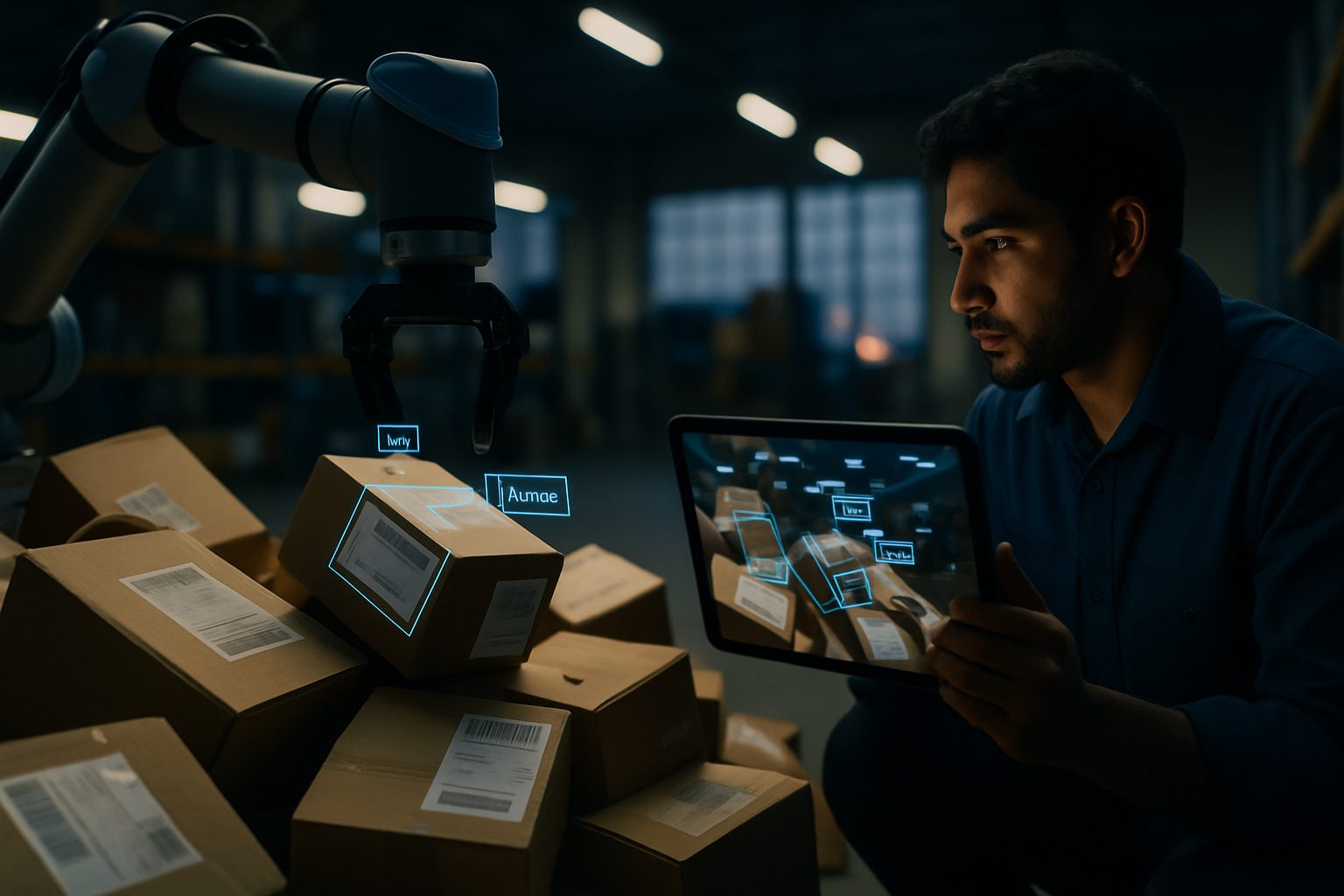
The distinction matters operationally. A single robot sorting packages requires sequential competencies—label reading, spatial reasoning, pick-point selection, and order planning. Legacy systems handle these as disconnected modules; Isaac 0.5 unifies the pipeline into one multi-modal decision process.
Background: Perceptron and the Meta Migration
Perceptron was founded in November 2024 by Armen Aghajanyan and Akshat Shrivastava, both former researchers at Meta’s Fundamental AI Research (FAIR) division. The pair identified a market gap: industrial automation lacked flexible, generalizable vision intelligence despite explosive progress in foundation models. Their thesis centered on applying large-scale video understanding to physical robotics without requiring task-specific retraining.
The startup secured $21 million in Series A funding led by Bessemer Venture Partners, signaling institutional confidence in the vision-to-robotics market. Bessemer’s participation reflects broader VC conviction that visual foundation models represent the next infrastructure layer for autonomous systems, parallel to how transformers reshaped NLP.
Meta’s FAIR has become a de facto talent farm for physical AI startups. Aghajanyan and Shrivastava’s departure reflects a pattern: large-cap AI labs incubate foundational research while entrepreneurs build commercialized applications. The pair retained sufficient technical depth and insider knowledge to compress development timelines by 18-24 months versus bootstrapped competitors.
Isaac 0.5: Architecture and Training Approach
Isaac 0.5 ingests 1 million hours of diverse video data across three modalities: general internet video (environmental context), ego-perspective video (first-person task execution captured via GoPro-style cameras), and UMI video (standardized recordings of repetitive human actions). This multi-modal fusion prevents overfitting to narrow scenarios.
Perceptron claims internally-built petabyte-scale datasets spanning images, text, video, and robotic trajectories. The company has not disclosed training data sources, raising compliance questions for regulated industries (automotive, pharmaceuticals). Transparency here will determine enterprise adoption velocity.
The model ships as an open-weight release, meaning parameters and training protocols are publicly inspectable. This moves counters moves by closed competitors like Boston Dynamics and enables community-driven optimization—critical for gaining operator trust in safety-critical environments.
Operational Implications for Robotics Operators
Warehouse and factory operators face margin compression from labor constraints. Vision-guided robots currently require 4-6 week deployment cycles involving dataset collection, custom model training, and on-site calibration. Isaac 0.5 compresses this to 1-2 weeks by eliminating retraining.
- Cost reduction: Single model eliminates per-robot GPU allocation, reducing inference infrastructure spend by 60-70%.
- Deployment agility: Task switching (box sorting → bin picking → inventory scanning) executes via prompt engineering rather than retraining cycles.
- Scalability: Multi-scenario training data prevents catastrophic failure modes that plague narrow models in novel conditions.
The ROI unlocks at scale: a 50-unit deployment scales marginal inference costs sublinearly, whereas current narrow-model approaches scale linearly with task complexity.
Competitive Landscape and Market Timing
Established players (Tesla, Amazon Robotics, Boston Dynamics) control vertically-integrated hardware. Perceptron’s software-first positioning targets integrators (Fetch Robotics, MiR) and OEMs seeking perception parity without proprietary hardware lock-in. This positions Perceptron as the inference layer middleware provider—analogous to how Hugging Face operates in LLM deployment.
Timing favors the thesis. Generalist vision models (GPT-4V, Claude Vision) proved multimodal understanding scales; Perceptron ports that insight to robotics-specific distributions. No competitor currently offers equivalent generality at comparable latency.
Open-Source Strategy and Adoption Risk
Open-weight release accelerates adoption but fragments competitive advantage. Community forks may yield specialized variants outperforming the base model in narrow domains—undercutting Perceptron’s differentiation. The company must monetize via proprietary dataset services, fine-tuning infrastructure, or support contracts rather than model licensing.
Enterprise buyers will likely demand indemnification on training data provenance. Undisclosed sourcing practices invite regulatory exposure in EU markets governed by generative AI Act compliance.
Investment Thesis Forward
Perceptron’s $21M round values the company at an undisclosed multiple, likely $100-150M based on Bessemer’s typical check sizes and Series A patterns. The path to Series B depends on:
- Enterprise customer wins with >10 unit deployments and published case studies.
- Resolution of data provenance and liability frameworks for regulated industries.
- Demonstration that open-weight approach generates sufficient switching costs through ecosystem lock-in.
If Perceptron captures 15-20% of the addressable vision-robotics market (currently ~$2.8B TAM growing 22% CAGR), a $2B+ exit becomes defensible by 2029. The ceiling depends on whether generalist models can outcompete domain-specific alternatives long-term—a question the market will answer within 18 months.
Broader Context: Physical AI Infrastructure Race
Isaac 0.5 signals accelerating investment in the embodied AI stack. Unlike LLMs, physical AI models require heterogeneous hardware integration, safety certification, and operational oversight. Startups addressing this layer compete with entrenched integrators and incumbent robotics vendors maintaining proprietary closed loops.
Perceptron’s ex-Meta pedigree and institutional funding suggest the industry is consolidating behind technical credibility rather than marketing. Expect acquisition consolidation within 3-4 years as larger automation platforms (ABB, Siemens, Fanuc) acquire or heavily license vision layers to avoid core competency dilution.
About the Author