TL;DR:
* The Terafab Alliance: Intel has officially joined Elon Musk’s “Terafab” initiative, a massive AI chip complex designed to power the next generation of Tesla’s Optimus robots and SpaceX’s Starlink satellites.
* The 1-Terawatt Goal: The collaboration aims to build a Texas-based facility capable of producing one terawatt of computing power annually, a scale previously thought impossible for a single site.
* Intel’s Pivot: For Intel, this isn’t just a partnership; it’s a desperate bid to reclaim its dominance in the silicon race by anchoring itself to the world’s most ambitious “Physical AI” project.
The announcement that Intel is joining forces with Elon Musk’s Terafab project marks a tectonic shift in the global semiconductor landscape. While the industry has been focused on cloud-based LLMs, Musk is building a vertically integrated empire for “Physical AI”—the intelligence that drives robots and spacecraft. By bringing Intel into the fold, Musk is securing a domestic supply chain for the custom silicon required to make the Optimus humanoid robot a mass-market reality. For Intel, this alliance offers a lifeline: a chance to prove its foundry services can compete with TSMC on the most demanding chips ever designed.
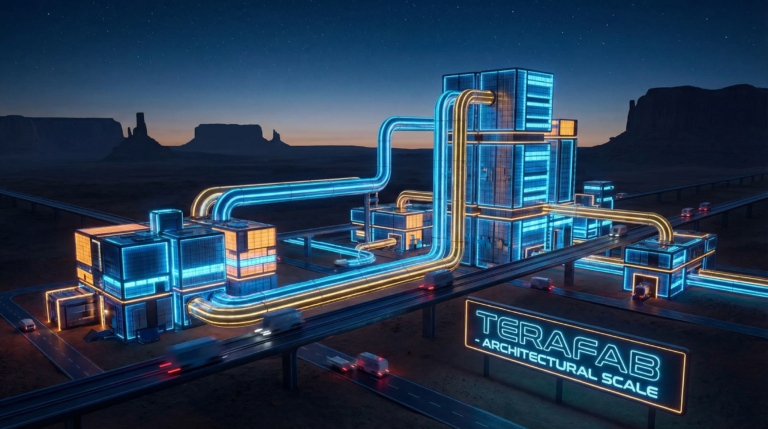
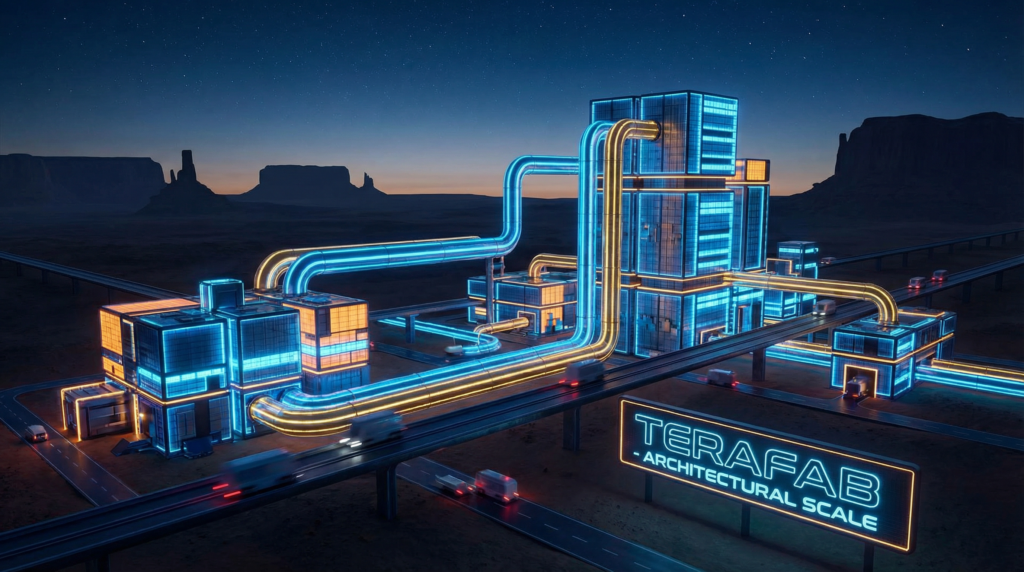
However, the “Terafab” is more than just a factory; it is a conceptual prototype for the future of industrial compute. The goal of producing one terawatt of computing power per year at a single site in Texas is a feat of engineering that defies traditional scaling laws. This isn’t about incremental gains in transistor density; it’s about a radical rethinking of how energy, cooling, and data transfer are handled at a planetary scale. If successful, the Terafab will become the beating heart of the autonomous world, providing the “brains” for millions of robots that will eventually replace human labor in dangerous or repetitive tasks.
The geopolitical subtext of this partnership cannot be ignored. As the US-China tech rivalry intensifies, the Terafab represents a massive “onshoring” of critical AI infrastructure. By bypassing the traditional global supply chain and building a sovereign compute engine in the heart of Texas, the Intel-Musk alliance is creating a fortress of American technological power. The question remains whether Intel can keep up with Musk’s breakneck pace of iteration, or if the sheer scale of the Terafab will overwhelm the legacy chipmaker’s ability to adapt.
Background: Intel, Tesla, and the Terafab Initiative
Intel Corporation, once the undisputed king of silicon, has spent the last decade struggling to transition from the PC era to the mobile and AI eras. Under CEO Pat Gelsinger, the company has launched “IDM 2.0,” a strategy to open its factories to outside customers. The Terafab project is the ultimate test of this strategy. Intel brings decades of manufacturing expertise, but it must now prove it can execute on Musk’s “first principles” approach to engineering, which often involves discarding established industry norms in favor of radical efficiency.
Tesla and SpaceX, the other two pillars of the Terafab, provide the demand. Tesla’s Optimus Gen 3 is expected to enter mass production by late 2026, requiring millions of high-performance AI chips. SpaceX’s Starlink constellation is also evolving, with new satellites requiring onboard AI for autonomous collision avoidance and data routing. The Terafab is the convergence point for these needs, a “mega-foundry” that treats compute as a raw utility, much like electricity or water, essential for the functioning of a modern, autonomous civilization.