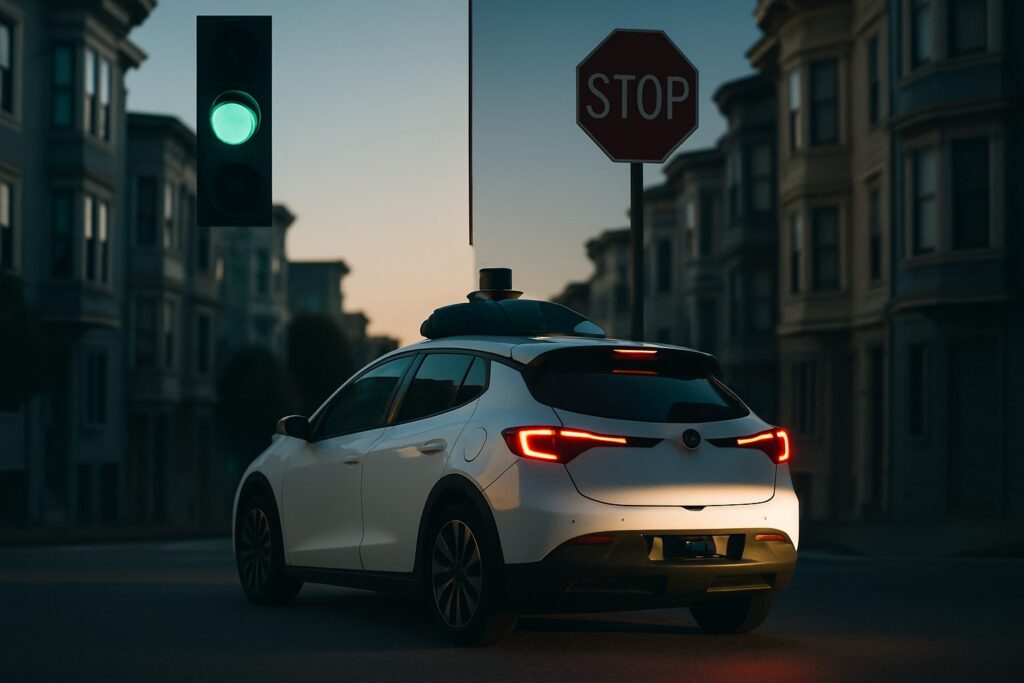
Federal Push Meets Local Resistance: Robotaxi Industry at Regulatory Crossroads
TL;DR: The National Highway Traffic Safety Administration fast-tracked Zoox’s commercial robotaxi launch while California lawmakers escalate safety scrutiny over autonomous vehicle interactions with emergency responders, creating divergent regulatory pressures that will reshape industry deployment timelines.
Regulatory Whiplash: Acceleration and Braking Collide
The autonomous vehicle industry faces contradictory regulatory momentum that could fragment deployment strategies across jurisdictions. Federal regulators are removing barriers while state and local officials are erecting them, forcing robotaxi operators to navigate fundamentally different playbooks.
NHTSA’s exemption for Zoox removes a critical bottleneck. The agency granted temporary relief from eight federal motor vehicle safety standards, clearing the path for paid rides in Las Vegas. This represents the final major federal hurdle Zoox needed to clear before commercial operations.
Conversely, California is tightening the screws. After Waymo robotaxis stalled during July 4 traffic and drained batteries while blocking key San Francisco streets, Mayor Daniel Lurie demanded enhanced state regulations. Rep. Kevin Mullin simultaneously introduced federal legislation mandating minimum safety standards for emergency responder interactions.
The Zoox Inflection Point
Zoox’s temporary exemption is operationally significant—the company confirmed paid rides are imminent, starting in Las Vegas. This compressed timeline suggests federal regulators prioritize scaling over prescriptive safety mandates.
Emergency Response: The Emerging Liability
Incidents where autonomous vehicles interfere with emergency responders are becoming regulatory poison. The convergence of San Francisco’s mayor, state regulators, and federal lawmakers around emergency response protocols suggests this will become a compliance requirement that robotaxi operators cannot ignore.
Background: Key Players and Context
Zoox is an Amazon-owned autonomous vehicle company that has custom-built a robotaxi platform. The company has been operating in pilot phases but lacked federal approval to charge passengers. The NHTSA exemption removes this constraint, allowing commercial services to begin without meeting eight specific safety standards—a regulatory gap that will likely require Zoox to demonstrate superior safety performance to survive inevitable congressional scrutiny.
Waymo operates robotaxis across San Francisco, Phoenix, and other markets but has faced mounting criticism over operational failures, particularly during peak traffic events. The July 4 incident exposed operational vulnerabilities: vehicles running out of power in congested conditions creates cascading problems for traffic management and emergency response, turning autonomous vehicles from a convenience into an infrastructure liability.
The National Highway Traffic Safety Administration is operating in deregulatory mode, viewing exemptions and streamlined approval processes as mechanisms to accelerate technology deployment. NHTSA’s strategy assumes market competition and real-world performance data will generate safety improvements faster than prescriptive rules.
California state regulators and San Francisco city officials operate under a different assumption: autonomous vehicles deployed at scale without robust emergency response protocols create systemic risks that markets won’t self-correct. This jurisdictional tension reflects deeper disagreements about regulatory philosophy—federal speed versus local safety.
Strategic Implications for the Industry
Geography matters enormously now. Operators receiving federal exemptions can launch in permissive jurisdictions (Las Vegas, Phoenix) while facing restrictions in California. This creates a two-tier deployment model where companies optimize for regulatory arbitrage rather than uniform safety standards.
The emergency responder issue is systematically underestimated. Unlike accident liability or collision avoidance, emergency response interference touches firefighting, ambulance dispatch, and police operations—constituencies with direct political power. Mullin’s bill signals this will become a mandatory standard rather than a best practice.
Capital and Timeline Acceleration
Zoox’s path to paid rides accelerates venture return timelines. Waymo and competitors now face pressure to prove emergency response compliance or accept geographic restrictions. This bifurcation favors operators with federal relationships (Zoox/Amazon) over those dependent on municipal tolerance (Waymo/Alphabet).
What’s Next: Monitoring Points
- Mullin’s bill trajectory—whether it gains bipartisan support will determine if emergency response standards become mandatory federally or remain state-level
- Zoox’s Las Vegas launch performance—early operational data will either validate NHTSA’s exemption strategy or fuel calls for stronger standards
- Waymo’s compliance moves—watch for engineering changes to emergency response protocols as California tightens rules
- Regulatory arbitrage patterns—which states/cities become robotaxi havens versus which remain restrictive
The industry is fragmenting into federal-friendly and local-resistant zones. Companies optimized for California deployment face structural disadvantages. Those willing to launch in permissive jurisdictions first gain operational data and revenue, creating momentum for federal deregulation. The next 12 months will reveal whether federal speed overwhelms local resistance or vice versa.