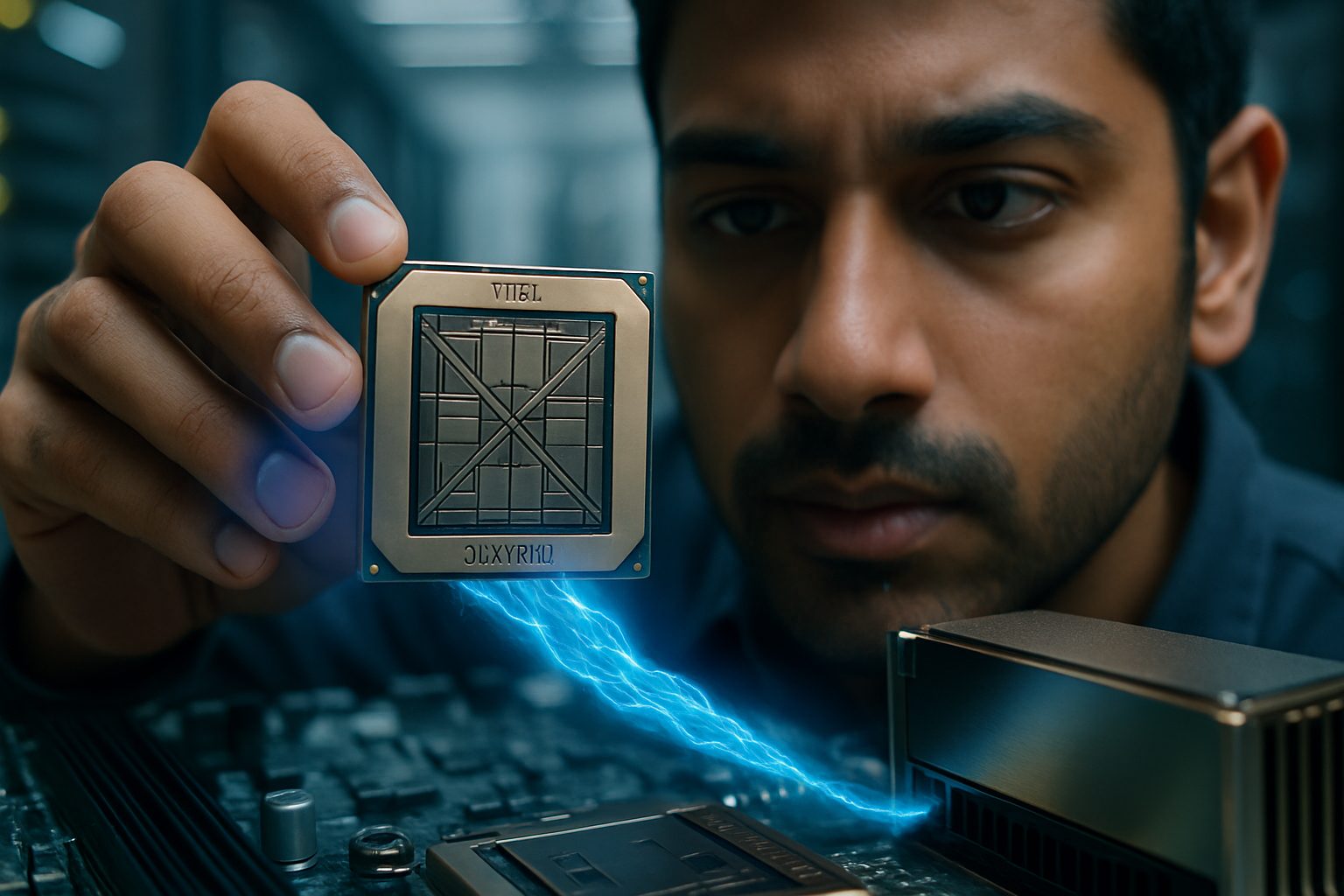
Nvidia’s Vera CPU: Breaking the x86 Stranglehold with Custom Olympus Cores
TL;DR: Nvidia’s Vera CPU features 88 custom Olympus cores delivering 1.8 TB/s NVLink bandwidth and 1.5 TB memory support, directly challenging Intel and AMD dominance. The monolithic compute design targets AI agent hosting and hyperscaler infrastructure, with major cloud providers already committed to deployment.
Why This Matters for Infrastructure Operators
Vera represents Nvidia’s first direct assault on CPU procurement cycles. For cloud operators, this means CPU-GPU co-optimization without vendor fragmentation—a significant operational advantage when managing AI workloads at scale. CoreWeave, Lambda, and other AI infrastructure providers have already locked in deployments, signaling confidence in the architecture’s viability.
The dual-socket Vera Superchip configuration delivers 176 cores with 1.8 TB/s inter-chip NVLink bandwidth, outpacing AMD’s Turin Epycs on memory throughput. For agentic AI workloads specifically, this eliminates CPU-GPU bottlenecks that plague distributed inference systems.
Background: The Stakes in CPU Design
Intel and AMD have dominated datacenter CPU markets for decades, leveraging x86 architecture’s software ecosystem and incremental performance gains. Nvidia’s Grace CPU series, launched in 2024, proved the company could manufacture viable Arm-based processors. However, Grace remained GPU-adjacent—designed primarily as a companion chip for GPU clusters.
Vera escalates this position fundamentally. Unlike Grace, Vera operates as a standalone platform, capable of managing entire AI infrastructure independent of Nvidia GPUs. The whitepaper released in July 2026 revealed previously undisclosed architectural details that challenge conventional CPU design wisdom.
Eight major hyperscalers—Alibaba, ByteDance, Meta, Oracle, CoreWeave, Lambda, Nebius, and NScale—have committed to deployment, suggesting the industry is ready to fragment the traditional Intel-AMD duopoly. This represents the most credible CPU challenge since AMD’s EPYC launch in 2017.
Vera’s Architecture: Monolithic Compute, Disaggregated Everything Else
The Olympus Core Design Philosophy
Vera bucks the chiplet trend popularized by AMD and Intel. All 88 cores sit on a single monolithic die fabbed at TSMC 3nm, delivering superior core-to-core latency and bandwidth compared to multi-die competitors. This design choice optimizes for the low-latency synchronization requirements of agentic AI workloads, where coordination overhead kills throughput.
Each Olympus core implements Armv9.2 instruction set extensions, supporting 176 threads across the single socket. According to The Register’s technical analysis, this represents Nvidia’s first fully-custom CPU core design, departing from Arm’s reference designs used in Grace.
Memory and I/O Disaggregation
While compute remains monolithic, I/O and memory are split across dedicated chiplets. Eight LPDDR5X controllers provide support for up to 1.5 TB of memory per socket, with 2.4 TB/s aggregate bandwidth in dual-socket configuration. This mirrors Amazon’s Graviton 4 approach but optimizes specifically for GPU-heavy workloads.
Two distinct I/O dies handle PCIe 6.4, CXL 3.1, and proprietary NVLink Chip-to-Chip connectivity separately, preventing I/O congestion from impacting core performance. The 1.8 TB/s bidirectional NVLink-C2C bandwidth between sockets is 2.5x higher than conventional CPU socket interconnects.
The Vera Superchip: 176 Cores, 3 TB Memory, One Liquid-Cooled Package
Nvidia’s dual-socket Vera Superchip configuration, unveiled at GTC in March 2026, pairs two CPUs connected via NVLink-C2C for 176 total cores and 352 threads. The superchip accepts 16 SOCAMM2 LPDDR5X modules, delivering 2.4 TB/s memory bandwidth—double that of AMD’s 2024 Turin EPYC lineup.
Reference architectures call for 128 superchips per liquid-cooled rack: 22,528 cores and 384 TB aggregate memory. This density is optimized for agentic AI deployments where CPU-to-memory ratio matters more than CPU-to-GPU ratios in traditional large language model inference.
Two Distinct Workload Targets: GPU Management and Agentic AI
GPU Cluster Orchestration
Vera’s primary role in Nvidia’s ecosystem is as the control plane CPU for upcoming Vera Rubin GPU systems. This consolidates infrastructure management, eliminating the need for separate CPU and GPU procurement from different vendors. Hyperscalers gain direct control over CPU-GPU synchronization latency and memory coherency.
Agentic AI Hosting: The Contentious Use Case
More strategically important is Vera’s positioning as a native host for AI agents—autonomous systems that don’t execute on GPUs but require high-throughput reasoning and decision-making. The Register notes this focus is “contentious” because it directly threatens traditional CPU vendors’ enterprise accounts.
Agentic workloads are inherently different from LLM inference: they demand low-latency branching logic, frequent context switching, and variable memory access patterns that favor cache efficiency. Vera’s monolithic core design and Olympus architecture specifically optimize for these characteristics, rather than the dense linear algebra that dominates GPU-accelerated compute.
Strategic Implications: Breaking the CPU Monopoly
Vera’s success threatens Intel and AMD’s core business model. By controlling both CPU and GPU design, Nvidia eliminates the neutral CPU vendor role in AI infrastructure. Hyperscalers must now choose between Nvidia’s integrated solution or splitting procurement across competitors.
Intel’s Xeon and AMD’s EPYC lines have benefited from vendor-agnostic positioning for two decades. Vera erodes that advantage by offering CPU-GPU co-optimization that split procurement cannot match. The eight-company deployment commitment signals hyperscalers accept this trade-off for performance and latency gains.
For ARM ecosystem players, Vera’s success validates custom core design on Arm ISA outside of the traditional smartphone-to-cloud pipeline. If Vera gains traction, expect AMD and Intel to accelerate ARM exploration, fragmenting the x86 ecosystem further.
What Investors Should Monitor
Watch hyperscaler capital allocation shifts. If Meta, ByteDance, and Oracle deploy Vera at scale, CPU spending growth in IT budgets effectively redirects to Nvidia. This could compress Intel’s data center gross margins by 200-300 basis points within two years.
Monitor Vera’s agentic AI adoption rates closely. If autonomous agent workloads scale faster than LLM inference (as some analysts predict), CPU-optimized architectures could command pricing premiums over GPU commoditization. This extends Nvidia’s ASP growth runway beyond GPU saturation points.
About the Author