Northrop’s Orbital Robotics Shift Reframes Satellite Economics as Life-Extension Business
TL;DR: Northrop Grumman’s new Mission Robotic Vehicle with DARPA-developed robotic arms is replacing simpler docking spacecraft, enabling permanent satellite upgrades that extend asset life 6+ years—a model that works only for expensive geostationary assets while mega-constellations rely on disposability.
The Operational Pivot: From Temporary Docking to Permanent Modules
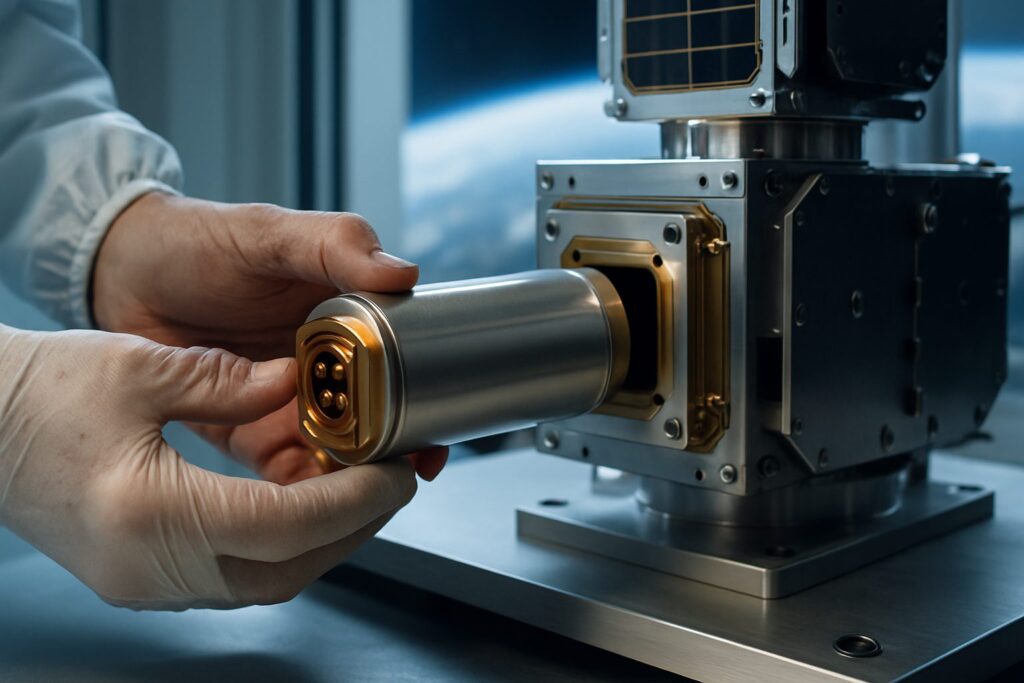
The economics of satellite operations just shifted. Northrop Grumman’s new approach separates the servicing robot from the life-extension payload, allowing one expensive robotic vehicle (MRV) to dock multiple cheaper propulsion pods (MEPs) across different satellites. This liquifies capital: operators buy and own the MEPs permanently; Northrop reuses the MRV across 10+ customers.
For satellite operators, the math is compelling. The Optus satellite, launched in 2009 and designed for 15 years, gains six additional revenue-generating years. That’s 40% operational extension at a fraction of replacement cost.
Docking at 27,000 Miles: The Technical Moat
Autonomously maneuvering and docking two objects traveling at thousands of miles per hour remains exceptionally difficult. The MRV’s dual robotic arms must precisely attach MEP pods to satellites never designed for in-orbit servicing—a capability Northrop developed with DARPA funding.
The MRV itself is refuelable in orbit, a proof-of-concept for future satellite infrastructure standards. Most operators haven’t added docking provisions to their designs yet, citing cost and weight penalties, but this will change if in-orbit servicing becomes routine.
Market Context: When Extension Economics Work
The Existing Fleet: Early Proof Points
Two MEVs launched in 2019-2020 have already extended three customers’ missions by 10 cumulative years. MEV-1 waits for new assignments; MEV-2 remains docked to an Intelsat satellite through 2030. These earlier vehicles use a simpler probe-and-thruster-nozzle design—effective but single-use per satellite.
Why Geostationary Assets, Not Constellations
The extension model targets expensive, large geostationary satellites ($500M–$2B deployed costs). Starlink and Amazon’s LEO mega-constellations intentionally embrace disposability: launch costs ($2K–$5K per kilogram) now favor flying numerous cheap units over maintaining expensive ones.
Geostationary satellites, positioned 22,000+ miles up, justify servicing economics precisely because replacement costs and launch delays create acute operational risk. LEO operators can tolerate unit loss; GEO operators cannot.
Northrop’s Evolving Business Model
Northrop Grumman positions satellite servicing as a platform business. Earlier MEV contracts tied Northrop’s capital to individual satellites for years. The MRV model separates capital allocation: operators buy permanent MEP modules; Northrop scales the MRV across a growing customer base.
This mirrors aerospace repair economics: Southwest Airlines owns maintenance hangers; Boeing sells spare parts to multiple carriers. Northrop is building analogous modularity in orbit.
What Investors Should Watch
Technology Adoption Risk: Current satellite designs lack docking interfaces. Widespread adoption requires either retrofitting existing fleets (expensive, mission-critical logistics) or waiting for new-build satellites with servicing-ready architecture. Northrop’s long-term revenue depends on either outcome materializing.
Competitor Pressure: SpaceX and other launch providers could enter servicing directly. Axiom Space is building orbital infrastructure; Effective Space has developed berthing technology. The MRV’s robotic arm capability is defensible short-term but not permanent moat-grade.
Regulatory Clarity: In-orbit refueling and permanent fixture attachment require advanced FAA/FCC coordination. Current space debris standards don’t account for satellite-attached pods remaining in orbit 6+ years post-service. Regulatory approval delays could compress near-term addressable market.
Addressable Market Scale: Roughly 400 active geostationary satellites exist; ~60% are candidates for extension (age 10–18 years, operators with available capital). At $50M–$150M per extension contract, serviceable market is $12B–$36B over 10 years—material, but not transformative for a defense prime.
The Sustainability Narrative vs. Economic Reality
Northrop frames this as enabling “sustainable space” infrastructure. Technically accurate: extending satellite life reduces launch cadence and debris risk. Economically accurate: only for assets where replacement carries extreme cost or schedule penalty.
The LEO mega-constellation model—cheap, replaceable, frequent launch—may be more efficient for many applications despite apparent wastefulness. Extension economics work when satellite acquisition cost exceeds 10x annual operational value. That threshold is narrowing as launch costs fall.
Northrop’s success hinges on geostationary satellite operators choosing life extension over gradual constellation migration—a bet increasingly contingent on launch price stagnation, not technological superiority.