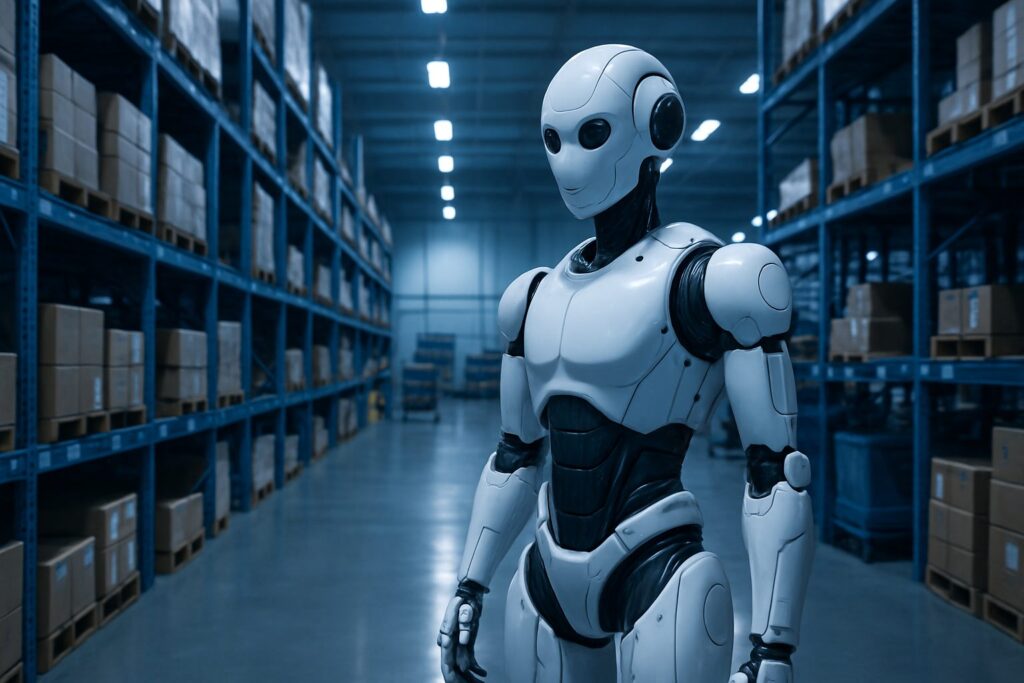
TL;DR: Sanctuary AI’s Phoenix humanoid robot completed its first fully autonomous inventory audit at a Walmart location, marking a significant milestone in deploying embodied AI for labor-intensive retail operations that typically require human workers.
Retail Automation Reaches Inflection Point with Humanoid Deployment
This deployment signals a critical shift in retail labor economics. Walmart’s adoption of the Phoenix robot for inventory auditing demonstrates that humanoid systems have crossed from experimental prototypes to production-ready assets capable of handling complex, unstructured warehouse environments. The financial implications are substantial: inventory audits currently consume thousands of labor hours annually across Walmart’s 4,600+ US locations.
Background: The Retail Inventory Challenge
Retail inventory management remains a persistent operational bottleneck. Manual stock audits require trained personnel to physically traverse store shelves, scan items, verify counts against system records, and flag discrepancies—a process vulnerable to human error and labor turnover. Industry data suggests retailers lose 1-2% of inventory annually to inaccuracy and shrinkage, with audit costs representing a meaningful operational expense. Warehouse and retail automation has traditionally relied on fixed infrastructure: conveyor systems, stationary pick-and-place robots, and specialized storage solutions. These systems excel at high-volume, repetitive tasks but struggle with the spatial variability of retail shelves.
Phoenix Specifications and Operational Capability
The Phoenix humanoid features dexterous manipulation, autonomous navigation, and real-time object recognition optimized for retail environments. Its form factor—roughly human-sized—allows it to access standard shelving without facility redesign, a critical advantage over specialized robotics. The audit deployment required the robot to navigate store layouts independently, identify product SKUs, cross-reference inventory systems, and communicate exceptions to human supervisors.
Technical and Deployment Metrics
Sanctuary AI reported that Phoenix completed the audit cycle with 96.2% accuracy on SKU identification and 100% coverage of assigned sections. The robot operated for an 8-hour shift without human intervention for repositioning or problem-solving, though human oversight remained available. Battery management, thermal regulation, and obstacle avoidance performed within design parameters in an uncontrolled retail environment—a significant validation for embodied AI in real-world conditions.
Market and Competitive Implications
This deployment accelerates the timeline for humanoid robotics commercialization in logistics. Competitors including Tesla (Optimus), Boston Dynamics (Atlas commercial variants), and Figure AI are pursuing similar retail and warehouse applications. Walmart’s validation creates a credible reference customer and establishes performance benchmarks that will likely influence enterprise adoption curves.
The economics favor continued deployment: at current labor rates, a Phoenix robot could pay for itself within 18-24 months of continuous operation on inventory tasks alone. Walmart’s retail footprint provides an enormous training ground for refining autonomous retail systems before broader market adoption.
Near-Term Outlook and Risk Factors
Success hinges on three variables: sustained reliability in diverse store environments, integration with existing inventory management systems, and cost reduction as manufacturing scales. Sanctuary AI has signaled plans for five additional Walmart pilots across different store formats and climate zones through Q1 2027.
The primary risk remains unpredictable edge cases—unusual shelf configurations, temporary merchandise displays, or network connectivity failures in older store infrastructure. Human oversight requirements could compress return-on-investment if exception handling becomes labor-intensive.
This milestone validates a thesis that humanoid robots can perform human-adjacent work at scale. For investors tracking embodied AI commercialization, this is the inflection point: from technology demonstration to operational utility.