TL;DR
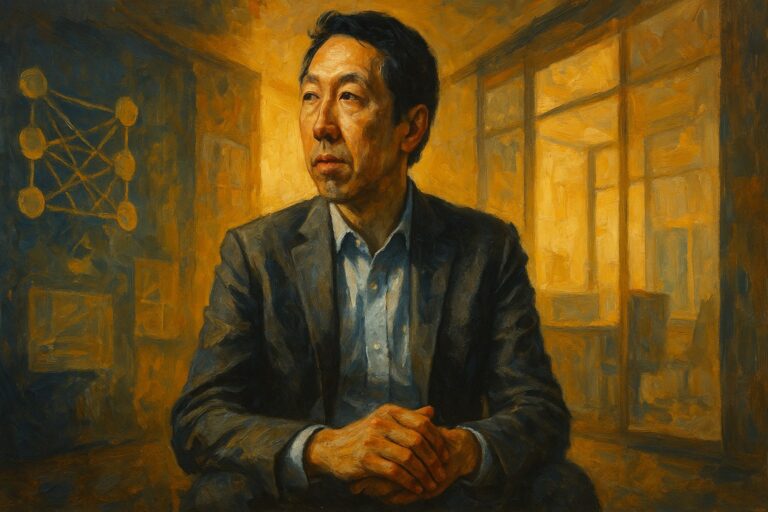
Andrew Ng is one of the world’s most influential AI researchers turned entrepreneur. He has shaped the field at Google Brain, Baidu, and Stanford—and now backs the next generation of AI founders through AI Fund, a thesis-driven venture firm investing in applied machine learning.
Career Highlights
Ng’s career reads like a map of AI’s rise to prominence. In the early 2000s, he was a Stanford computer scientist publishing foundational work in machine learning and robotics. Google hired him to lead Google Brain, the search giant’s moonshot effort to build artificial neural networks at scale. By 2011, he had become one of the field’s most visible voices—equal parts researcher and technologist.
His move to Baidu in 2014 marked a pivot toward commerce. As Chief Scientist, Ng built Baidu’s AI group into one of the world’s largest applied machine learning operations, working on speech recognition, autonomous vehicles, and search. He returned to the U.S. in 2017, but not to academia. Instead, he founded deeplearning.ai, an education platform that has trained millions in neural networks and practical machine learning. “AI is the new electricity,” he declared in those years—a phrase that echoed through startup pitch decks and board meetings globally.
In 2023, Ng founded AI Fund with the thesis that the next wave of AI value would come not from algorithmic breakthroughs, but from companies applying existing models to real business problems. The fund raised over $600 million and quickly became one of the most active backers of seed-stage AI applications. Ng brought institutional discipline to founder-backing—offering not just capital, but his operational expertise and network.
I. The Inflection Point
The inflection came in 2011, when Ng made a public bet on deep learning at a moment when the field was widely dismissed. Most AI researchers favored symbolic systems and smaller datasets. Ng saw differently. He published a paper suggesting that neural networks trained on massive datasets could outperform traditional machine learning. He was right—two years later, deep learning triggered the modern AI boom.
But Ng’s real inflection was personal. After years as a researcher, he realized the academic machine was too slow. “I think one of the biggest mistakes in AI is to assume the path forward is going to be a narrow one,” he said in a 2017 interview. He moved from theory to building. First Google Brain. Then Baidu. Each move was a step toward understanding how to industrialize machine learning—how to take research and turn it into products at scale.
II. The Build
AI Fund is not a traditional venture firm. It is a thesis-driven platform designed to seed, fund, and scale companies that apply large language models and other AI to specific verticals. Ng’s approach is hands-on: he co-founds companies alongside portfolio entrepreneurs, helping them find product-market fit before external capital arrives.
- AI Fund Core Operations: Pre-seed capital ($500K–$1M), operational support, and founder co-founding from Ng and his team
- Portfolio Company Model: AI Fund typically takes ~10–15% equity in exchange for seed capital and intensive engagement
- Vertical Focus: Supply chain optimization, healthcare AI, enterprise software, and financial services
- Education Integration: deeplearning.ai courses serve as both a lead generation engine and training ground for portfolio founders
- Strategic Capital: Relationships with mega-cap LPs and strategic investors (major tech and industrial firms)
- Network Leverage: Direct access to Ng’s relationships at Google, Baidu, major universities, and the AI research community
The strategy is disciplined. Rather than chase the latest AI hype, Ng targets sectors where machine learning solves measurable business problems—reducing costs, accelerating workflows, improving safety. He believes the venture winners in AI will not be new infrastructure companies, but boring applications in unglamorous industries.
III. The Person
Ng’s temperament is one of measured intensity. He speaks slowly, chooses words carefully, and rarely gestures. In conversations, he asks more questions than he answers—a habit formed in decades of research and mentorship. He has trained thousands of students and has a teacher’s patience, though also a teacher’s directness about what works and what doesn’t.
He is relentlessly optimistic about AI’s potential, yet pragmatic about timelines. Unlike many in Silicon Valley, Ng does not claim AI will achieve human-level general intelligence imminently. He focuses on the next 5-10 years: narrow, powerful models that add measurable value to specific businesses. “The bottleneck is not algorithms,” he has said. “It’s execution.” His own career reflects this belief—he left academia because he wanted to execute.
Ng maintains an unusual discipline for someone of his stature. He limits social media, avoids the conference circuit, and spends most of his time in direct conversation with founders. He still writes technical papers and teaches, evidence of a researcher who never fully left academia, only expanded beyond it.
IV. The Network & Numbers
Milestones
- Founded AI Fund: 2023
- Founded deeplearning.ai: 2017
- Left Baidu: 2017
- AI Fund First Close: ~$600M
- Portfolio Companies: 50+ active companies (as of 2024)
- deeplearning.ai Users: 5M+ registered learners
Key Relationships
- Fei-Fei Li: Co-director of Stanford’s Human-Centered AI Institute; longtime research collaborator and peer in the AI ethics conversation
- Dario Amodei & Daniela Amodei: Founders of Anthropic; separate trajectory but shared conviction that applied AI will create the most value
- Sundar Pichai: CEO of Google; relationship spans Google Brain era and ongoing strategic discussions
- deeplearning.ai: Educational platform co-owned and directly operated; serves as pipeline for recruitment and thought leadership
- Landing AI: Earlier venture into AI for manufacturing; later evolved into platform layer for AI Fund portfolio
V. The Thesis
Ng’s central bet is that the AI boom has entered its maturation phase. The days of pure infrastructure play are ending. LLMs are increasingly commodified. The next trillion dollars in value will come from companies that apply these models to solve problems in manufacturing, logistics, healthcare, and financial services—industries that represent trillions in annual spending.
This thesis runs counter to the current venture enthusiasm for foundation models and frontier AI labs. Ng is not anti-frontier research. But he believes the venture returns will accrue to companies that take proven AI techniques and execute them in domains where AI has not yet penetrated. “The real bottleneck in AI is not the algorithms,” he says. “It’s domain expertise, data, and execution. Those are the things that are hard to replicate.”
He is betting that AI founders with deep vertical expertise, backed by the world’s most experienced AI technologist, will outcompete both startups led by pure ML engineers and internal teams at incumbent firms. AI Fund is structured to prove this thesis, one company at a time.
Factbox
Name Andrew Yan-Tak Ng | Age 56 | Location Palo Alto, CA, USA | Company & Role AI Fund, Founder & Managing General Partner | Education BS Carnegie Mellon University (Computer Science), MS MIT (Computer Science), PhD UC Berkeley (Computer Science) | Founded AI Fund 2023 | Most Recent Round Series A (AI Fund); publicly launched 2023 with $600M in commitments | Portfolio Size 50+ companies | Contrarian Belief The next wave of AI venture returns will come from boring vertical applications in supply chain and healthcare, not from frontier model companies.