The Helium Crisis: How Hormuz Exposed the Semiconductor Supply Chain’s Hidden Fragility
TL;DR: The ongoing closure of the Strait of Hormuz has triggered a global helium shortage, exposing critical vulnerabilities in the semiconductor supply chain. With spot prices doubling and specialized transport logistics collapsing, leading chipmakers face an existential threat to advanced manufacturing that cannot be solved by simply building more fabs.
The Invisible Bottleneck
The semiconductor industry is facing a reckoning it has postponed for years. While geopolitical risk modeling has long centered on Taiwan and the physical production of chips, a more insidious vulnerability has quietly compounded upstream. The closure of the Strait of Hormuz since early March 2026 has choked off a third of the world’s helium supply, revealing a supply chain optimized for cost efficiency rather than resilience.
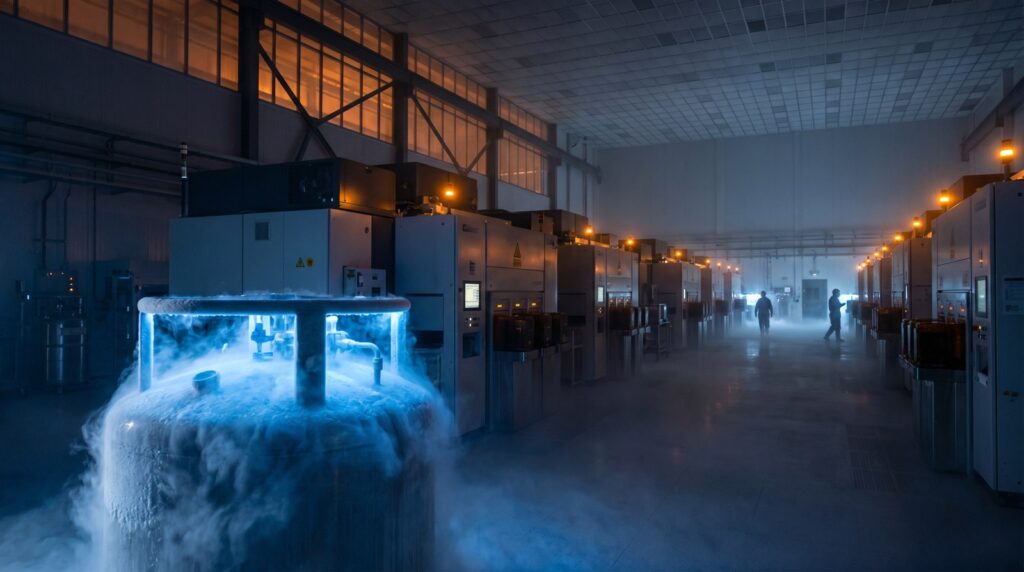
Helium is an existential input for advanced cleanrooms. As the coldest liquid on Earth, it is indispensable for cooling EUV systems, detecting microscopic leaks, and flushing toxic residue from silicon wafers. Unlike other materials, it cannot be easily substituted or stockpiled. Chipmakers can typically store only about six weeks of liquid helium before it warms, expands, and becomes dangerous to contain.
A Concentrated Exposure
The current crisis stems from structural dependencies that the industry understood but largely ignored. Following Iranian strikes on Qatar’s Ras Laffan facility—which produces roughly 33% of global helium as a byproduct of liquefied natural gas—QatarEnergy declared force majeure on LNG contracts. The exposure is stark: South Korea sourced nearly 65% of its helium from Qatar in 2025, while Taiwan’s dependency on the Gulf Cooperation Council reached 69% in 2024.
The disruption extends beyond the gas itself. The logistics networks required to transport specialized helium containers have collapsed alongside air cargo capacity out of Gulf hubs. Approximately 200 of these highly specialized cryogenic containers are currently stranded in the strait, effectively freezing a significant portion of the global transport infrastructure.
Compounding Shocks and Downstream Effects
The helium shortage is colliding with a sustained, AI-driven reallocation of fabrication capacity. Data centers are projected to consume up to 70% of global DRAM production by the end of 2026. This insatiable demand for High Bandwidth Memory (HBM) is already squeezing consumer and industrial segments. When combined with the helium shock, the effects are materializing rapidly: spot prices for helium have doubled, DRAM pricing has surged, and enterprise PC vendors are passing 15% to 20% price increases to customers.
Industry leaders are acknowledging the strain. Reports indicate that SK Hynix and Samsung expect memory shortages to persist into 2027. The Semiconductor Industry Association warned in 2023 that a Gulf disruption would produce precisely these shocks, yet the industry continued to operate with virtually no slack.
Background: The Key Players and Forces
Taiwan Semiconductor Manufacturing Co. (TSMC) is the world’s largest contract chipmaker, producing the most advanced logic chips for companies like Apple and Nvidia. Based in Taiwan, TSMC relies heavily on imported gases and chemicals to maintain its ultra-precise manufacturing environments. The company has recently expanded its global footprint, but its core operations remain deeply dependent on established supply routes.
Samsung Electronics and SK Hynix, both headquartered in South Korea, dominate the global memory chip market, particularly the High Bandwidth Memory (HBM) essential for artificial intelligence accelerators. Their fabrication facilities require massive, uninterrupted volumes of ultra-pure gases to achieve the yields necessary for profitable high-volume production.
The Strait of Hormuz is a narrow, strategically vital waterway between the Persian Gulf and the Gulf of Oman. It is a critical chokepoint for global energy shipments, including the liquefied natural gas (LNG) from which much of the world’s helium is extracted as a byproduct. Disruptions in the strait immediately impact global supply chains far beyond the energy sector.
The Limits of New Fabs
The current crisis demonstrates that the massive capital expenditures pouring into new fabrication plants across North America and Europe are insufficient on their own. A multi-billion-dollar fab is effectively worthless if it cannot secure the single-source gases and specialized tools required to operate its cleanrooms.
Governments are beginning to react. Taiwan has formally requested strategic helium and LNG reserves, while South Korea has launched an emergency review of critical semiconductor materials with Middle East dependencies. However, these measures will not resolve the immediate exposure. The industry must recognize that a supply chain organized solely around just-in-time delivery and cost optimization cannot absorb concurrent shocks. The helium crisis is not an anomaly; it is a structural warning.