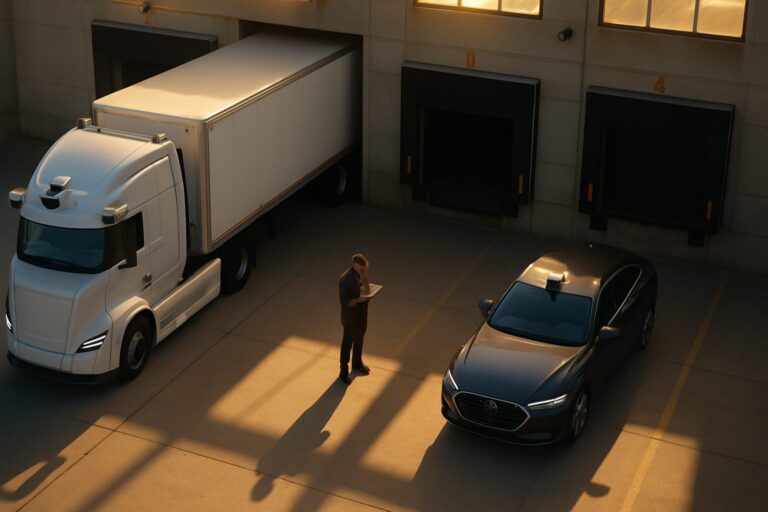
Aurora’s 30,000-Truck Target Hinges on Driver-as-Service Transition
TL;DR
Aurora projects 30,000 autonomous trucks generating $5B revenue by 2030, scaling from 200 trucks today by shifting to a driver-as-service model where customers own vehicles and pay $0.85/mile for autonomy software. The real test arrives in 2027 when third-generation hardware launches and the company targets breakeven gross margins.
The Core Scaling Problem
Aurora’s CFO David Maday outlined the path to 30,000 autonomous trucks by 2030, but investor reaction has been tepid—shares dropped 12.42% since the September 23 investor day. The apparent contradiction: 30,000 trucks sounds massive until you realize major manufacturers produce 250,000-300,000 new trucks annually.
Maday’s credibility depends on execution starting immediately. The financial structure must shift from capital-intensive ownership to software-as-a-service licensing for this plan to work. This isn’t theoretical—it’s the difference between whether Aurora can ever achieve sustainable unit economics.
Business Model Evolution: The Real Unlock
Transportation-as-a-Service (Current)
Aurora currently operates a limited proof-of-concept with ~500 trucks generating revenue at $2/mile, covering costs including fuel surcharge. The company owns and operates vehicles, which ties up capital and limits scalability. Customers include Detmar Logistics, Hirschbach, McLane, and Werner.
Driver-as-a-Service (2027+)
The transition begins in 2027 when Aurora shifts customers to fleet ownership while charging $0.85/mile for autonomy software subscription. This moves trucks off Aurora’s balance sheet entirely—the critical lever for scaling to thousands of vehicles without proportional capital requirements.
The company expects breakeven gross margins by H1 2027 with 500 trucks operational. This timing is aggressive but necessary to restore investor confidence that the model actually works.
Hardware Commoditization Via Aumovio Partnership
Third-generation hardware launching end of 2027 represents the real inflection point. Aumovio (formerly Continental) manufactures and finances the sensor/compute kits, reducing Aurora’s hardware R&D burden and capital requirements. Critically, Aumovio also handles servicing and repairs—outsourcing operational friction that could derail scaling.
This partnership addresses a structural problem: autonomous trucks require continuous hardware upgrades as software improves. By commoditizing and outsourcing hardware, Aurora becomes purely a software/services company. That’s the narrative investors actually want to hear.
Geographic Expansion and Margin Trajectory
Aurora plans to expand from Southern states to “vast majority of continental U.S.” by 2030. Maday explicitly stated gross margins accelerate post-2028, implying the company expects substantial cost reductions as fleet density increases and hardware manufacturing scales. Reach-through margins (after capex) remain undefined—a gap investors should probe.
Background: Aurora, the Autonomous Trucking Race, and Industry Context
Aurora Innovation is one of three major public autonomous trucking plays competing in a $800B+ trucking market. Founded in 2017 by veterans from Tesla, Google, and Uber ATG, Aurora has focused on highway autonomy rather than local delivery. The company went public via SPAC in 2021 at a ~$11B valuation.
The autonomous trucking market remains nascent. Driver shortages and retention costs create genuine economic pressure for automation, but regulatory fragmentation (state-by-state AV licensing), liability frameworks, and cybersecurity remain unsolved. Aurora’s competitors include Waymo (backed by Alphabet, focusing on long-haul) and TuSimple (pre-bankruptcy collapse in 2023), which provides cautionary tales about overpromising timelines.
The $2/mile rate Aurora charges today undercuts human driver economics in some regional lanes, but sustainability depends on reaching 4-5x higher utilization rates and lower hardware costs than current deployments. Early customers represent pilots, not production-grade commercial operations.
Recent market dynamics: autonomous vehicle companies face sustained pressure to demonstrate profitability and unit economics rather than scale. Investor skepticism has grown as promised Level 4 deployment timelines consistently slip. Maday’s 2030 projections directly challenge that skepticism by tying scale to specific business model transitions rather than technology breakthroughs alone.
What Investors Should Watch
- Q4 2026 delivery of 200 trucks—operational reality check on vehicle reliability and customer satisfaction
- H1 2027 gross margin breakeven with driver-as-service customers—proof the model isn’t just theoretically sound
- End of 2027 Aumovio hardware launch and volume pricing—validation that third-party suppliers will build commodity AV hardware
- Path to profitability—Maday avoided discussing net margins or EBITDA timelines; that’s the next interrogation point
The Bottom Line
Aurora’s 30,000-truck vision isn’t impossible, but it requires flawless execution on three dependencies: (1) driver-as-service adoption and retention by major carriers, (2) third-generation hardware achieving sub-$50K per-unit costs at scale, (3) geographic expansion without regulatory setbacks. Investors are right to be skeptical—not because 30,000 trucks is implausible mathematically, but because autonomous vehicle companies have consistently underestimated integration complexity and customer friction.
The next 12 months will determine if Maday’s credibility holds.
About the Author