$4,000 Robot Dogs Signal Mass-Market Shift for Quadrupeds—But Practical Use Cases Remain Elusive
TL;DR
Unitree’s $4,000 quadruped robots demonstrate radical cost compression in legged robotics, but real-world applications remain limited compared to wheeled and aerial alternatives. The company’s pricing power—fueled by Chinese manufacturing—positions it as the Xerox of quadrupeds, with humanoids at $13,500 representing the potentially transformative product line.
The Investment Signal: Affordability Precedes Utility
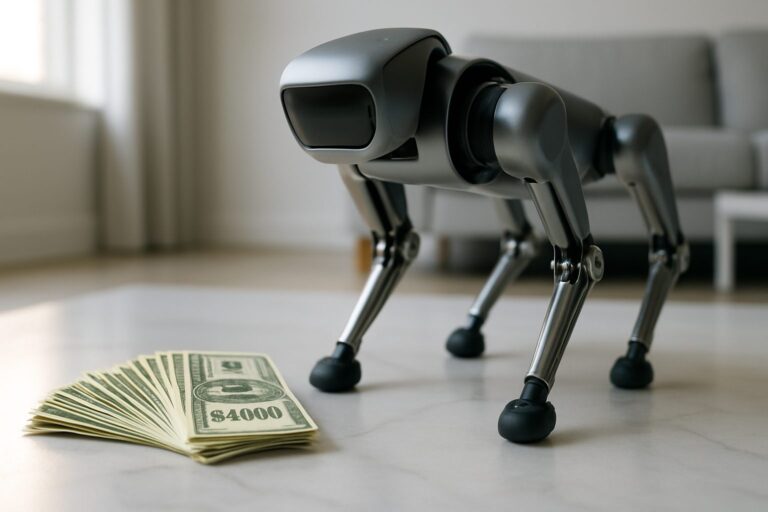
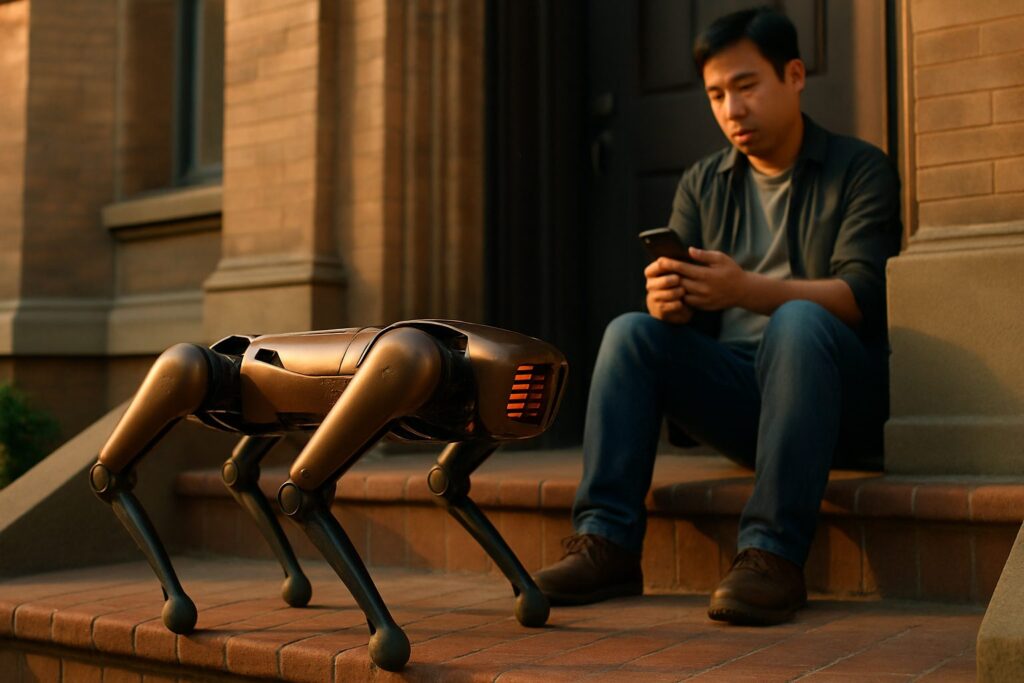
Ars Technica’s Timothy B. Lee spent four grand on a Unitree Go2 and walked it through DC—a mundane commute that crystallizes the robotics market’s actual inflection point. Price, not capability, is now the limiting variable. When hardware costs drop 70-80% from historical levels, applications multiply. The device proved reliable for two miles downhill but overheated (84°C internal temp) on the return climb, collapsing near his front door with 5% battery remaining.
This limitation matters precisely because the price now makes edge cases viable. Academic institutions already deploy Unitree quadrupeds extensively. Entertainment venues find them marketable. Neither would have justified $15,000-20,000 hardware costs two years ago.
Background: Unitree’s Path to Disruption
Unitree Robotics, founded in 2016, emerged from Hangzhou, China as a vertically integrated manufacturer focused on legged robotics. The company prioritized design iteration velocity and manufacturing scale over premium positioning—a deliberate contrast to Boston Dynamics’ enterprise-research model. By 2023, Unitree had captured mindshare among academic researchers and early adopters through aggressive pricing on its Go and B series quadrupeds.
The broader context: China’s robotics manufacturing ecosystem—featuring lower labor costs, government subsidies, and established supply chains for actuators and sensors—enables companies like Unitree to undercut Western competitors by 60-70%. Companies including DJI (drones) and Xiaomi (consumer electronics) pioneered this playbook. Unitree replicated it in legged robotics.
Humanoid robotics represents Unitree’s strategic pivot. The company launched its G1 humanoid in 2023 at $13,500—undercutting Tesla’s Optimus (not yet widely available) and Boston Dynamics’ Atlas (enterprise-only). This pricing creates a beachhead in service robotics, warehousing, and light manufacturing roles that would remain inaccessible at $100,000+ price points.
Recent legal headwinds: The article references “legal restrictions in the United States” without elaboration, likely referring to export controls or tariff classifications imposed under Biden-era China policy. These constraints potentially limit Unitree’s domestic distribution but don’t eliminate the competitive threat.
Where Quadrupeds Actually Fail
Lee’s honest assessment: quadrupeds solve few real problems better than existing solutions. Wheeled robots outpace quadrupeds on energy efficiency and speed for last-mile delivery. Aerial drones dominate surveying, inspection, and mapping tasks. The Go2’s lack of manipulators makes it useless for pick-and-place or maintenance work.
- Thermal management remains a weakness—sustained hill climbing at 87°F ambient caused dangerous internal temperatures
- Battery endurance under load is marginal (two-mile downhill walk required charging; uphill return nearly failed)
- No proven commercial logistics, manufacturing, or infrastructure use cases exist at scale
Quadrupeds excel in unstructured terrain navigation—rubble sites, forest floors, or steep slopes. But these niches lack market density.
Why Price Compression Matters More Than You Think
The Xerox precedent is instructive: Xerox invented the graphical user interface in 1981 but failed to commercialize it. Apple, IBM, and Microsoft miniaturized, simplified, and priced the technology for mass adoption. Unitree isn’t inventing quadrupeds; it’s making them disposable enough for experimentation.
At $4,000, researchers can buy multiple units for parallel testing. Rental companies can justify fleet economics for entertainment or short-term surveying. Universities can outfit labs without capex freeze approvals. Volume unlocks second and third-order use cases.
The $13,500 humanoid pricing follows the same logic. Tesla’s Optimus is vaporware; Boston Dynamics’ Atlas costs $150,000+. At Unitree’s price, industrial customers can pilot humanoids in confined roles: materials handling, repetitive assembly line tasks, or hazardous environment inspection.
Thermal and Battery Reality Check
Lee’s field experience exposed critical engineering trade-offs. The Go2’s battery depleted to dangerous levels on moderate terrain. Internal temps spiked to 183°F—near the failure threshold for lithium cells—during a routine commute in 87°F weather.
This suggests Unitree prioritized cost reduction over thermal management redundancy. Industrial buyers should expect similar constraints. The $4,000 price reflects a specific design philosophy: minimum viable performance, maximum cost efficiency. Users operating in hot climates, extended missions, or steep terrain will hit limits quickly.
Future iterations will likely separate thermal management and battery capacity as premium-tier options, creating a product ladder that captures higher-margin sales.
The Humanoid Angle: Where Unitree’s Real Opportunity Lies
Unitree’s quadruped success is a prototype for humanoid scaling. Humanoids solve broader problems—they can grip, climb stairs, open doors, and operate in spaces designed for human workers. The $13,500 G1 humanoid opens warehouse automation, light manufacturing, and hospitality applications previously reserved for companies deploying $200,000+ systems.
If Unitree maintains manufacturing cost discipline, a $9,000-11,000 humanoid within 2-3 years is plausible. At that price, enterprise ROI calculations shift dramatically. Payback periods compress from 5-7 years to 2-3 years for repetitive warehouse tasks.
This threatens Boston Dynamics’ (Hyundai-backed) and Tesla’s humanoid strategies if those companies remain locked into premium positioning. Lee’s report notes Unitree’s cost advantage stems directly from Chinese manufacturing leverage, a moat competitors cannot easily replicate without relocating supply chains.
Regulatory Headwinds and Export Controls
The article alludes to legal restrictions but doesn’t detail them. Likely factors include:
- Entity List restrictions: U.S. export controls on robotics and AI chips bound for Chinese companies
- FCC and DOD concerns: Questions about dual-use surveillance capabilities embedded in Unitree’s lidar and autonomous navigation systems
- Tariff reclassification: Potential 25-35% tariffs on imported quadrupeds under new China trade policy
If tariffs apply, Unitree’s $4,000 price point becomes $5,000-5,500 in the U.S., eroding cost leadership. Domestic competitors like Boston Dynamics could use tariff protection to rebuild pricing power. Conversely, tariffs could accelerate Unitree’s manufacturing footprint in Mexico or Vietnam.
Bottom Line for Operators and Investors
For operators: Quadrupeds remain niche; buy only if unstructured terrain justifies the trade-offs. Humanoids are the real target—wait for Unitree’s next-gen models or track competing announcements from Tesla and Boston Dynamics.
For investors: Watch for Unitree’s U.S. market penetration rate post-restrictions. If volume remains strong despite tariffs or legal barriers, the company has achieved strategic cost leadership. A $50M Series C valuation rumor (unconfirmed) would be justified by humanoid trajectory alone. Conversely, export controls could cripple growth, creating opportunity windows for domestic competitors to rebuild market position.
The real question isn’t whether quadrupeds matter. It’s whether Unitree’s manufacturing model—proven on quadrupeds—can sustain humanoid pricing under regulatory pressure. History suggests cost leaders rarely surrender margins voluntarily.