TL;DR: Uber liquidated its entire Serve Robotics stake without prior notice to the company, signaling strategic divergence on autonomous delivery economics. The move validates operational friction between platforms and specialized robotics vendors as deployment costs and utilization rates fail to justify partnership expansion.
Uber’s Silent Exit Exposes Cracks in Autonomous Delivery Partnership Model
Uber’s complete divestment from Serve Robotics—disclosed via regulatory filing rather than press release—reveals the fragility of capital-light platform bets on specialized hardware vendors. The ride-hailing giant reduced its stake throughout 2025 and finalized the exit this month, catching Serve management off-guard despite years of operational integration.
The transaction matters because it demonstrates that even marquee partnerships with guaranteed deployment commitments cannot overcome fundamental disagreements on unit economics and operational scaling. Serve’s second-quarter earnings call exposed the core tension: delivery volume through Uber declined for the first time in 17 consecutive quarters due to “lower-than-expected robot utilization,” while Serve’s other food delivery partner saw volumes surge 50% quarter-over-quarter.
Background: From Internal Spin-Off to Strategic Liability
Serve Robotics began as Postmates X, the robotics division of on-demand delivery startup Postmates, which Uber acquired for $2.65 billion in 2020. The autonomous sidewalk delivery bot unit spun into an independent company in 2021 as Uber consolidated logistics infrastructure under a single corporate entity.
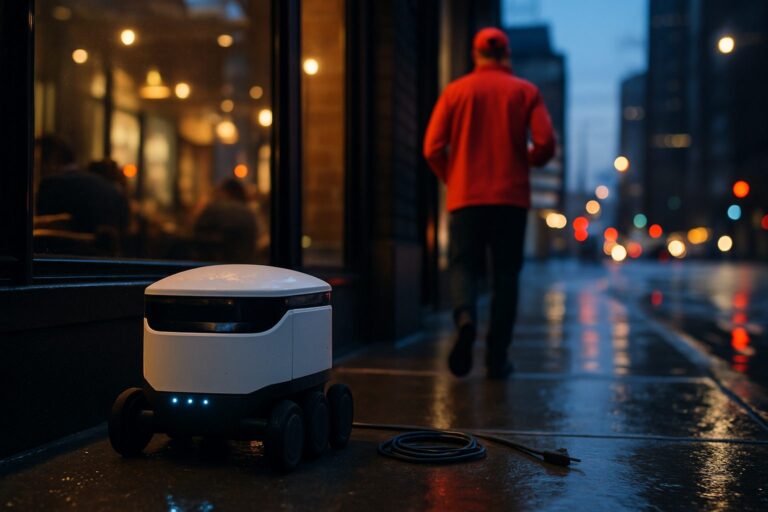
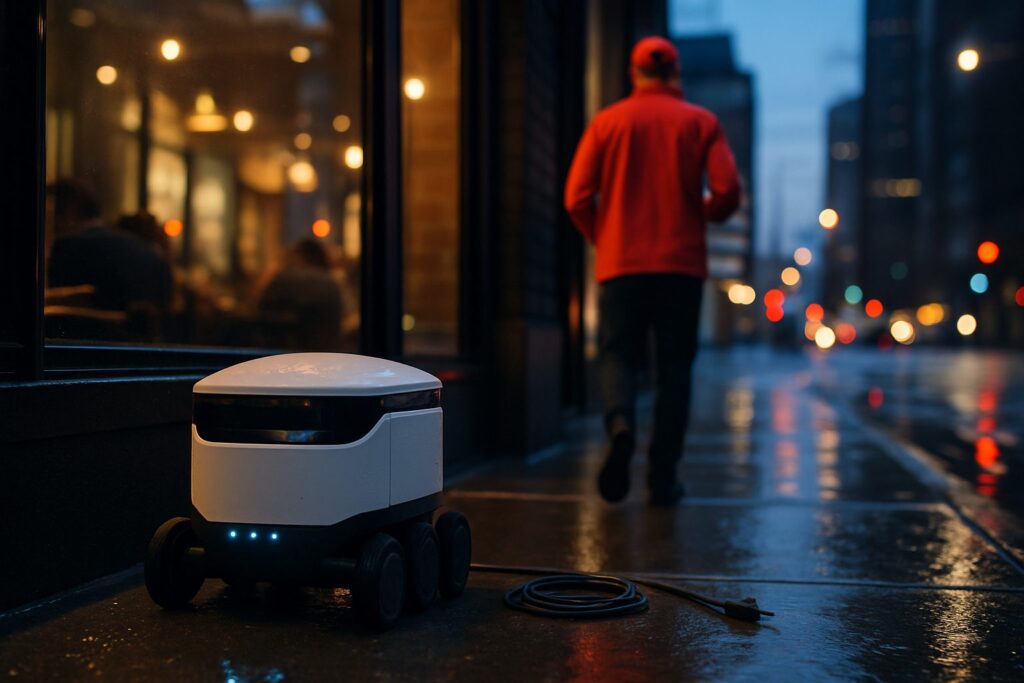
Uber formalized partnership with Serve in 2022, expanding the agreement in May 2023 to deploy up to 2,000 autonomous bots across multiple U.S. markets integrated directly into Uber’s consumer app. This arrangement represented a capital-efficient approach to autonomous last-mile delivery—outsource hardware production and operational liability to a specialized vendor while capturing delivery volume on platform.
The partnership appeared structurally sound. Serve gained guaranteed demand and distribution. Uber gained optionality without full capital commitment to robotics R&D or fleet maintenance. Yet the model failed to deliver promised utilization rates, suggesting either demand constraints or inefficient merchant/consumer workflows that autonomous bots cannot adequately address.
Diverging Operating Models Signal Structural Incompatibility
Serve CEO Ali Kashani stated the companies hold “differing views” on fleet coordination and merchant integration—euphemisms for disagreements on how to actually operate autonomous delivery at scale. These operational disputes likely centered on network effects: Uber’s algorithm prioritizes immediate delivery for high-margin orders, while Serve’s utilization depends on steady-state order flow across less profitable routes and longer delivery windows.
Serve’s stronger performance with an unnamed food delivery competitor suggests the robot hardware is viable but incompatible with Uber’s incentive structures. Uber likely demands integration with its peak-demand pricing model and merchant exclusivity, while Serve needs open-network access to diversify revenue beyond a single platform dependent on declining utilization.
Neither party plans to renew the partnership when it expires in early 2027. Serve’s August earnings call clarified the split was mutual, not forced—the company indicated renewal made no strategic sense given divergent scaling requirements.
Broader Context: Uber’s Speculative Robotics Portfolio Faces Retrenchment
Serve represents just one of 30+ autonomous vehicle technology investments Uber has made. This portfolio approach—backing competing robotics vendors without committing to any single platform—allowed the company to hedge bets while avoiding the capital intensity of vertically integrated autonomous delivery systems.
However, the strategy revealed a critical flaw: platform integration requires operational alignment that capital investment alone cannot guarantee. Autonomous vehicle technology companies need either vertical integration (Tesla, Waymo) or committed anchor customers willing to optimize workflows around hardware constraints (Amazon with Rivian). Uber’s arms-length vendor model satisfies neither condition.
The Serve exit signals Uber is reallocating capital away from speculative robotics plays toward proven autonomous trucking and mobility solutions. The TechCrunch reporting indicates this divestment was deliberate and planned—Uber simply declined to notify Serve until the regulatory disclosure became mandatory, a professional courtesy failure that underscores the relationship’s actual temperature.
Investment Implications for Autonomous Delivery Market
The Serve-Uber separation validates investor skepticism about consumer-facing autonomous delivery robots. Utilization economics remain stubborn: even with platform integration and guaranteed demand, sidewalk bots cannot generate sufficient unit margins to justify fleet expansion. The mathematics favor either hyper-specialized routes (airports, controlled campuses) or fully autonomous long-haul trucking where efficiency gains compound across longer distances.
For Serve, losing Uber’s deployment commitment and customer feed is material. The company will need to demonstrate that diversifying across multiple platform partners generates sufficient utilization rates to sustain operations. If Serve’s stronger performance on its unnamed partner is replicable across additional platforms, the company survives as a specialized vendor in fragmented delivery ecosystems. If Uber’s platform was actually the optimal deployment environment and utilization decline reflects broader demand constraints, Serve faces existential pressure.
For institutional investors in autonomous delivery, the Serve-Uber split reinforces a hard lesson: capital efficiency in robotics requires either operational control or demand guarantees, not tentative partnerships between companies with misaligned business models.