Zoox’s NHTSA Exemption Unlocks Commercial Robotaxi Operations and Sets AV Industry Blueprint
TL;DR
Amazon-owned Zoox secured federal exemption to charge for robotaxi rides starting August 10, operating up to 2,500 vehicles for two years without traditional steering wheels or pedals. The precedent clears regulatory pathways for Tesla’s Cybercab and other autonomous developers, while Uber commits $10 billion to deploy 120,000 driverless vehicles across multiple partnerships.
The Regulatory Breakthrough
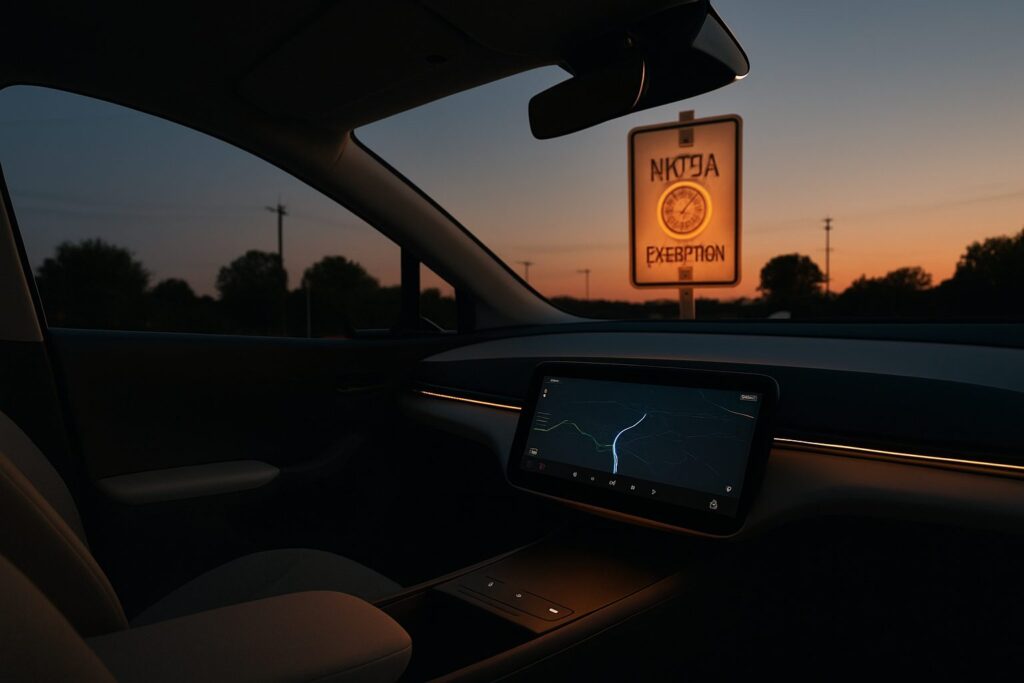
Zoox’s commercial operations permission marks the inflection point between demonstration and revenue generation. The NHTSA exemption allows the company to operate commercially in Las Vegas, San Francisco, and newly launched programs in Miami and Austin—a shift from previous demonstration-only authority.
The approval exempts Zoox vehicles from federal requirements for steering wheels, pedals, and other redundant controls. Sensors on the vehicle exterior replace traditional mirrors and mechanical fail-safes designed for human drivers.
Why This Matters for the Industry
This exemption establishes a regulatory template for any AV developer pursuing driverless architectures. Tesla’s two-seater Cybercab becomes immediately viable under this framework, and other manufacturers now have a precedent for designing purpose-built autonomous vehicles without human-centric safety redundancies.
The two-year operational window caps Zoox’s fleet at 2,500 vehicles—substantial enough to prove commercial viability at scale, but constrained enough to maintain regulatory oversight during a critical learning phase.
Uber’s $10 Billion Autonomous Gambit
Uber CEO Dara Khosrowshahi disclosed a $10 billion commitment to deploy 120,000 driverless vehicles over coming years. This aligns with Uber’s comprehensive autonomous vehicle partnership ecosystem, which spans multiple developers and fleet operators.
The capital allocation reflects Uber’s strategy: acquire fleet operators, partner with AV hardware/software companies, and leverage network effects from existing ride-hail infrastructure. More partnerships are reportedly in development.
Company Background: Key Players
Zoox (Amazon Subsidiary)
Amazon acquired Zoox in 2020 for approximately $1.2 billion. The company has engineered purpose-built robotaxis designed for dense urban environments, with custom bi-directional seating and sensor architecture optimized for autonomous operation. Current operations span Las Vegas and San Francisco, with expanding capacity in Miami and Austin.
Uber’s Autonomous Vehicle Portfolio
Uber divested its own self-driving unit (ATG) to Aurora Innovation in 2020 but maintains equity stakes and partnerships across multiple AV developers. The company operates as an integrator—acquiring fleet management capabilities (like Moove) while partnering with hardware/software providers for different geographic markets and vehicle types.
Moove: The Overlooked Fleet Operator
Moove evolved from African fintech (vehicle financing for app drivers) into a mega fleet owner managing 42,000 vehicles across 13 countries. The startup recently raised $250 million Series C (valuation: $2.1 billion) led by Mubadala Investment Company. As Waymo’s official fleet operator in Phoenix, Miami, Las Vegas, and future London operations, Moove controls critical infrastructure for robotaxi deployment—already owning robotaxi assets from unnamed competitors.
Tesla’s Cybercab Opportunity
Tesla’s two-seater autonomous vehicle design directly benefits from Zoox’s exemption precedent. The Cybercab requires no steering wheel or pedals, making it unviable under previous federal standards. The NHTSA exemption removes this barrier, enabling Tesla to pursue commercial robotaxi operations without fundamental design redesigns.
Capital Flowing Into Fleet Management Infrastructure
Moove’s $250 million Series C signals investor conviction that fleet management—not hardware or autonomous software alone—represents the bottleneck for scaled robotaxi deployment. Managing 42,000+ vehicles requires logistics, maintenance, compliance, and regulatory expertise. Moove’s position as Waymo’s operator gives it first-mover advantages in this critical layer.
The startup’s plan to hire 350 people and purchase additional Waymo robotaxis indicates confidence in near-term volume growth. This mirrors traditional auto industry patterns where logistics operators capture significant margins from OEMs.
Implications for Investors and Operators
- Regulatory tailwind confirmed: NHTSA exemption removes the primary legal barrier to AV commercialization, accelerating timelines for all stakeholders.
- Fleet management moat: Companies like Moove control access to robotaxi deployment. Expect consolidation in this layer.
- Uber’s ecosystem bet: $10 billion over “coming years” suggests 5-7 year deployment horizon, not immediate profitability.
- Hardware design freedom: Purpose-built vehicles (Zoox, Cybercab) outcompete retrofitted designs. Traditional automakers face redesign pressure.
- Geographic dependency: Early deployments concentrate in dense metros (SF, Vegas, Phoenix, Miami, Austin, London). Expansion to secondary markets remains unproven.
What’s Next
Zoox’s commercial revenue generation starts August 10. Watch for monthly rider data, cost-per-mile metrics, and incident reports—the metrics that determine whether robotaxis achieve unit economics parity with human drivers.
Moove’s AV division and Waymo’s partnership will become a critical bellwether for fleet management profitability. If Moove achieves target margins, expect rapid capital deployment into competing fleet operators.
Tesla’s Cybercab timeline remains the wildcard. Any 2026-2027 commercial launch would reshape competitive dynamics, forcing AV-native companies to prove cost leadership against Tesla’s manufacturing scale and battery advantages.