Mars Rover Autonomy Breakthrough: Perseverance Shatters Distance Record With Self-Driving Tech
TL;DR: NASA’s Perseverance rover broke Mars distance records by completing 90% of its drives autonomously using onboard vision systems—demonstrating that edge AI navigation dramatically outpaces Earth-controlled rovers and accelerates scientific discovery timelines.
The Operational Win: Why Autonomous Navigation Changes Planetary Exploration Economics
Perseverance will imminently surpass the 45.16 km (28.06 mile) distance record previously held by Opportunity rover, achieving this milestone in roughly one-third the operational time. The speed differential hinges on a single architectural choice: autonomous navigation that eliminates command-wait cycles.
This matters operationally because Mars communication latency averages 20 minutes round-trip. A rover that waits for Earth-based driving commands wastes daylight hours. Perseverance’s onboard compute processes terrain imagery in real-time, allowing wheels to turn while algorithms calculate safe routes—compressing exploration cycles from days into hours.
Technical Architecture: Vision Compute Element vs. Legacy Systems
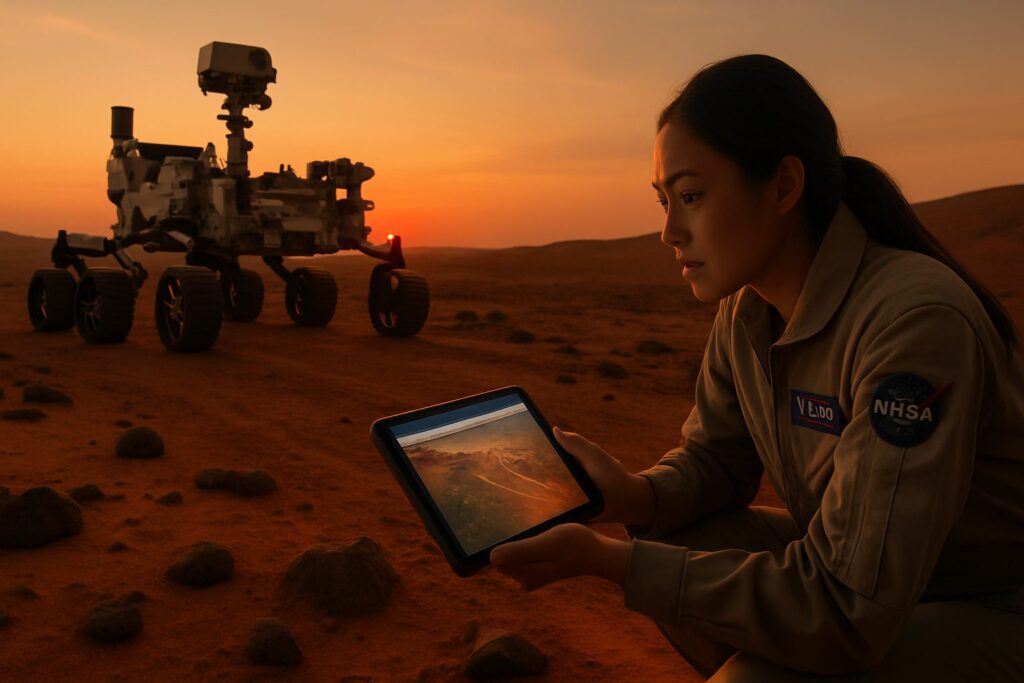
Perseverance’s Vision Compute Element enables near-real-time hazard detection and pathfinding. The rover images surrounding terrain with its stereo cameras, processes the feed through onboard algorithms, and computes navigable trajectories without Earth intervention. Approximately 90% of its driven distance leverages this autonomous capability.
Curiosity, Perseverance’s near-identical predecessor, operates under severe computational constraints. Its processing architecture—partially based on 1990s-era chipsets—handles autonomous driving for only 10% of traversals. Over 15 years on Mars, Curiosity covered 38.6 km. Perseverance’s superior onboard processor eliminated bottlenecks that forced Curiosity into extended pause-and-wait cycles.
The generational gap is narrow but decisive: slightly more modern silicon enables the rover to “perform all sensing and computation while wheels are turning.” Maximum wheel speed (150 meters per hour) isn’t the constraint—latency is.
Scientific Return: Spread-Out Objectives Reward Speed
Mission deputy scientist Vivian Sun credits autonomous mobility with expanding research scope. Perseverance’s landing zone in Jezero Crater contains widely distributed geological targets, unlike Curiosity’s focused Mount Sharp study. Faster inter-site transit allows the rover to reach new locations ahead of planned timelines, catching scientists off-guard with discoveries.
The rover investigates Martian ancient rocks dated to ~4 billion years ago, predating any terrestrial samples. This era preceded the “heavy bombardment” phase when Mars potentially hosted lakes and oceans. Autonomous navigation compresses the timeline for characterizing these 4-billion-year-old environments in situ—a capability unavailable to any previous mission.
“The real enabling technology has been its auto navigation system,” noted Steven Lee, Perseverance project manager at JPL. The gap between 10% and 90% autonomous operation translates directly into expanded scientific objectives and accelerated data acquisition schedules.
Background: Perseverance, Curiosity, and Mars Exploration Evolution
NASA’s Perseverance rover landed in Jezero Crater in February 2021, arriving as the successor to Curiosity (launched 2011). Both rovers share nearly identical hardware architectures, with critical differences in onboard compute systems. While Curiosity remains operational after 15 years, its 1990s-era processor chipsets limit real-time decision-making capacity.
The Opportunity rover, which operated from 2004 to 2018, established the previous distance record at 45.16 km before a dust storm terminated communications. Opportunity’s driving was almost entirely Earth-commanded, reflecting the computational constraints of its era. Modern deep space missions have progressively shifted burden from ground controllers to onboard systems.
Perseverance represents a watershed moment in planetary rover design: sufficient onboard processing to enable genuine autonomous operation without sacrificing scientific capability or mission duration. The Vision Compute Element—a marginal hardware upgrade—delivered exponential operational improvements. This shift from latency-bound, ground-commanded rovers to edge-compute-enabled autonomous vehicles mirrors terrestrial self-driving vehicle architecture, adapted for Mars’ harsh radiation and communication delays.
Investment Implications: Edge AI for Extreme Environments
Perseverance’s success validates a broader thesis: edge processing outperforms remote command architectures in high-latency, mission-critical scenarios. This extends beyond Mars to deep-sea exploration, undersea mining, and polar research—environments where communication delays exceed decision-making windows.
The rover demonstrates that incremental processor upgrades yield disproportionate operational gains. Future missions will likely accelerate this trend, embedding increasingly sophisticated vision-language models and pathfinding algorithms into planetary exploration vehicles. Companies developing compact, radiation-hardened compute modules for space applications face expanding addressable markets as agencies prioritize autonomy-first mission designs.