TL;DR
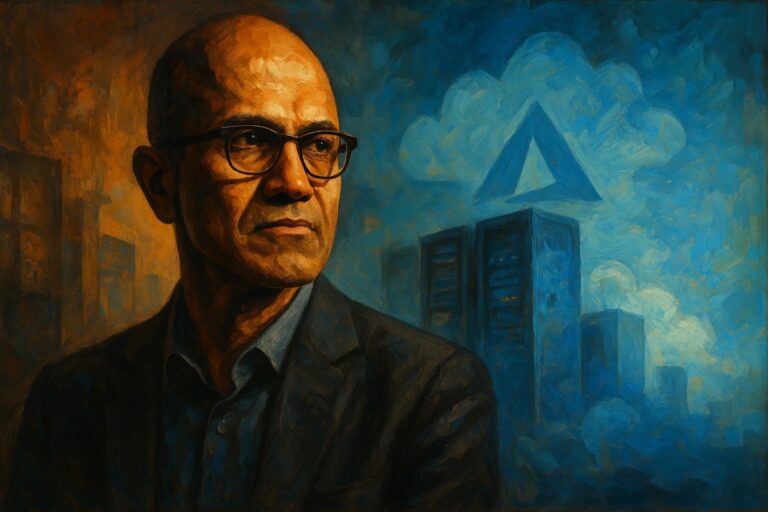
Satya Nadella transformed Microsoft from a PC-centric dinosaur into a cloud-first powerhouse. In a decade as CEO, he repositioned the company around artificial intelligence, revived developer trust, and doubled the stock price. He is the rare executive who inherited a legacy business and genuinely renewed it.
Career Highlights
Satya Nadella joined Microsoft in 1992 as a software engineer, arriving during the Windows 95 era when the company was the unquestioned king of personal computing. For two decades, he was an insider’s insider—invisible to the public but instrumental in building the cloud infrastructure that would become Azure. He held leadership positions in Server & Tools, the business unit that generated reliable, unglamorous profit while the company’s culture calcified around its core Windows franchise.
By the early 2010s, Microsoft was in crisis. Not a financial crisis—the company was profitable and massive—but a strategic one. Mobile was eating the world. The iPhone had shipped. Android was proliferating. Microsoft had built billions in revenue on the assumption that software would always run on PCs. The company was late to mobile, late to cloud, and run by executives who still thought like PC licensors rather than platform builders. The culture was toxic: stack-ranking employees, siloing divisions, a suffocating emphasis on protecting legacy revenue streams.
In February 2014, when Nadella was named CEO at age 46, few outside the company noticed. He was not a household name. He had not founded anything. He was an operational executive with an engineering background and a quiet demeanor. “The operating system of the company needs to change,” he said in his first public address. It was not a metaphor. He meant it structurally and culturally.
What followed was one of the most disciplined transformations in technology history. Nadella pivoted Microsoft toward the cloud. He embraced Linux and open-source software—heresy under Bill Gates. He rebuilt developer relationships. He made the painful decision to write down the Nokia acquisition as a loss and retreat from consumer phones. Most importantly, he changed how the company thought about itself: not as a software licensing monopoly, but as a platform provider for the hybrid world.
I. The Inflection Point
The turning point came in 2016 when Nadella made the decision to commoditize Windows. Microsoft released SQL Server on Linux. The company began charging for cloud services on a usage basis rather than per-seat licensing. These were not earth-shattering announcements, but they signaled something fundamental: Microsoft no longer saw itself as protecting a moat around its own software stack. It was now willing to run workloads on any platform, anywhere, if it meant capturing the higher-margin cloud services and AI layers above them.
Azure—Microsoft’s cloud platform—started as a hobby project relative to Amazon Web Services, which dominated the market. But Azure had a decisive advantage: enterprises already used Microsoft software. They had legacy systems. They had Windows Server running in their data centers. Azure could offer a migration path. By 2020, Azure had captured the number-two position in cloud infrastructure. By 2023, it was close behind AWS in market share.
“We are in the business of empowering every person and every organization on the planet to achieve more,” Nadella said, redefining Microsoft’s mission. It sounded corporate. But it worked because he actually executed against it. The company divested consumer businesses. It focused on serving enterprises, developers, and—crucially—its partnerships with Google, Apple, and Linux foundations.
II. The Build
Nadella inherited a company worth ~$300 billion in market capitalization. He built it into a $3 trillion entity by focusing on a coherent ecosystem: cloud infrastructure, productivity software, gaming, and increasingly, artificial intelligence.
- Azure: A hyperscale cloud platform now serving millions of customers, generating over $80 billion annually in revenue across cloud services.
- Microsoft 365: The rechristened Office suite, now a subscription-based platform with embedded AI through Copilot, reaching over 400 million users.
- GitHub: Acquired in 2018 for $7.5 billion, now the world’s largest code repository and a developer platform with AI-assisted coding tools.
- Xbox & Gaming: Transformed from a consumer hardware business into a services ecosystem with Game Pass, now including the acquisition of Activision Blizzard for $68.7 billion in 2023.
- OpenAI Partnership: A $13 billion bet on generative AI, embedding large language models into every Microsoft product and positioning the company at the center of the AI revolution.
- Dynamics & Business Cloud: Enterprise software for sales, service, and finance, now AI-enabled and generating $20+ billion in annual revenue.
The strategy is coherent: take existing enterprise relationships (Office, Windows Server, Dynamics) and layer cloud infrastructure and AI on top. The goal is not to disrupt Microsoft’s legacy business but to expand the economic moat around it. Every product decision maps to cloud adoption and AI capability.
III. The Person
Nadella is cerebral and deliberate. He speaks softly. He thinks before answering questions. Colleagues describe him as genuinely curious—not performatively so, but actually interested in how other companies think and what his peers are building. He reads voraciously, publishes essays on company culture, and has written a memoir, “Hit Refresh,” that is unusually honest about both his insecurities and his worldview.
His leadership style inverted Microsoft’s top-down hierarchy. He empowered division leaders. He killed stack-ranking. He promoted transparency about financial results and strategic bets. He hired experienced executives from outside the company—Satya Rajam from Intuit to run Office, Amy Hood to manage finance—and gave them real authority. In doing so, he signaled that merit and clarity of thinking mattered more than Microsoft pedigree.
Nadella is also known for his equanimity. When Azure had outages, he took personal responsibility. When the Activision acquisition faced regulatory scrutiny, he navigated it with patience rather than aggression. “Culture will outlive your products,” he has said. It captures his core conviction: that how a company behaves matters more than what it ships in any given quarter.
IV. The Network & Numbers
Milestones Box
- Joined Microsoft: 1992
- Named CEO: February 2014
- Market Cap (as of 2024): ~$3 trillion
- Employees: ~225,000
- Annual Revenue (FY2024): ~$245 billion
Key Relationships
- Satya Rajam: President of Productivity & Business Processes
- Amy Hood: Executive Vice President and Chief Financial Officer
- Sam Altman: CEO of OpenAI, strategic AI partnership
- Satya Nadella’s board: Brad Smith (VP & Chief Legal Officer), John Thompson (Chairman)
V. The Thesis
Nadella believes that artificial intelligence will redefine every category of software. He is not hedging this bet—he has staked Microsoft’s future on it. The company is embedding copilots (AI assistants) into Azure, Office, GitHub, Dynamics, and Windows itself. The bet is that over the next five years, the primary value in software will not be the interface or the traditional feature set, but the AI layer that personalizes, automates, and anticipates what users need.
This is a trillion-dollar bet. If AI becomes as fundamental to software as databases and APIs, then the companies that own the infrastructure (Azure), the development platforms (GitHub, Visual Studio), and the distribution (Office, Windows) will capture enormous value. Nadella is positioning Microsoft to own all three. The OpenAI partnership is not a hedge. It is a down payment on the future.
“We are at an inflection point in technology,” Nadella said in 2024. “The race is not to build the best AI model. The race is to embed AI into the fabric of every application and organization.” That sentence defines his thesis. Microsoft will not be the company that builds better GPT models than OpenAI. It will be the company that makes AI accessible to every developer and every enterprise. That is a very different game—and one Microsoft is positioned to win.
Factbox
Name Satya Narayana Nadella | Age 56 | Location Seattle, Washington | Company & Role Microsoft, Chief Executive Officer | Tenure as CEO 2014–present | Employees ~225,000 | Contrarian Belief Legacy businesses can be genuinely renewed rather than disrupted—if you change the operating system of the company itself.