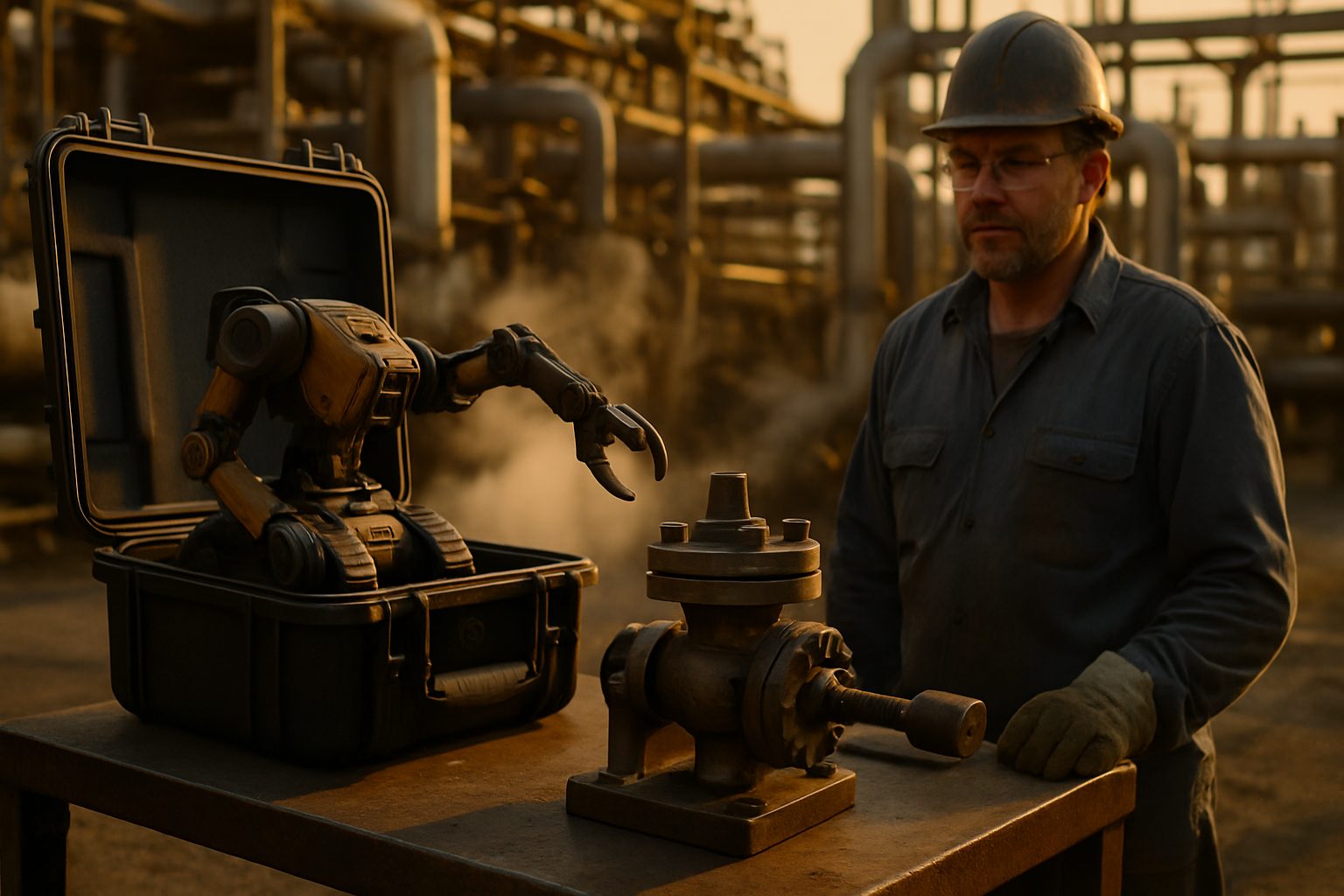
Nexterity’s Remote-Controlled Bolt Automation Targets $Bn Piping Infrastructure Market
TL;DR: Nexterity’s portable robot automates bolted flange joint maintenance on pipes 2–8 inches in diameter, addressing both worker safety and a critical labor shortage in North American pipefitting. The rental-equipment model targets a massive fragmented market spanning oil, water, food, and manufacturing sectors.
Why This Matters for Infrastructure Operators
Bolted flange joint maintenance is the productivity bottleneck in industrial piping. Pipefitters spend hours performing high-torque, repetitive work that causes injury and burnout. Nexterity’s approach—remote-controlled automation in a Pelican case—bypasses the capital intensity that has kept robotics out of this fragmented market.
For operators, the rental model means zero upfront capital, instant deployment flexibility, and immediate ROI through reduced labor hours and injury prevention.
Context: Nexterity and TechCrunch Disrupt 2026
Nexterity is a startup founded by Lindsey Elliott, a former ExxonMobil engineer and planner specializing in oil, gas, and petrochemical infrastructure. Elliott developed the company after identifying bolted flange joint maintenance as a persistent pain point during conversations with pipefitters and members of the American Society of Mechanical Engineers’ Pressure Vessels & Piping Division.
The startup is one of 200 companies selected for TechCrunch Disrupt 2026’s Startup Battlefield, the premier demo competition for early-stage companies. Disrupt 2026 features six industry-focused stages showcasing automation, AI, and robotics innovations alongside participation from OpenAI, Anthropic, and Replit.
The Bolting Symposium, mentioned as Nexterity’s research touchstone, is an annual industry gathering for piping professionals—colloquially known as “torque dorks”—focused on standardization and best practices in bolted joint maintenance.
The Technical Solution: Modular, Battery-Powered Bolt Automation
Nexterity’s robot consists of two modular pieces that clamp around a pipe section. It simultaneously tightens or loosens four bolts using battery power and can slide laterally across the pipe once attached. The system fits in a standard Pelican case and weighs light enough for a single worker to carry and deploy.
Elliott’s team has engineered multiple configurations to handle pipes ranging from NPS2 to NPS8 (2–8 inches in diameter). This specificity is deliberate: Elliott’s market research found that 80% of industrial piping infrastructure falls within this size range, making it the optimal automation target.
The modular design sidesteps the capital deployment challenge that has limited robotics penetration in construction and maintenance. Portability enables rapid site-to-site deployment—a requirement for Nexterity’s rental-equipment business model.
Market Scope: Why Piping Automation Scales
The addressable market extends far beyond oil and gas. Water, wastewater, food and beverage processing, mining, nuclear, and green manufacturing all depend on identical bolted flange joint infrastructure. This fragmentation across verticals means no single operator controls enough scale to justify custom robotics—but Nexterity’s rental model converts that fragmentation into an advantage.
North American pipefitting productivity remains notoriously low, according to Elliott. Workers routinely face 12-hour shifts for three months consecutively, driving fatigue-related errors and injuries. Automated bolt handling directly addresses both occupational safety and labor retention in an industry experiencing a significant talent shortage.
Business Model and Go-to-Market Strategy
Nexterity treats its robots as construction rental equipment rather than capital assets. This eliminates the $100K+ purchase barriers typical of industrial robotics and aligns economics with customer cash flow: operators pay only when they deploy.
The rental model also creates recurring revenue and generates maintenance data that Elliott can leverage to improve future iterations. Operators gain predictability; Nexterity gains market visibility and customer stickiness.
Deployment friction remains the critical variable. If a worker can unbox, position, and activate the robot in under 15 minutes, adoption accelerates. Elliott’s emphasis on Pelican-case portability suggests this metric was central to her design process.
Operational Risks and Implementation Challenges
Standardization across pipe geometries is the first hurdle. While NPS2–NPS8 covers 80% of pipes, irregular or corroded flanges may require manual adjustment. If setup time approaches 30+ minutes, the ROI calculation flattens.
Operator training and adoption pose secondary risks. Pipefitters may resist automation if perceived as a threat to employment rather than a tool that reduces drudgery. Elliott’s emphasis on remote control (rather than full autonomy) suggests she’s designed for human oversight, which should ease labor acceptance.
Inventory logistics could constrain scaling. Nexterity must maintain regional distribution centers or partner with equipment rental networks to deliver units within 24–48 hours. This capital requirement is material and often underestimated by early-stage robotics companies.
Investment Angle
Nexterity demonstrates the applied robotics opportunity that venture capital has largely overlooked: not flashy humanoids, but capital-light automation targeting fragmented, labor-constrained blue-collar markets. The rental model inverts the risk: Nexterity captures upside without requiring customers to bet billions on purchased equipment.
The market is large but diffuse. Success requires both product-market fit (which Elliott appears to have validated through industry dialogue) and operational discipline in rental-fleet logistics. Series A investors should scrutinize her supply-chain assumptions closely.
If Nexterity captures even 5% of North American bolted-joint maintenance, annual revenue could exceed $50M within seven years, given the market’s size and fragmentation.
What’s Next
Watch for Nexterity’s Disrupt demo on September 24–26, 2026. The pitch will likely focus on pilot-site metrics: labor-hour reduction, injury prevention data, and operator satisfaction scores.
Post-demo, the startup will need to prove repeatable customer acquisition in at least two verticals (likely oil/gas and water treatment) before Series A closes. The rental-fleet management infrastructure will be make-or-break.
About the Author