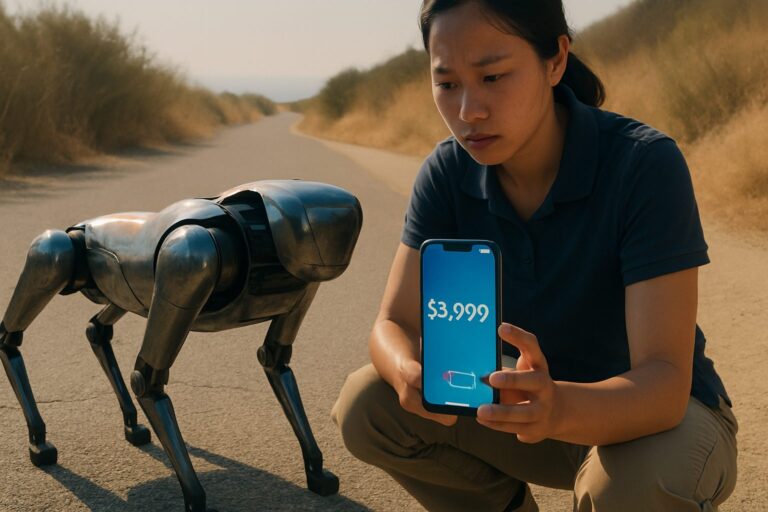
TL;DR: Chinese robotics manufacturer Unitree demonstrated mass-market viability of quadruped robots at $4,000—a price point that makes previously research-only hardware accessible to early adopters. The real play isn’t dog robots; it’s using quadrupeds as a development platform to dominate humanoid robotics at $13,500, undercutting Western competitors by 60-70%.
The Price Collapse That Changes Market Dynamics
When commodity hardware reaches critical affordability thresholds, markets shift. Ars Technica’s hands-on review of Unitree’s quadruped robot exposes exactly this inflection point: the $4,017 entry price obliterates previous cost assumptions for legged robotics.
The technical performance proved unremarkable—thermal throttling, battery constraints, and an ungraceful collapse near a Washington DC residential doorstep. Yet that failure matters less than the market signal it sends. Accessible hardware unlocks unexpected applications. Nobody can justify R&D spending on $50,000 robots for niche use cases. At $4,000, pilots become viable.
Background: Unitree’s Path to Market Dominance
Unitree Robotics, a Hangzhou-based manufacturer, emerged from China’s robotics acceleration ecosystem in the early 2020s. The company prioritized manufacturing efficiency and vertical integration—hallmarks of Chinese hardware scaling—rather than pursuing premium positioning.
The quadruped platform served dual purposes: generating revenue while building institutional knowledge for the humanoid pivot. By 2023, Unitree launched its first humanoid robot, pricing it at $13,500. This represented a 75-80% cost reduction versus Boston Dynamics or European equivalents at the time.
Regulatory headwinds emerged quickly. U.S. export controls on advanced robotics and potential CFIUS scrutiny now constrain Unitree’s domestic market penetration. However, the damage—or rather, the competitive reset—has already occurred globally.
The broader context: Western robotics companies (Boston Dynamics, Tesla’s aspirations) built premium brands around humanoids. Unitree inverted the strategy, flooding markets with accessible quantity to drive manufacturing scale and cost reduction.
Real-World Performance Constraints
The test unit illustrated fundamental hardware limitations: thermal management failures under sustained load, battery depletion after two miles of mixed terrain, and absence of graceful failure modes.
These aren’t showstoppers for development platforms or research integration. They’re acceptance criteria for different customer segments than traditional robotics buyers.
Misdirected Utility Analysis
The reviewer’s honest assessment—”not much” practical utility—misses market dynamics. Wheeled robots dominate delivery. Drones own aerial inspection. Quadrupeds lack manipulation capability.
But that’s feature analysis, not market analysis. A $4,000 platform enables researchers, startups, and system integrators to ask “what if” at scale. Academic robotics labs can now afford multi-unit deployments. Companies can prototype swarm behaviors. That optionality has immense value.
The Strategic Play: Humanoid Domination Through Cost Leadership
Unitree’s quadruped investment functions as a cash flow engine and manufacturing school for humanoid robotics. By achieving $13,500 humanoid pricing, the company undercuts Western competitors and creates addressable markets that didn’t exist at $50,000+ entry points.
Tesla’s Optimus and Boston Dynamics’ Atlas remain enterprise-focused. Unitree’s sub-$15K humanoid changes customer calculus: boutique manufacturers, regional logistics operations, and research facilities can now justify deployment.
Volume manufacturing compounds cost reduction. Each quadruped unit trains supply chains, refines assembly processes, and drives component pricing down. Humanoid units inherit this infrastructure advantage.
Investment Implications and Market Timing
The $4,000 quadruped represents successful commoditization of previously boutique technology. For industrial automation investors, this signals: Chinese manufacturers have captured cost-structure leadership in legged robotics.
Western competitors face two options: compete on differentiation (manipulation, AI software, integration ecosystems) or accept margin compression. Pure hardware races are lost.
The U.S. regulatory response—tightening Unitree’s domestic access—suggests policy makers recognize this threat. Tariffs and export controls may reshape the timeline, but they won’t reverse the cost-structure shift already embedded in global supply chains.
For operators and integrators: the calculus changed in 2024-2026. Quadruped robotics transitioned from R&D curiosity to commercially feasible platform. Early pilots should expect thermal and battery limitations; standardize on refresh cycles and thermal load testing. Humanoid robotics democratization follows the same curve, compressed into 18-24 months.
Near-Term Opportunity
Startups integrating quadruped platforms into surveying, inspection, or autonomous last-mile solutions now have viable hardware costs. Previous business cases required $20K+ hardware; $4K hardware unlocks margin structures that support small-scale operations.
Long-Term Risk
Regulatory restrictions on Chinese robotics imports could fragment markets and slow global standardization. Fragmentation benefits regional champions but delays ecosystem maturation across borders.