TL;DR: NVIDIA has unveiled Halos for Robotics, the industry’s first full-stack, comprehensive safety system for physical AI, drawing on over 18,600 engineering years of autonomous vehicle safety expertise to bring robots safely into factories, warehouses, and logistics operations alongside human workers [1]. The platform unifies AI compute, sensor connectivity, a dedicated safety software stack, and a world-first accredited inspection lab, with Agility Robotics becoming the inaugural partner to integrate the system into its Digit humanoid robot [1].
NVIDIA Unifies Physical AI Safety From Silicon to Software
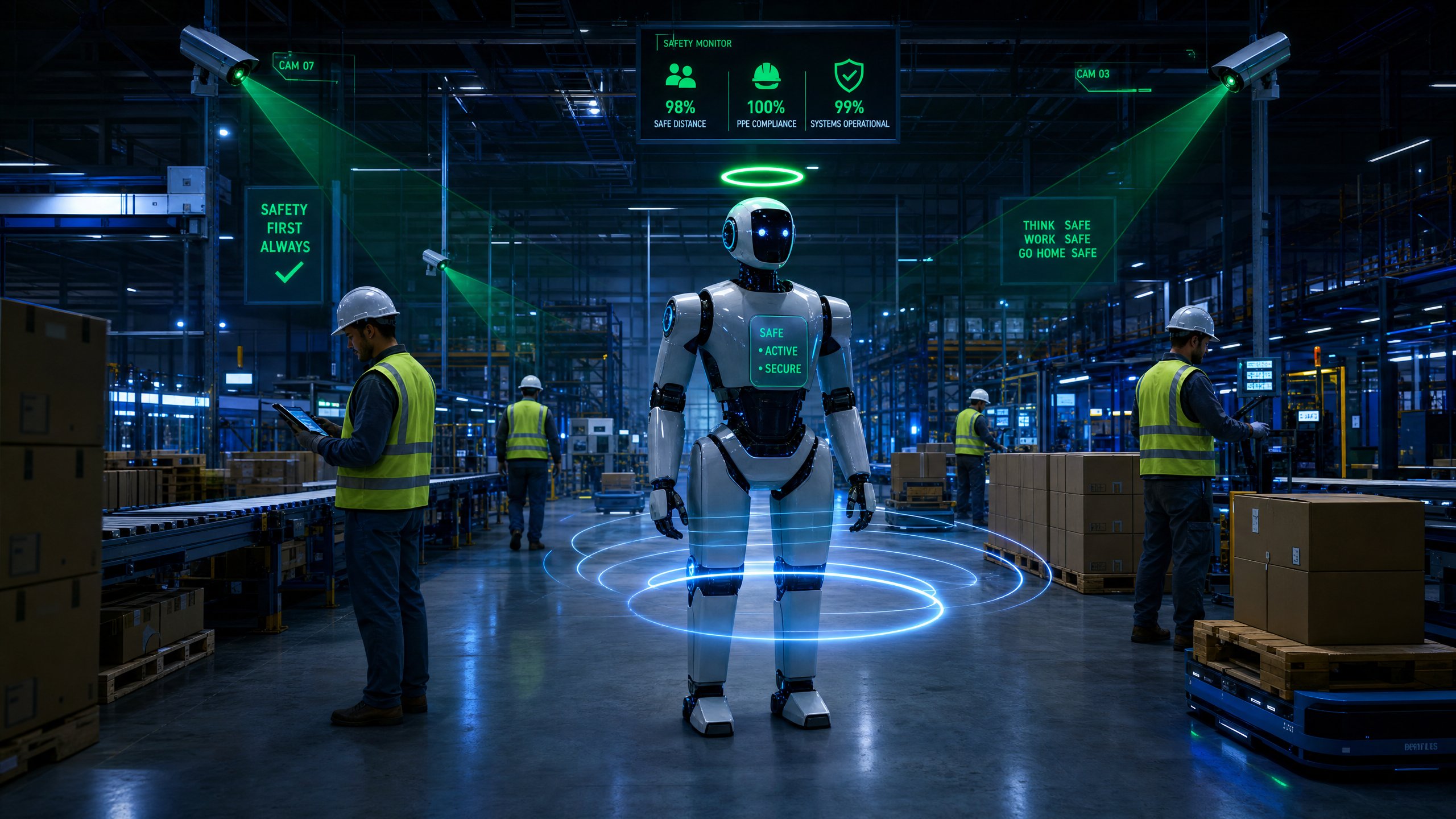
NVIDIA unveiled Halos for Robotics at the Automate 2026 conference in Chicago, addressing what the company describes as the critical missing layer in the industrial robotics stack: a standardized, end-to-end safety architecture [1]. Current industrial safety protocols typically force autonomous robots to stop or slow down whenever a human enters their vicinity, which significantly hampers operational efficiency and limits the economic case for deploying humanoid machines at scale. NVIDIA’s answer is a unified architecture that spans every layer of the robot, from the silicon up to the application software, enabling machines to operate dynamically and safely alongside workers without relying on physical barriers or blanket shutdown triggers [1].
The system is built on three interlocking pillars. At the hardware layer, NVIDIA IGX Thor provides industrial-grade AI compute with built-in safety capabilities, paired with the Holoscan Sensor Bridge for real-time sensor connectivity and data fusion. Above that sits NVIDIA Halos OS, the dedicated software stack that includes Halos Core — a safety-related operating environment — and a collection of safety application blueprints. Topping the architecture is the NVIDIA Halos AI Systems Inspection Lab, the world’s first ANSI National Accreditation Board (ANAB)-accredited program for functional and AI safety in physical AI systems [1]. “With NVIDIA Halos for Robotics, developers and system builders can harness NVIDIA’s proven autonomous vehicle safety foundation to develop safer robots faster and bring them into industrial operations alongside workers with greater confidence,” said Deepu Talla, Vice President of Robotics and Edge AI at NVIDIA [1].
Agility Robotics and the Digit Humanoid Lead the First Wave
Agility Robotics, whose bipedal Digit humanoid is already deployed at Amazon, GXO, Schaeffler, and Toyota Motor Manufacturing Canada, is the first company to integrate elements of Halos for Robotics into its proprietary safety system [1]. The collaboration centers on embedding NVIDIA IGX Thor and Halos Core into Digit’s safe human detection system, giving the robot industrial-grade compute with certified safety capabilities at the hardware and software layers simultaneously [1]. Agility will also participate in the NVIDIA Halos AI Systems Inspection Lab, where the two companies will jointly validate Digit’s safety-related software, AI components, and cybersecurity protections against rigorous international standards including IEC 61508, ISO 13849, and ISO/IEC TR 5469 before final third-party certification [1].
“For humanoids to deliver value at scale, safety has to be built into the robot and validated across the entire system,” said Peggy Johnson, CEO of Agility Robotics [1]. “Partnering with NVIDIA to implement and optimize the Halos for Robotics system extends our leadership in responsible automation, which is a nonnegotiable requirement for bringing humanoids safely into industrial workflows. This collaboration unlocks true human-robot teamwork, driving the long-term returns that will power next-generation manufacturing and logistics operations.” [1]
The Outside-In Safety Blueprint and the Inspection Lab Ecosystem
One of the most technically distinctive components of the Halos platform is the Outside-In Safety Blueprint, now available in early access on GitHub as open-source software [1]. Rather than relying solely on the robot’s own onboard sensors, this blueprint extends robot perception by tapping into external warehouse cameras and AI agents that continuously monitor the surrounding environment. The system can dynamically predict human movement, detect workers approaching from blind spots, and modulate robot speed and trajectory in real time — a capability that fundamentally changes the safety calculus for dense, multi-agent industrial environments [1].
The NVIDIA Halos AI Systems Inspection Lab has already assembled a coalition of more than 40 companies spanning manufacturers, certification bodies, and safety technology vendors [1]. Leading certification agencies including TÜV Rheinland, UL Solutions, TÜV SÜD, exida, SGS, and CertX all formally recognize the lab as part of their certification pathway. On the silicon and software side, partners include Infineon, NXP Semiconductor, STMicroelectronics, Texas Instruments, Acontis, FreeRTOS, and QNX, while industrial application developers such as FORT Robotics, KION Group, and Lyte AI are building functional safety agents using the Outside-In Blueprint [1]. Laurie E. Locascio, President and CEO of ANSI, noted that the accreditation “confirms the program has the competence and impartiality to evaluate robotic AI systems against recognized safety requirements, giving companies a rigorous and internationally recognized foundation for their path to certification” [1].
Background: The Physical AI Safety Imperative
The launch of Halos for Robotics reflects a broader inflection point in the industrial automation industry. As humanoid robots transition from research demonstrations to production deployments, the absence of standardized safety certification frameworks has been a significant barrier to enterprise adoption. Traditional industrial robot safety, governed by standards such as ISO 10218, was designed for caged, stationary manipulators — not for bipedal machines navigating shared human workspaces. The emergence of AI-driven physical agents that perceive, reason, and act in unstructured environments requires an entirely new safety paradigm, one that accounts for the probabilistic nature of AI decision-making alongside classical functional safety requirements [1].
NVIDIA’s entry into this space leverages its decade-long investment in NVIDIA DRIVE, the autonomous vehicle safety platform that underpins the Halos architecture. By porting that proven safety foundation to the robotics domain and coupling it with an accredited inspection infrastructure, NVIDIA is positioning itself as the de facto safety standard-setter for the physical AI era — a role that could prove as strategically significant as its dominance in AI training compute [1].
Key Components of the NVIDIA Halos for Robotics Platform
The table below summarizes the principal components of the Halos for Robotics architecture, their functions, and the ecosystem partners supporting each layer.
| Layer | Component | Function | Key Partners |
|---|---|---|---|
| Hardware | NVIDIA IGX Thor + Holoscan Sensor Bridge | Industrial AI compute with built-in safety and real-time sensor fusion | Advantech, NexCobot, Infineon, NXP, STMicro, TI |
| Software | Halos OS (Halos Core + Outside-In Blueprint) | Safety-related OS functions, human detection, dynamic robot behavior control | Acontis, FreeRTOS, QNX, FORT Robotics, KION Group |
| Inspection | AI Systems Inspection Lab (ANAB-accredited) | Pre-certification validation against IEC 61508, ISO 13849, ISO/IEC TR 5469 | TÜV Rheinland, TÜV SÜD, UL Solutions, exida, SGS, CertX |
| First Integrator | Agility Robotics Digit Humanoid | Production humanoid deployed at Amazon, GXO, Schaeffler, Toyota | Agility Robotics |
References:
[1] NVIDIA Newsroom, “NVIDIA Announces Halos for Robotics, the Industry’s First Full-Stack Safety System for Physical AI,” June 22, 2026. Source Link
About the Author