TL;DR: Covariant closed a $100M Series D to scale its physics-based AI picking platform across third-party logistics warehouses, directly addressing the acute labor shortage and throughput bottleneck in goods-to-person fulfillment.
Covariant’s $100M Series D: Accelerating AI-Native Picking at Scale
Covariant, the Berkeley-based robotics AI company, announced a $100M Series D funding round, signaling investor confidence in its approach to automating unstructured bin-picking tasks within 3PL networks. The capital targets rapid deployment across logistics partners, where human picking labor remains chronically constrained and error rates remain high.
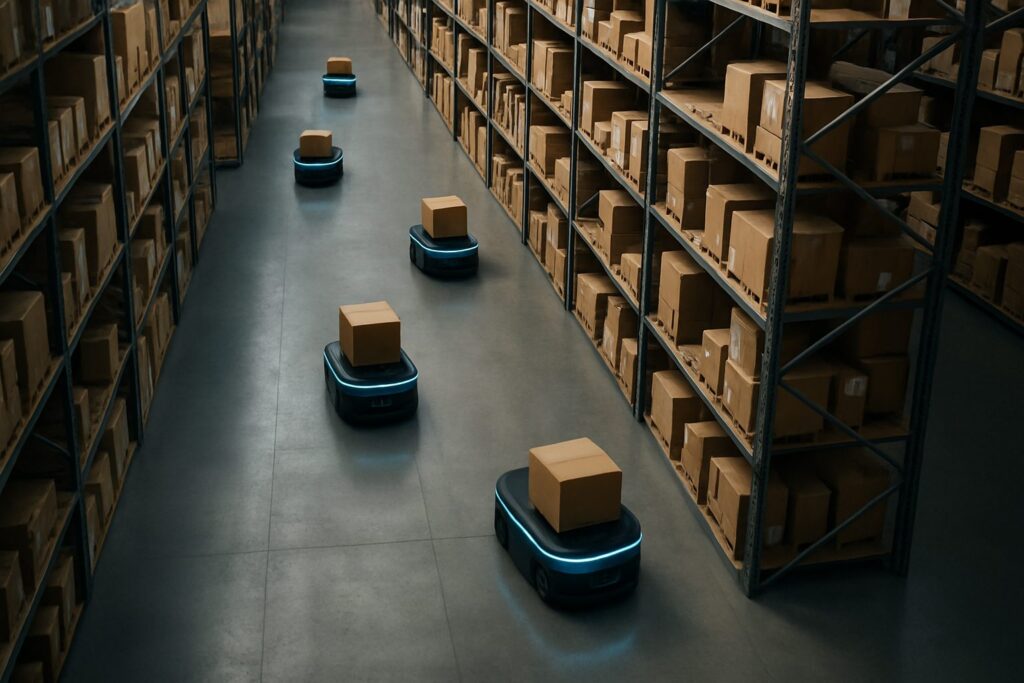
For warehouse operators and logistics integrators, this round validates a critical operational thesis: rule-based, hand-coded robotics cannot handle the variability inherent in cross-customer fulfillment environments. Covariant’s physics-informed neural networks learn to grasp arbitrary objects in clutter, reducing the manual intervention cycles that plague traditional vision-based systems.
Market Timing: Labor Crisis Meets Automation Readiness
Third-party logistics centers face dual pressures—wage inflation and tight labor availability—while e-commerce volume continues to surge. A single warehouse can process 100K+ SKUs daily, each requiring precise bin identification and extraction. Legacy conveyance systems fail when picking accuracy or speed degrade.
Covariant’s differentiation lies in generalizable grasping behavior. Unlike competitors requiring extensive retraining per warehouse or object class, its models transfer across customer inventories with minimal fine-tuning, reducing time-to-productivity for new deployments.
Competitive Positioning Within Warehouse Automation
Covariant competes alongside Berkshire Grey, which focuses on carton-level sortation, and bespoke integrators building custom picking cells. Its advantage: deployment velocity and adaptability to existing 3PL conveyor infrastructure without wholesale system redesigns.
The funding also reflects investor appetite for applied AI in logistics—a sector where ROI calculation is straightforward (labor cost avoidance) and adoption friction remains moderate compared to autonomous vehicles or humanoid robotics.
Operational and Financial Implications
Unit Economics and Payback Cycles
Covariant’s systems target a 2–3 year payback at typical 3PL labor rates ($18–24/hour). A single picking station handling 800–1,200 picks/shift displaces 1–2 FTE equivalents, creating immediate cost justification for warehouse operators managing seasonal volume swings.
The Series D enables Covariant to subsidize early 3PL deployments, absorbing integration risk and accelerating adoption curves critical for market consolidation in its segment.
Supply Chain and Strategic Implications
If Covariant achieves its deployment targets across major 3PL networks (XPO, J.B. Hunt, Schneider), it becomes the de facto standard for AI-native picking, creating switching costs and customer lock-in. This positions the company as a likely acquisition target for larger logistics platforms or industrial automation roll-ups.
Investors should monitor customer concentration risk. Heavy reliance on 2–3 major 3PLs exposes Covariant to pricing pressure and contract renegotiation risk. Diversification across verticals (e-commerce, retail, food/beverage) will signal maturity.
Looking Forward
The $100M deployment will serve as a real-world testing ground for Covariant’s claims around generalization and reliability. Throughput metrics, pick-success rates, and time-to-reliability at scale will determine whether the company can sustain its valuation trajectory or faces commoditization pressure from entrenched automation vendors.
For operators evaluating picking automation, Covariant’s move signals that physics-based AI is no longer theoretical—it’s operationally viable and well-capitalized. The strategic question shifts from “will this work?” to “can we integrate it faster than our competitors?”