Exoskeletons Move from Lab to Logistics: $500M Market Poised to Triple
TL;DR: Powered exoskeletons are entering mainstream deployment across rescue, military, and industrial sectors. Market valuations of $500M are projected to double or triple by 2035, driven by cost-competitive robotics and proven fatigue reduction in field conditions.
Operational Reality: Where Exoskeletons Deploy Today
Seattle Mountain Rescue now deploys powered exoskeletons during wilderness search operations. These hip and leg-attached devices demonstrably improve rescuer endurance during the extended physical exertion that defines emergency recovery work—where speed and sustained capability directly correlate to survival outcomes.
The Ukrainian military has already operationalized Hypershell exoskeletons on active front lines, with soldiers reporting faster work cycles and extended combat effectiveness when hauling ammunition. This isn’t theoretical. Colonel Vitalii Serdiuk’s March 2026 statement to Ukrainska Pravda documents measurable performance gains in real combat conditions.
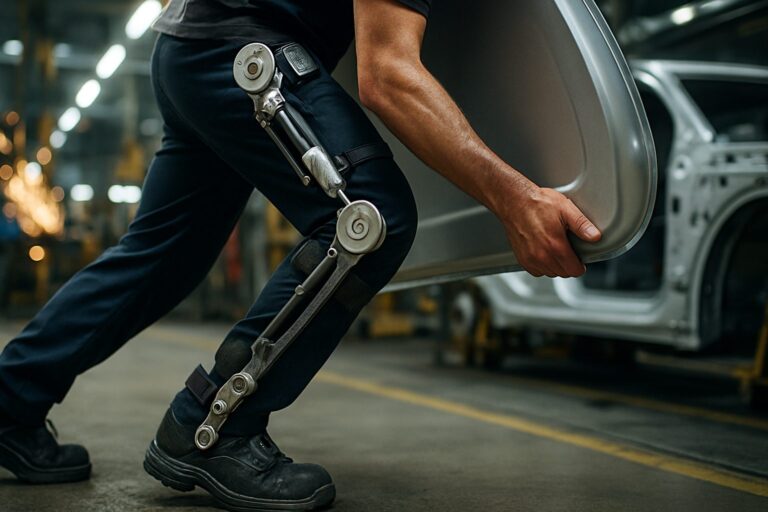
Industrial logistics has moved faster toward adoption. IKEA, Ford, Boeing, and Mazda Toyota have integrated exoskeleton systems into warehouse and assembly operations. The SuitX torso and upper-limb devices reduce occupational muscle strain during repetitive heavy-load handling—a direct labor productivity and injury reduction play.
Market Trajectory: From Niche to Mainstream
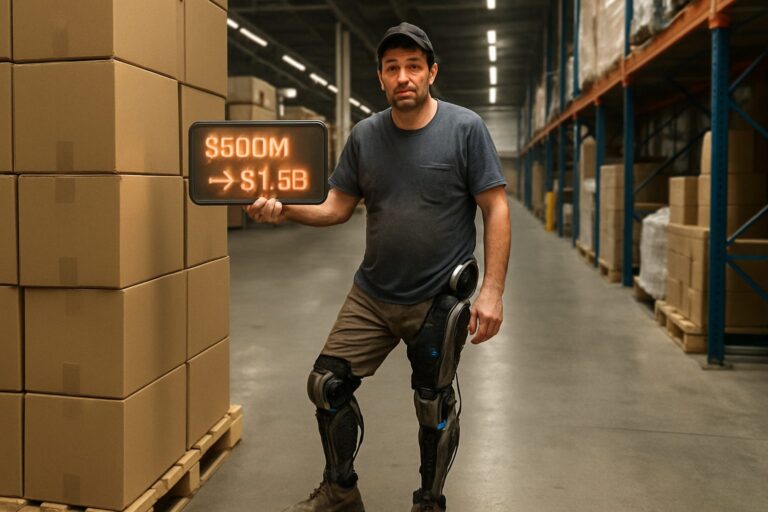
Current sector valuation sits at approximately $500 million. Analyst consensus projects expansion to $1-1.5 billion by 2035. Finland’s ExoPELA research program validated exoskeleton efficacy in firefighting and rescue work, providing the clinical credibility that procurement decision-makers require.
Consumer and clinical variants now exist for rehabilitation, daily assistance, and exercise applications. This segmentation creates multiple revenue streams beyond high-intensity occupational use.
The Engineering Inflection: Why Now?
Cost compression in three subsystems enabled commercial viability: robotic motors, sensor arrays, and control electronics have all become sufficiently affordable and power-efficient. Battery density improvements removed a historical constraint.
The concept isn’t new—Nicholas Yagn patented a mechanical exercise apparatus in 1890, and Leslie C. Kelley designed a steam-powered walking assist in 1919. Modern actuator-based systems emerged by the late 1960s with electronic control. What changed is manufacturing scale and component cost.
How Exoskeletons Generate Mechanical Advantage
Powered exoskeletons operate via a simple energy transfer model: battery-powered actuators convert electrical input into mechanical force applied to the wearer’s body. Attachment points typically anchor at trunk, waist, and limbs.
The Hypershell attaches at waist and thighs, amplifying hip flexion and extension during load-carrying. The SuitX targets torso and shoulders, distributing upper-body strain. Mechanical advantage comes from redirecting load through the external frame, reducing the metabolic cost of movement.
Some systems improve movement precision and dexterity beyond raw strength augmentation. Others compensate for reduced physical capacity in medical rehabilitation contexts.
Background: Institutional Adoption and Validation
IKEA’s warehouse integration represents the first major retail logistics commitment. SuitX systems have operated within IKEA facilities for several years, establishing a proof-of-concept for repetitive heavy-handling industries. The deployment shifted exoskeletons from research artifacts to operational equipment.
Aerospace and automotive manufacturing adoption by Ford, Boeing, and Mazda Toyota validates cross-sector applicability. These industries operate under stringent safety and efficiency metrics. Their integration signals that exoskeletons meet production-scale reliability and ROI standards.
Finnish ExoPELA research project bridged the gap between occupational use and emergency services. By quantifying muscle load reduction and strain mitigation in rescue and firefighting contexts, the program provided peer-reviewed justification for public sector procurement decisions.
Ukrainian military deployment marks the first documented combat use. Operationalization under active threat conditions represents the most demanding validation environment. Performance gains in ammunition transport—a quintessentially high-fatigue task—establish exoskeletons as force-multipliers in asymmetric conflict scenarios.
Seattle Mountain Rescue trials extend the pattern into civilian emergency response. Rescue operations require sustained effort in uncontrolled terrain under time-critical conditions. Exoskeleton-assisted rescuers maintain velocity and decision-making capacity longer than unaugmented teams, directly improving victim recovery probabilities.
Investment Thesis: Scale and Segmentation
The sector benefits from parallel demand growth across three non-overlapping markets: industrial logistics, defense procurement, and medical rehabilitation. No single buyer controls the growth trajectory, reducing concentration risk.
Battery and motor technology improvements benefit exoskeleton manufacturers without direct R&D expense—they inherit gains from EV, drone, and robotics industries. Margins structurally improve as component suppliers scale production.
Regulatory frameworks remain immature, creating a window for first-movers to establish de facto standards before formal safety and performance certifications calcify competitive advantage.
About the Author